Are Black Holes Actually Fuzzballs?
TL;DR
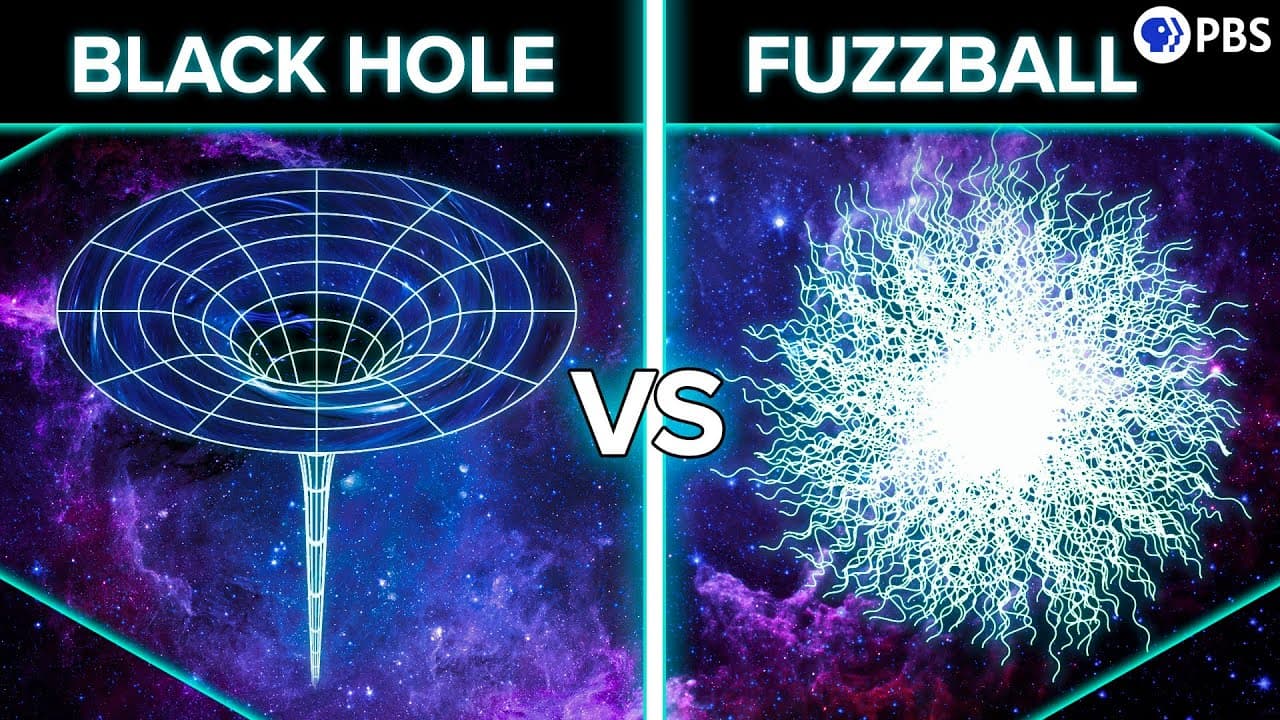
Fuzzballs may solve black hole paradoxes using string theory.
Transcript
Thank you to Brilliant for supporting PBS. Black holes are a paradox. They are paradoxical because they simultaneously must exist but can’t, and so they break physics as we know it. But many physicists will tell you that the best way to fix broken physics is with string. String theory, in fact. And in the black holes of string theory - fuzzballs - ... Read More
Key Insights
- Black holes present paradoxes because they must exist according to general relativity, yet their singularities defy known physics.
- The no-hair theorem suggests black holes have limited observable properties, yet their entropy suggests hidden microstates.
- Hawking radiation implies black holes lose mass randomly, conflicting with quantum information conservation.
- String theory proposes fuzzballs as a solution, replacing singularities with string structures, avoiding infinite density.
- Fuzzballs encode information on event horizons using string theory, aligning with Bekenstein's entropy formula.
- Fuzzballs lack a traditional interior; space and time end at their surface, eliminating singularities.
- String theory's fractionation effect allows fuzzballs to maintain structure even under extreme gravity.
- Fuzzballs appear like black holes from a distance, preserving classical effects like gravitational lensing.
Install to Summarize YouTube Videos and Get Transcripts
Explore YouTube Video Summarizer or Get YouTube Transcript Extractor
Questions & Answers
Q: What is the main paradox associated with black holes?
The main paradox associated with black holes is the conflict between general relativity and quantum mechanics. General relativity predicts singularities with infinite density, where known physics breaks down. Additionally, the no-hair theorem suggests limited observable properties, but black hole entropy implies hidden information, leading to the black hole information paradox.
Q: How does string theory propose to resolve black hole paradoxes?
String theory proposes the concept of fuzzballs to resolve black hole paradoxes. Instead of singularities, fuzzballs consist of complex string structures that encode vast amounts of information on their surfaces. This aligns with Bekenstein's entropy formula and suggests a resolution to the information paradox by preserving quantum information as black holes evaporate.
Q: What is the no-hair theorem in relation to black holes?
The no-hair theorem posits that black holes can be described by only a few observable properties: mass, electric charge, and angular momentum. This suggests a limited amount of observable information, which contradicts the large entropy and hidden microstates implied by black hole entropy calculations, contributing to the information paradox.
Q: What role does Hawking radiation play in black hole paradoxes?
Hawking radiation suggests that black holes lose mass over time by emitting radiation, which is completely random. This poses a problem for the conservation of quantum information, as the radiation does not carry away the information that formed the black hole, leading to the black hole information paradox and challenging fundamental laws of physics.
Q: How do fuzzballs differ from traditional black holes?
Fuzzballs differ from traditional black holes in that they do not have a singularity at their core. Instead, they consist of a surface made of tangled strings and branes, eliminating the concept of an interior. This surface encodes information and maintains structure under extreme gravity, potentially resolving paradoxes associated with traditional black holes.
Q: What is fractionation in string theory, and how does it relate to fuzzballs?
Fractionation in string theory refers to the effect where the tension of a string decreases as more strings are merged, allowing the resulting object to stretch to larger scales. This effect enables fuzzballs to maintain structure at the horizon scale, even under extreme gravitational forces, supporting their role in resolving black hole paradoxes.
Q: What is the significance of the Strominger-Vafa model in understanding fuzzballs?
The Strominger-Vafa model was a breakthrough in understanding fuzzballs, as it demonstrated that the number of microstates on a black hole's event horizon, according to string theory, matched Bekenstein's entropy formula. This provided evidence that string theory could encode information on black hole surfaces, offering a potential resolution to the information paradox.
Q: How do fuzzballs appear from a distance compared to traditional black holes?
From a distance, fuzzballs appear similar to traditional black holes. They exhibit classical effects such as gravitational lensing and time dilation, making them appear effectively black due to massive redshifting of escaping light. However, their stringy surface differentiates them from traditional black holes, offering a unique perspective on quantum gravity.
Summary & Key Takeaways
-
Black holes are paradoxical objects that challenge our understanding of physics, as their singularities defy the laws of quantum mechanics and general relativity. String theory offers a potential solution through the concept of fuzzballs, which replace singularities with complex string structures that encode information and resolve paradoxes.
-
Fuzzballs, as proposed by string theory, suggest that black holes have a surface made of tangled strings and branes, rather than an empty event horizon. This stringy surface allows for the encoding of vast amounts of information, aligning with the Bekenstein formula for black hole entropy and potentially resolving the black hole information paradox.
-
The concept of fuzzballs challenges traditional views of black holes by eliminating the notion of a singularity and suggesting that space and time end at the fuzzball's surface. While fuzzballs behave like black holes from a distance, their stringy nature offers a new perspective on quantum gravity and the fundamental structure of the universe.
Read in Other Languages (beta)
Share This Summary 📚
Summarize YouTube Videos and Get Video Transcripts with 1-Click
Try YouTube Summary with ChatGPT & Claude or YouTube Transcript Generator
Explore More Summaries from PBS Space Time 📚
Summarize YouTube Videos and Get Video Transcripts with 1-Click
Try YouTube Summary with ChatGPT & Claude or YouTube Transcript Generator