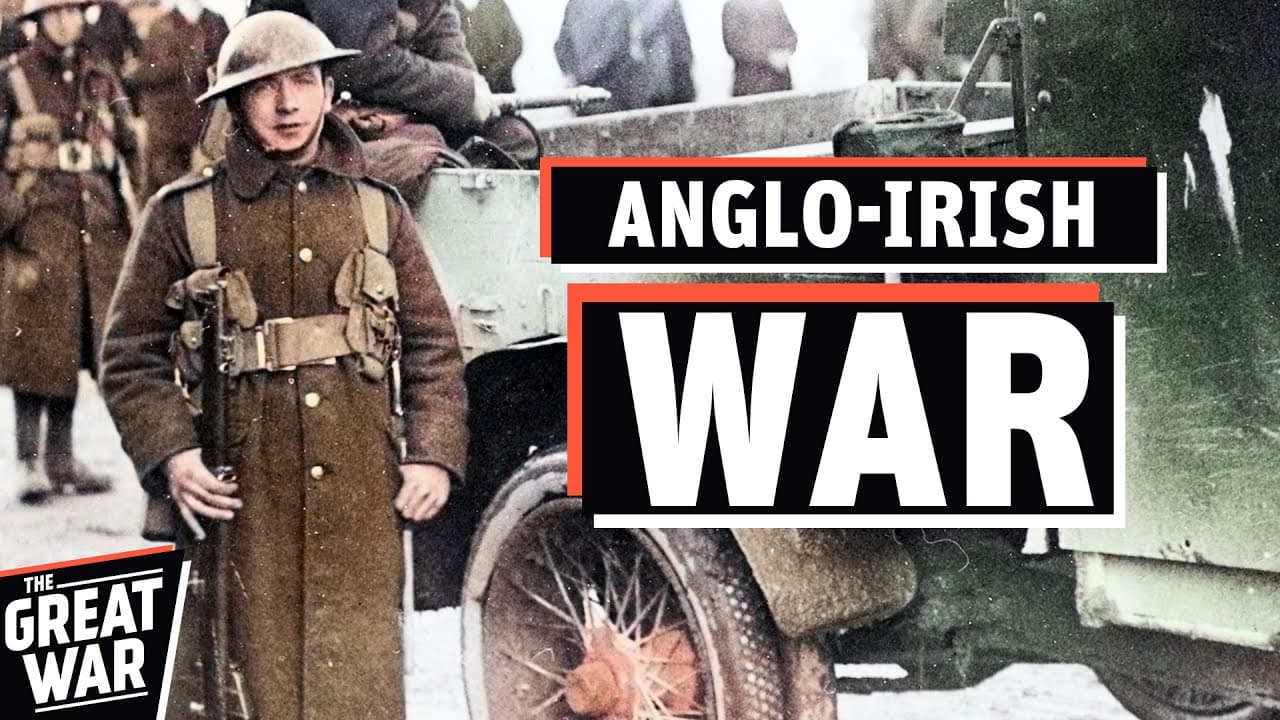
Outbreak of the Irish War of Independence - Black and Tans vs. IRA Guerrillas (Documentary)
TL;DR
The Irish War of Independence escalated with the arrival of the Black and Tans.
Transcript
than the trenches of the Western Front. Hi, I'm Jesse Alexander and welcome to the Great War. In the spring of 1920, conflict between Ireland and Britain was certainly nothing new. But during the Great War, tensions had risen over the concept of Home Rule for Ireland and culminated in the Easter Uprising of 1916. By 1919, the violence had grown int... Read More
Key Insights
- The Irish War of Independence intensified in 1920, following the arrival of the Black and Tans, a controversial British force known for their brutal tactics.
- The Black and Tans were recruited from Great War veterans to bolster the Royal Irish Constabulary, but their lack of police training led to violent reprisals against civilians.
- The IRA, seeking independence, utilized guerrilla warfare tactics, focusing on ambushes and attacks on isolated police barracks to counter the superior British military strength.
- The conflict was characterized by its 'in betweenness,' with ambiguous frontlines and indistinguishable combatants, blending war and peace in an uneasy balance.
- The IRA's decentralized structure allowed for local support and tactical flexibility, enabling them to strike effectively against British forces despite limited resources.
- The British government's inability to control the countryside led to a retreat into urban areas, effectively ceding rural Ireland to the IRA by mid-1920.
- The violence and reprisals by the Black and Tans against civilians only fueled further resistance and resentment towards British rule in Ireland.
- The conflict's impact was profound, with ambushes becoming legendary in Irish history and shaping public perception of the war's progress and significance.
Install to Summarize YouTube Videos and Get Transcripts
Explore YouTube Video Summarizer or Get YouTube Transcript Extractor
Questions & Answers
Q: What was the significance of the Black and Tans in the Irish War of Independence?
The Black and Tans played a significant role in the Irish War of Independence as they were recruited to support the Royal Irish Constabulary in suppressing the IRA. Their arrival marked an escalation in the conflict due to their brutal tactics and lack of proper police training, leading to widespread violence and reprisals against civilians. This only intensified the resistance against British rule and highlighted the challenges the British faced in maintaining control over Ireland.
Q: How did the IRA's tactics differ from traditional military strategies?
The IRA employed guerrilla warfare tactics, which differed significantly from traditional military strategies. Instead of engaging in large-scale battles, the IRA focused on ambushes, surprise attacks, and raids on isolated police barracks. This approach allowed them to exploit their asymmetrical strengths against the superior British forces. The decentralized structure of the IRA provided tactical flexibility and local support, enabling them to strike effectively despite limited resources and avoid direct confrontations with better-equipped British troops.
Q: What challenges did the Black and Tans face in their role during the conflict?
The Black and Tans faced several challenges during the conflict. They were primarily recruited from Great War veterans, lacking proper police training, which led to their reliance on military tactics unsuitable for policing duties. Their unfamiliarity with the Irish rural landscape and cultural differences with the predominantly Catholic population further complicated their role. These factors, combined with the IRA's effective guerrilla tactics, made it difficult for the Black and Tans to maintain control and often resulted in violent reprisals against civilians, exacerbating tensions.
Q: What was the impact of the IRA's guerrilla warfare on the British forces?
The IRA's guerrilla warfare had a significant impact on British forces. By employing tactics such as ambushes and surprise attacks on isolated police barracks, the IRA effectively challenged the British military's superior strength. These tactics allowed the IRA to choose the time and place of engagements, often catching British forces off guard and minimizing their own casualties. The psychological impact of these tactics, combined with the IRA's ability to operate freely, highlighted the British strategy's failures and contributed to the eventual retreat of British forces to urban areas.
Q: How did the conflict affect the civilian population in Ireland?
The conflict had a profound effect on the civilian population in Ireland. The arrival of the Black and Tans and their brutal reprisals against civilians, including looting and destruction of property, exacerbated tensions and resentment towards British rule. The IRA's guerrilla tactics also involved local support, with civilians often providing shelter and resources to fighters. This involvement made civilians targets for reprisals, further blurring the lines between combatants and non-combatants and intensifying the struggle for independence.
Q: What role did the decentralized structure of the IRA play in the conflict?
The decentralized structure of the IRA played a crucial role in the conflict by allowing for local support and tactical flexibility. This structure enabled IRA units to operate independently, adapting quickly to changing circumstances and exploiting opportunities for ambushes and surprise attacks. The local nature of the units fostered strong community ties, with fighters often being related or well-known to civilians, which facilitated logistical support and intelligence gathering. This decentralized approach proved effective against the more rigid and centralized British forces.
Q: Why did the British forces struggle to maintain control over rural Ireland?
British forces struggled to maintain control over rural Ireland due to several factors. The IRA's effective use of guerrilla warfare tactics, such as ambushes and surprise attacks, made it difficult for British forces to secure rural areas. The decentralized nature of the IRA allowed for local support and intelligence, enabling them to operate effectively in the countryside. Additionally, the British reliance on the Black and Tans, who lacked proper training and often resorted to brutal reprisals, further alienated the local population and undermined British efforts to maintain control.
Q: What were the long-term consequences of the Black and Tans' actions during the conflict?
The long-term consequences of the Black and Tans' actions during the conflict were significant. Their brutal tactics and reprisals against civilians fueled further resistance and resentment towards British rule, strengthening the resolve of the Irish independence movement. The violence and unrest they perpetuated highlighted the British government's inability to control the situation, contributing to the eventual retreat of British forces and the ceding of rural areas to the IRA. The legacy of the Black and Tans' actions continues to shape perceptions of the conflict in Irish history.
Summary & Key Takeaways
-
In 1920, the Irish War of Independence escalated with the arrival of the Black and Tans, a force of Great War veterans recruited to support the Royal Irish Constabulary. Their brutal tactics and lack of proper training led to widespread violence and reprisals against civilians, further fueling the conflict.
-
The IRA employed guerrilla warfare tactics to combat the superior British forces, focusing on ambushes and attacks on isolated police barracks. This decentralized approach allowed for local support and tactical flexibility, enabling the IRA to effectively challenge British control despite limited resources.
-
The conflict was marked by its 'in betweenness,' with ambiguous frontlines and indistinguishable combatants. The British government's inability to control rural areas led to a retreat into urban centers, effectively ceding the countryside to the IRA and intensifying the struggle for Irish independence.
Read in Other Languages (beta)
Share This Summary 📚
Summarize YouTube Videos and Get Video Transcripts with 1-Click
Try YouTube Summary with ChatGPT & Claude or YouTube Transcript Generator
Explore More Summaries from The Great War 📚

Summarize YouTube Videos and Get Video Transcripts with 1-Click
Try YouTube Summary with ChatGPT & Claude or YouTube Transcript Generator