What Led to the Russian October Revolution?
TL;DR
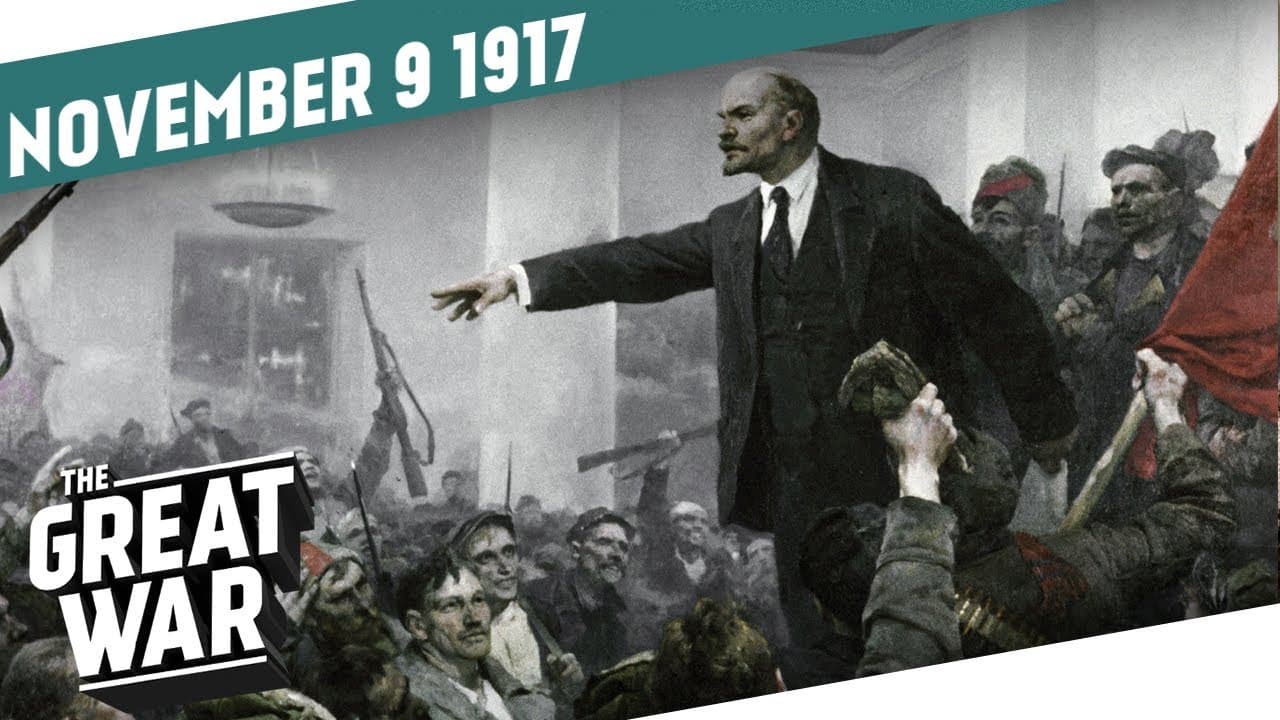
The Russian October Revolution was marked by the Bolsheviks seizing key locations in Petrograd and overthrowing the Provisional Government led by Alexander Kerensky. The Bolsheviks, led by Lenin, established a new government, although lacking broad political support. This event marked a significant shift in Russian politics and set the stage for further upheaval.
Transcript
Each episode of this show begins with a hook; something that hasn’t happened so far in the war, but not today. This week’s episode begins with a hook that has happened before, in fact, it happened only eight months ago - revolution in Russia. I’m Indy Neidell; welcome to the Great War. Last week, the Central Powers breakthrough on the Italian front... Read More
Key Insights
- The October Revolution was a Bolshevik coup rather than a mass workers' uprising.
- Bolsheviks seized strategic locations in Petrograd, including the Winter Palace.
- Lenin became the Chairman of the Council of People's Commissars.
- The new government lacked support from moderate Socialist Revolutionaries and Mensheviks.
- Italian front saw a significant retreat during the Battle of Caporetto.
- British forces achieved success in Palestine, capturing Gaza.
- Canadian forces suffered heavy casualties at Passchendaele.
- The Italian army underwent leadership changes, with General Armando Diaz replacing Cadorna.
Install to Summarize YouTube Videos and Get Transcripts
Explore YouTube Video Summarizer or Get YouTube Transcript Extractor
Questions & Answers
Q: How did the Bolsheviks seize power during the October Revolution?
The Bolsheviks seized power by strategically occupying key locations in Petrograd, such as the Winter Palace, bridges, and communication hubs. They faced minimal resistance as the Provisional Government was poorly defended, with its guards comprising mainly of inexperienced or unwilling troops. This allowed Lenin and his followers to establish a new government with relative ease.
Q: What was the role of Lenin in the October Revolution?
Lenin played a central role in the October Revolution as the leader of the Bolshevik Party. He orchestrated the coup by directing the seizure of strategic points in Petrograd and subsequently established the Council of People's Commissars, with himself as Chairman. His leadership was pivotal in consolidating Bolshevik power and setting the agenda for the new government.
Q: Why did the Provisional Government fall during the October Revolution?
The Provisional Government fell due to its inability to maintain control and effectively address the needs of the population. It was weakened by internal divisions, lack of military support, and growing unrest. The Bolsheviks capitalized on this instability, executing a well-planned seizure of power with minimal resistance, as the defenders were largely uncommitted or inadequately equipped.
Q: What were the consequences of the October Revolution for Russia?
The October Revolution led to the establishment of a Bolshevik government, marking the beginning of Soviet rule in Russia. It resulted in the withdrawal of Russia from World War I and set the stage for the Russian Civil War. The revolution also initiated significant political, social, and economic changes, ultimately leading to the creation of the Soviet Union.
Q: How did the Battle of Caporetto affect the Italian Front?
The Battle of Caporetto was a disastrous defeat for the Italian army, resulting in a significant retreat and loss of territory. It exposed weaknesses in Italian military leadership and strategy, leading to a change in command with General Armando Diaz replacing Cadorna. The battle highlighted the need for better coordination and support from Allied forces to stabilize the front.
Q: What was the significance of the British advance in Palestine during this period?
The British advance in Palestine, marked by the capture of Gaza, was significant as it demonstrated the effectiveness of combined infantry and cavalry tactics. This success disrupted Ottoman defenses and furthered British strategic objectives in the Middle East. However, despite these gains, the Ottomans managed to avoid complete encirclement, indicating the ongoing challenges of the campaign.
Q: What challenges did Canadian forces face at Passchendaele?
Canadian forces faced severe challenges at Passchendaele, including harsh weather conditions, treacherous terrain, and fierce German resistance. The battle was characterized by heavy artillery bombardments and high casualties, with Canadian divisions suffering significant losses. Despite these obstacles, the Canadians achieved their objectives, but at a substantial human cost, reflecting the brutal nature of World War I trench warfare.
Q: What was the purpose of the Supreme Allied War Council formed during this period?
The Supreme Allied War Council was formed to improve coordination and strategic planning among the Allied powers on the Western Front. Its purpose was to oversee military operations, ensure efficient use of resources, and harmonize the efforts of different national armies. This initiative aimed to address challenges posed by fragmented command structures and enhance the overall effectiveness of the Allied war effort.
Summary & Key Takeaways
-
The Bolsheviks, led by Lenin, took advantage of unrest in Petrograd to overthrow the Provisional Government. They quickly seized key infrastructure, such as the Winter Palace, and established a new government. However, this new regime lacked broad political legitimacy and faced opposition from other socialist factions.
-
On the Italian front, the Battle of Caporetto saw the Italians in full retreat, leading to leadership changes within the Italian army. Meanwhile, British forces made advances in Palestine, capturing Gaza, although the Ottomans managed to avoid complete encirclement and continued to resist.
-
Canadian forces engaged in the Battle of Passchendaele, achieving a costly victory. The heavy casualties highlighted the brutal nature of trench warfare. The formation of a Supreme Allied War Council aimed to improve coordination among the Allies, reflecting the ongoing strategic challenges of World War I.
Read in Other Languages (beta)
Share This Summary 📚
Summarize YouTube Videos and Get Video Transcripts with 1-Click
Try YouTube Summary with ChatGPT & Claude or YouTube Transcript Generator
Explore More Summaries from The Great War 📚
Summarize YouTube Videos and Get Video Transcripts with 1-Click
Try YouTube Summary with ChatGPT & Claude or YouTube Transcript Generator