How Supernovas Act as Universe’s Largest Particle Accelerators
TL;DR
Supernovas act as massive particle accelerators in the universe.
Transcript
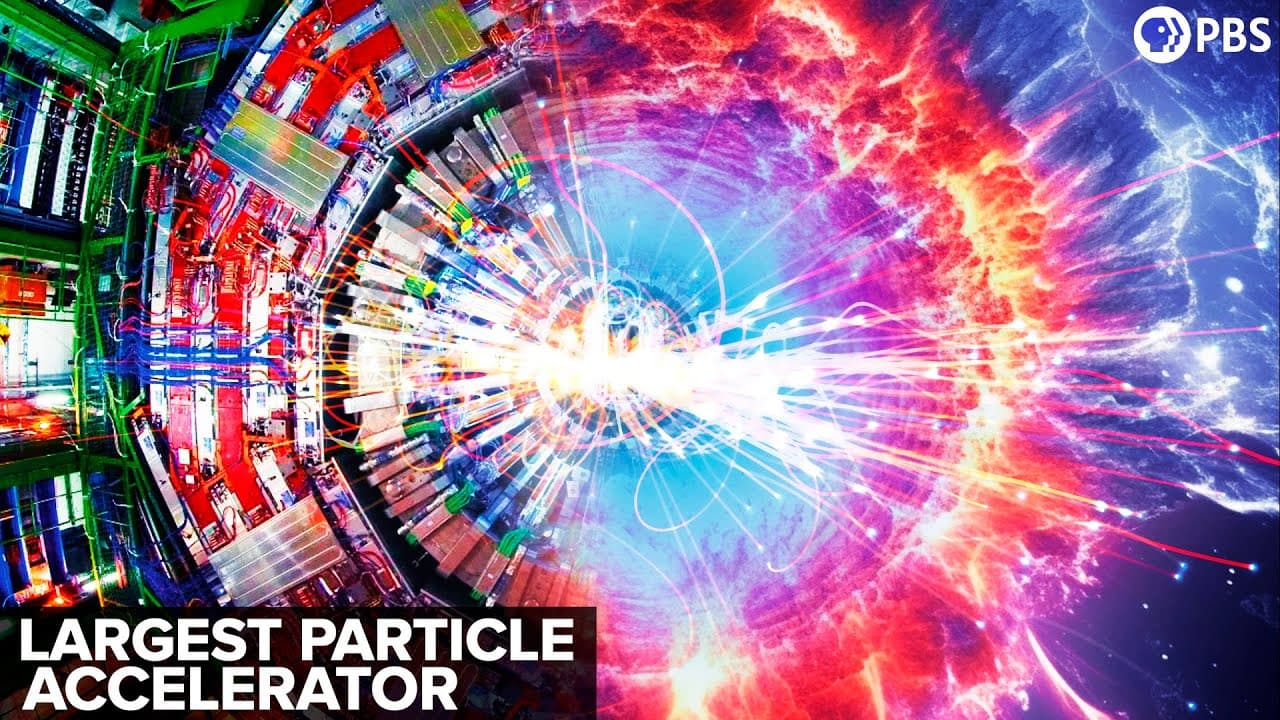
Hey Everyone. Before we get to the episode, just a heads up we have two new items at the merch store. There’s a link in the description Cern's Large Hadron Collider routinely collides particles at energies equivalent to a fraction of a second after the Big Bang. If this worries you, then the following fact will either put you at ease or scare th... Read More
Key Insights
- Supernovas are key sources of cosmic rays, acting as natural particle accelerators in space through shockwaves and magnetic fields.
- The discovery of cosmic rays dates back to 1912 by Victor Hess, who found that space bombards Earth with energetic charged particles.
- Cosmic rays have a vast range of energies, with some exceeding those produced by the Large Hadron Collider by millions of times.
- Shockwaves from supernovas, combined with magnetic fields, accelerate particles to high speeds through a process known as Fermi acceleration.
- The Fermi acceleration mechanism involves particles bouncing between magnetic fields, gaining energy with each pass.
- Supernova remnants can accelerate particles to energies up to 10^17 electron volts, though this is still lower than the highest energy cosmic rays observed.
- The origins of the most energetic cosmic rays remain uncertain, possibly linked to other galaxies, magnetars, or supermassive black holes.
- The Pierre Auger Observatory in Argentina plays a crucial role in studying cosmic rays, helping to trace their origins across the universe.
Install to Summarize YouTube Videos and Get Transcripts
Explore YouTube Video Summarizer or Get YouTube Transcript Extractor
Questions & Answers
Q: How do supernovas accelerate particles?
Supernovas accelerate particles through a process known as Fermi acceleration. This involves the interaction of shockwaves and magnetic fields generated by the supernova explosion. Particles bounce between these magnetic fields, gaining energy with each pass, similar to how man-made particle accelerators operate on Earth.
Q: What did Victor Hess discover about cosmic rays?
Victor Hess discovered cosmic rays in 1912 during a hot-air balloon ride. He found that the Earth is bombarded with energetic charged particles from space, which increase in detection as altitude rises. This discovery laid the foundation for understanding cosmic rays as a significant component of high-energy astrophysics.
Q: What is the significance of the Pierre Auger Observatory?
The Pierre Auger Observatory is a massive cosmic ray detector in Argentina, spanning 3000 square kilometers. It plays a crucial role in studying cosmic rays, particularly in tracing their origins across the sky. The observatory's findings suggest that the highest energy cosmic rays may originate from sources beyond our galaxy.
Q: What is the Fermi acceleration mechanism?
The Fermi acceleration mechanism is a process where particles gain energy by bouncing between magnetic fields. In the context of supernovas, particles are accelerated as they move through shockwaves and magnetic turbulence, gaining speed and energy with each pass. This mechanism is key to understanding how supernovas act as particle accelerators.
Q: How do cosmic rays compare to the energy levels at the Large Hadron Collider?
Cosmic rays can have energies far exceeding those produced by the Large Hadron Collider (LHC). While the LHC is one of the most powerful man-made particle accelerators, cosmic rays can reach energies millions of times higher, with some particles having the kinetic energy of a well-thrown baseball.
Q: What are some potential origins of the highest energy cosmic rays?
The highest energy cosmic rays may originate from various cosmic phenomena, including magnetars, supermassive black holes, and galaxy-scale magnetized shockwaves. These sources are capable of producing extreme magnetic fields and shockwaves, which can accelerate particles to the highest observed energies.
Q: How do shockwaves contribute to particle acceleration in supernovas?
Shockwaves are crucial in particle acceleration during a supernova. As the star explodes, shockwaves travel through space, interacting with magnetic fields. These interactions create a turbulent environment where particles can bounce and gain energy, accelerating to high speeds as they pass through the shockfront.
Q: What role do magnetic fields play in cosmic ray acceleration?
Magnetic fields play a vital role in cosmic ray acceleration by providing the force that deflects and accelerates charged particles. In supernovas, magnetic fields from the explosion and interstellar medium create a dynamic environment where particles can gain energy through repeated interactions, a process central to the Fermi acceleration mechanism.
Summary & Key Takeaways
-
Supernovas serve as immense particle accelerators in the universe, generating cosmic rays through shockwaves and magnetic fields. These cosmic rays have energies that can far exceed those produced by man-made accelerators like the Large Hadron Collider.
-
The discovery of cosmic rays began in 1912 with Victor Hess, and since then, scientists have uncovered their vast energy range and potential origins. Most cosmic rays are believed to originate from supernova explosions.
-
Despite significant advancements, the origins of the highest energy cosmic rays remain a mystery. Observatories like the Pierre Auger Observatory are crucial in tracing these particles and understanding their cosmic origins.
Read in Other Languages (beta)
Share This Summary 📚
Summarize YouTube Videos and Get Video Transcripts with 1-Click
Try YouTube Summary with ChatGPT & Claude or YouTube Transcript Generator
Explore More Summaries from PBS Space Time 📚
Summarize YouTube Videos and Get Video Transcripts with 1-Click
Try YouTube Summary with ChatGPT & Claude or YouTube Transcript Generator