Sn1 and Sn2 solvents effects
TL;DR
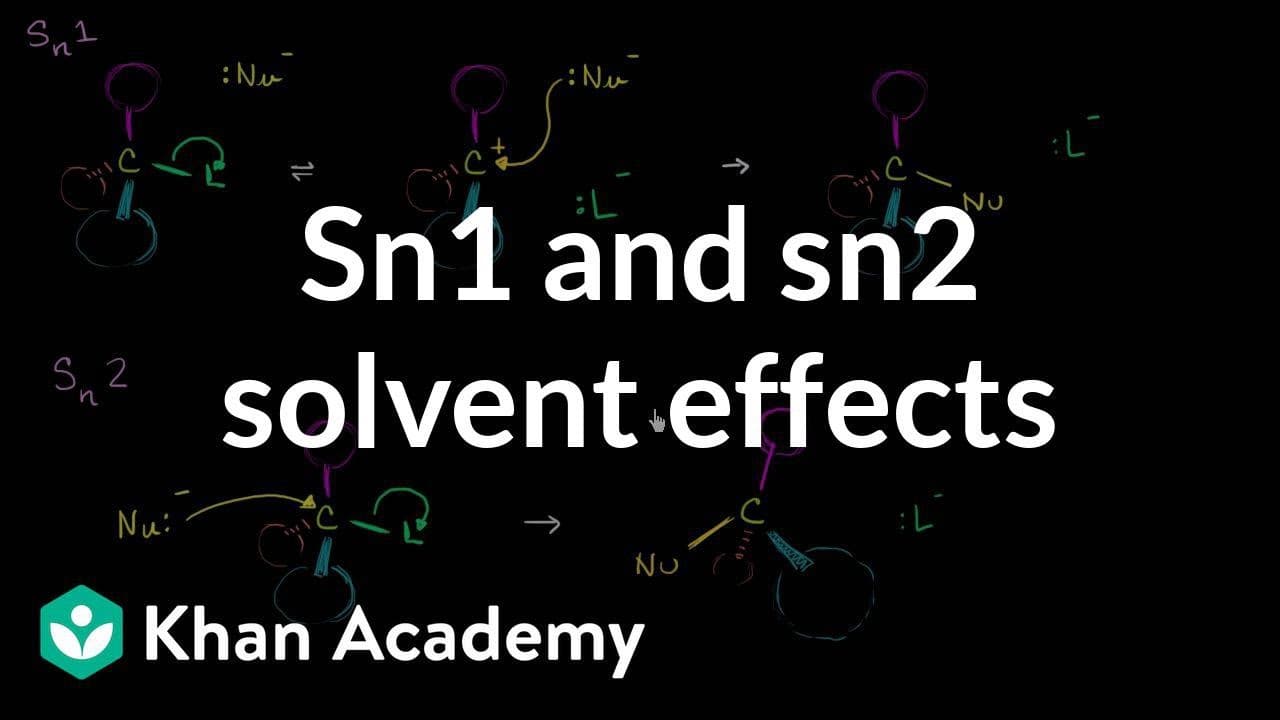
The video explains the difference between polar and nonpolar solvents and how they affect SN1 and SN2 reactions.
Transcript
So right here I have two potential solvents that you might see some type of reaction take place in. The one on the right is a very typical one, probably the most common of all solvents. This is water. And this right over here is diethyl ether. And we'll talk about naming things like this in the future dates, but you can see what's going on right ov... Read More
Key Insights
- 💦 Water and diethyl ether are both polar solvents due to the presence of an oxygen atom bonded to less electronegative elements.
- 😑 Polar solvents, with their partial positive and negative charges, are better at dissolving ions.
- 💦 Water is a protic solvent, while diethyl ether is nonprotic.
- 🍃 SN1 reactions involve a leaving group leaving and benefit from a protic environment.
- 👊 SN2 reactions involve a strong nucleophile attacking and benefit from a nonprotic environment.
- ❓ The molecular structure and electronegativity differences determine the polarity and properties of solvents.
- 🖐️ Solvents play a crucial role in determining the success of chemical reactions.
Install to Summarize YouTube Videos and Get Transcripts
Explore YouTube Video Summarizer or Get YouTube Transcript Extractor
Questions & Answers
Q: What is the difference between water and diethyl ether in terms of their molecular structure?
Water has an oxygen atom bonded to hydrogen atoms, while diethyl ether has an oxygen atom bonded to ethyl groups. The electronegativity difference is greater in water than in diethyl ether.
Q: Why are polar solvents better at dissolving ions?
Polar solvents have partial positive and negative charges, which attract ions. The positive ends of the solvents are attracted to the negative ions, allowing them to dissolve more easily.
Q: What is the difference between a protic and a nonprotic solvent?
A protic solvent can donate protons, while a nonprotic solvent does not have protons floating around. Water is an example of a protic solvent, while diethyl ether is a nonprotic solvent.
Q: How do polar solvents affect SN1 and SN2 reactions differently?
Both SN1 and SN2 reactions benefit from polar solvents. However, SN1 reactions, which involve a leaving group leaving, prefer a protic environment that can stabilize the leaving group's negative charge. SN2 reactions, which involve a strong nucleophile attacking the substrate, require a nonprotic environment to prevent the nucleophile from attacking protons instead.
Summary & Key Takeaways
-
Water and diethyl ether are both polar solvents due to the presence of an oxygen atom bonded to less electronegative elements.
-
Water is a protic solvent and can donate protons, while diethyl ether is nonprotic and does not have protons floating around.
-
Polar solvents are better at dissolving ions and are beneficial for both SN1 and SN2 reactions.
-
SN1 reactions prefer a protic environment, while SN2 reactions benefit from a nonprotic environment.
Read in Other Languages (beta)
Share This Summary 📚
Summarize YouTube Videos and Get Video Transcripts with 1-Click
Try YouTube Summary with ChatGPT & Claude or YouTube Transcript Generator
Explore More Summaries from Khan Academy 📚





Summarize YouTube Videos and Get Video Transcripts with 1-Click
Try YouTube Summary with ChatGPT & Claude or YouTube Transcript Generator