How to Differentiate the Fourth Root Using Chain Rule
TL;DR
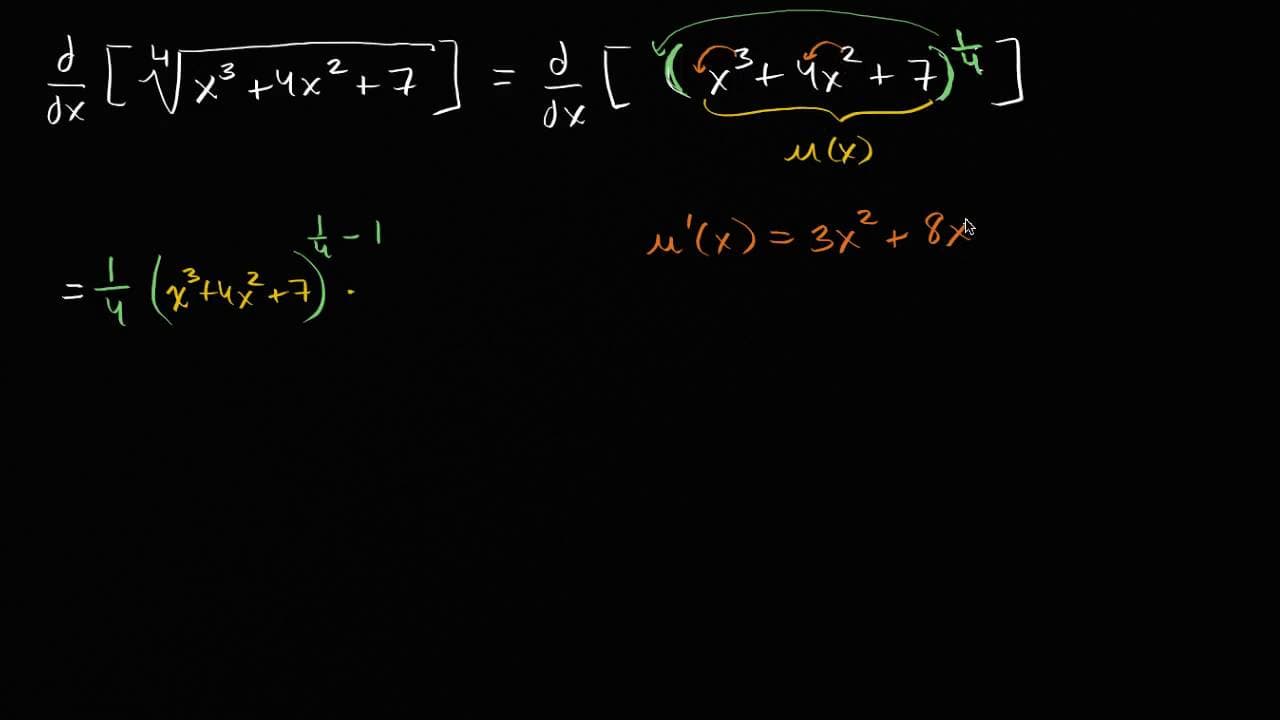
To differentiate the fourth root of an expression, rewrite it as a fractional exponent and apply the chain rule. Calculate the derivative of the outer function, then multiply by the derivative of the inner function. The video provides a detailed example of finding the tangent slope at a specific point.
Transcript
- [Voiceover] Let's see if we can take the derivative with respect to x of the fourth root of x to the third power plus four x squared plus seven. And at first you might say, "All right, "how do I take the derivative of the fourth root "of something, it looks like I have a composite function, "I'm taking the fourth root of another expression?" And ... Read More
Key Insights
- 😑 The fourth root of an expression can be represented as a fractional exponent.
- 🫚 The chain rule is applied when taking the derivative of the fourth root function.
- ✊ The power rule is used to find the derivative of the outer function.
Install to Summarize YouTube Videos and Get Transcripts
Explore YouTube Video Summarizer or Get YouTube Transcript Extractor
Questions & Answers
Q: How can the fourth root of an expression be rewritten as a fractional exponent?
The fourth root of an expression can be represented as the expression raised to the power of 1/4. For example, the fourth root of x is equivalent to x^(1/4).
Q: What is the chain rule used for in calculus?
The chain rule is used to find the derivative of a composite function. It allows us to differentiate the outer function with respect to the inner function and then multiply it by the derivative of the inner function.
Q: How do you find the derivative of the outer function using the power rule?
To find the derivative of the outer function, multiply the exponent by the coefficient and subtract 1 from the original exponent. For example, if the exponent is 1/4, the derivative would be (1/4) * (x^(1/4 - 1)).
Q: In the example given, what is the slope of the tangent line for the function y = fourth root of (x^3 + 4x^2 + 7) when x is equal to -3?
The slope of the tangent line is found by substituting x = -3 into the derivative equation and simplifying the expression. The resulting slope is 3/32.
Summary & Key Takeaways
-
To find the derivative of the fourth root of an expression, rewrite it as a fractional exponent.
-
Treat the fourth root as an outer function and the expression inside as an inner function.
-
Use the power rule to find the derivative of the outer function and multiply it by the derivative of the inner function.
-
An example is given to find the slope of the tangent line for the function y = fourth root of (x^3 + 4x^2 + 7), when x is equal to -3.
Read in Other Languages (beta)
Share This Summary 📚
Summarize YouTube Videos and Get Video Transcripts with 1-Click
Try YouTube Summary with ChatGPT & Claude or YouTube Transcript Generator
Explore More Summaries from Khan Academy 📚




Summarize YouTube Videos and Get Video Transcripts with 1-Click
Try YouTube Summary with ChatGPT & Claude or YouTube Transcript Generator