What Are Woodrow Wilson's Fourteen Points for Peace?
TL;DR
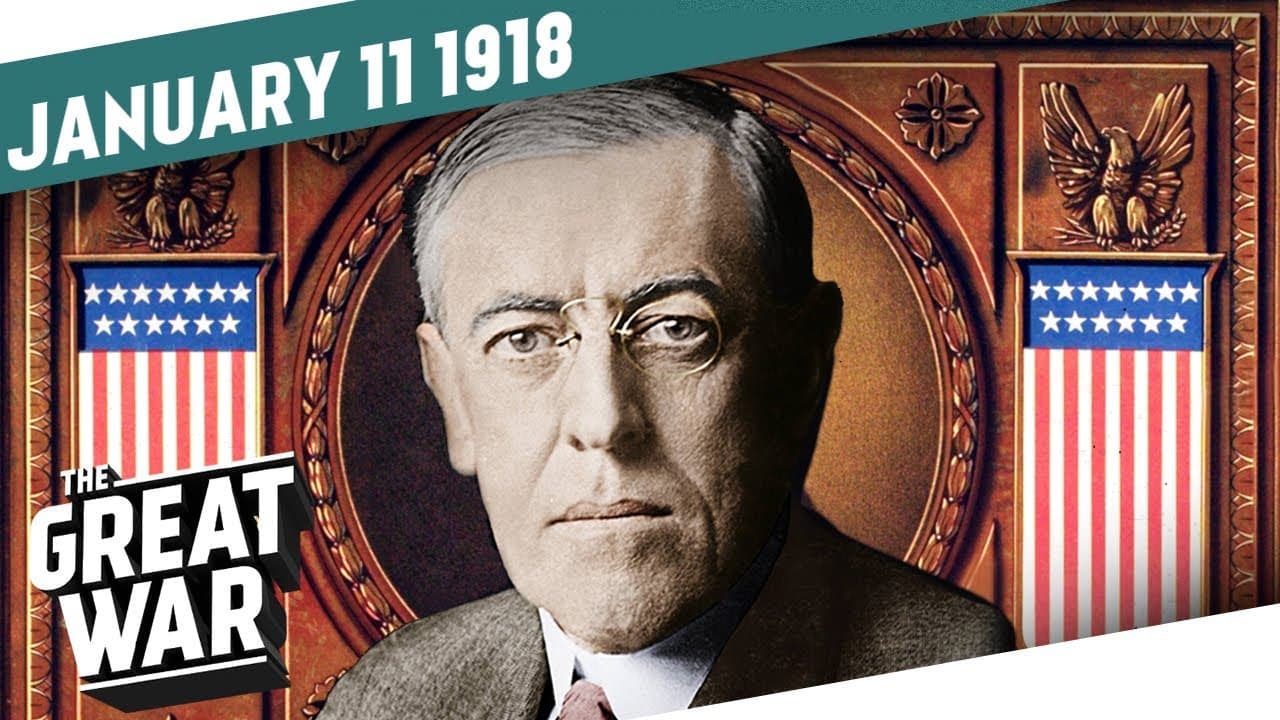
Woodrow Wilson's Fourteen Points for peace proposed principles like open diplomacy, free trade, and national self-determination to guide postwar negotiations. While some allies viewed them as overly idealistic, they were generally well-received in Europe, emphasizing specific territorial adjustments and the establishment of a General Association of Nations.
Transcript
1917 is over but the war is not. But even as nations plan huge new offensives in the field to hopefully make such an end a reality, one man alone is putting into words his specific hopes for a postwar world, Woodrow Wilson I’m Indy Neidell; welcome to the Great War. Last week, the Italians pushed the Austrians back at the Piave River, and the Briti... Read More
Key Insights
- Woodrow Wilson's 14 points aimed to establish a framework for peace, emphasizing open diplomacy, free trade, and national self-determination.
- The proposal was met with skepticism from Wilson's allies, who viewed his ideas as overly idealistic, yet it was well-received in Europe.
- Wilson's points included specific territorial adjustments, such as the evacuation of Russian and Belgian territories and the restoration of Alsace-Lorraine to France.
- The speech did not fully address independence for Southern Slavs or the autonomy of Croats and Slovenes, highlighting its limitations.
- In the Caucasus, instability grew with skirmishes between Armenians and Ottomans, as Armenians formed a national army amidst the Russian withdrawal.
- The Ottomans, led by Enver Pasha, planned to expand eastward, seeing the Russian Revolution as an opportunity to regain lost territories.
- Germany, under Ludendorff, prepared for a decisive offensive on the Western Front, hoping to secure favorable peace terms before American forces arrived.
- The Armenian national army, composed of experienced soldiers and volunteers, faced challenges due to limited artillery and trained personnel.
Install to Summarize YouTube Videos and Get Transcripts
Explore YouTube Video Summarizer or Get YouTube Transcript Extractor
Questions & Answers
Q: What were the main objectives of Woodrow Wilson's 14 points?
Wilson's 14 points aimed to establish a framework for a just and lasting peace following World War I. Key objectives included open diplomacy without secret agreements, freedom of the seas, removal of trade barriers, reduction of armaments, and national self-determination. The points also addressed specific territorial adjustments and the formation of a League of Nations to ensure collective security.
Q: How did European nations react to Wilson's 14 points?
European reactions to Wilson's 14 points were mixed. While the plan was generally well-received in Europe for its moral vision, some of Wilson's allies were skeptical, viewing his proposals as overly idealistic. They were concerned about the practicality of implementing such principles amidst the complex political landscape of postwar Europe.
Q: What were the implications of Wilson's speech for the Austro-Hungarian Empire?
Wilson's speech had significant implications for the Austro-Hungarian Empire, as it suggested autonomous development for its peoples rather than full independence. This approach did not encourage a separate state for Southern Slavs, leaving the future of Croats and Slovenes uncertain. The proposal highlighted the challenges of balancing national aspirations with geopolitical realities.
Q: What was the situation in the Caucasus during this period?
The Caucasus region was marked by increasing instability as the Russian Revolution unfolded. The Armenian national army, formed to defend against Ottoman advances, faced challenges in organization and resources. The region's strategic importance was underscored by Ottoman ambitions to expand eastward, exploiting the power vacuum left by the Russian withdrawal.
Q: What were Enver Pasha's objectives in the Caucasus?
Enver Pasha, the Ottoman Minister of War, aimed to capitalize on the Russian Revolution by expanding Ottoman influence in the Caucasus. He sought to regain territories lost to Russia and compensate for potential losses in the Arab provinces to the British. Enver's plans involved mobilizing the Third Army for an offensive in the region, targeting strategic locations like the Baku oilfields.
Q: How did the German military strategy shift in early 1918?
In early 1918, Germany, under Ludendorff, shifted its military strategy to focus on a decisive offensive on the Western Front. With Russia exiting the war, Germany aimed to leverage its advantage before American forces could arrive in strength. This strategy involved planning multiple offensives, such as GEORG, MARS, and MICHAEL, to achieve a breakthrough and secure favorable peace terms.
Q: What was the composition and role of the Armenian national army?
The Armenian national army was composed of experienced soldiers from the Armenian Druzhiny battalions, volunteers from Ottoman Armenia, and remnants of the Russian army. It included infantry, cavalry, and militia units, well-equipped with machine guns but lacking in artillery. The army played a crucial role in defending Armenian territories amidst the chaotic power dynamics in the Caucasus.
Q: What was the significance of the German plans for a Western Front offensive?
The German plans for a Western Front offensive were significant as they represented a strategic shift to secure a decisive victory before American reinforcements could arrive. The offensive aimed to exploit the temporary numerical advantage gained from the eastern front's closure. Success would allow Germany to dictate favorable peace terms, impacting the war's outcome and postwar European order.
Summary & Key Takeaways
-
In early 1918, President Woodrow Wilson outlined his 14-point plan for peace, aiming to guide postwar negotiations with principles like open diplomacy and national self-determination. The plan received mixed reactions, being seen as idealistic by some allies but welcomed in Europe.
-
Meanwhile, in the Caucasus, tensions escalated as Armenians, supported by remnants of the Russian army, organized a national army to defend against Ottoman advances. The region's instability was exacerbated by differing national interests and the ongoing Russian Revolution.
-
Germany, under Ludendorff, focused on planning a major offensive on the Western Front, aiming to secure a decisive victory before American troops could fully reinforce the Allies. This strategic push reflected a shift in German priorities, emphasizing the Western Front's importance.
Read in Other Languages (beta)
Share This Summary 📚
Summarize YouTube Videos and Get Video Transcripts with 1-Click
Try YouTube Summary with ChatGPT & Claude or YouTube Transcript Generator
Explore More Summaries from The Great War 📚

Summarize YouTube Videos and Get Video Transcripts with 1-Click
Try YouTube Summary with ChatGPT & Claude or YouTube Transcript Generator