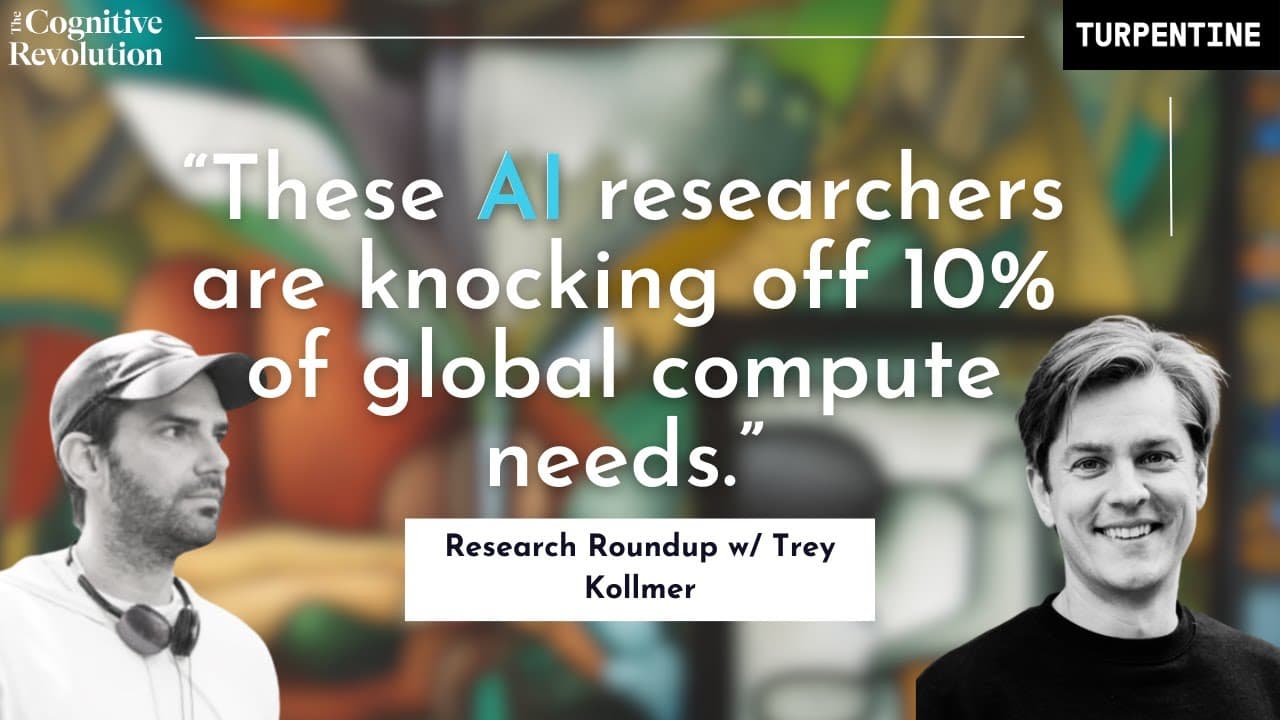
How to Enhance Transformer Models with Trey Kollmer
TL;DR
Trey Kollmer discusses recent advancements in AI research, focusing on techniques to reduce global compute needs and improve language model performance. Key topics include analogical prompting, compressive historical records for better memory, and the potential for superhuman learning capabilities through extended context windows. These innovations could significantly transform AI applications across various fields.
Transcript
no less than Imad mustak from stability said brilliant researchers like this literally knock 10% off of global training compute needs with these improvements which are impossible to predict 10 million tokens starts to give you the opportunity to put like whole bodies of literature into a single token right I mean The Great Gatsby famously fits into... Read More
Key Insights
- Analogical prompting allows models to recall relevant examples autonomously, outperforming few-shot prompting by leveraging the model's internal knowledge base.
- Compressive historical records could enhance memory and retention abilities in language models, allowing for more efficient processing of past interactions.
- Extended context windows, potentially up to 10 million tokens, could enable models to make connections across vast bodies of information, enhancing learning capabilities.
- Ring Attention offers a novel approach to scaling context length linearly with device count, breaking free from traditional memory constraints.
- Streaming LLMs can maintain consistent performance over long transcripts by utilizing attention sinks, which help manage attention across extended sequences.
- Markdown formatting is found to be more effective for OpenAI models, while XML tags are recommended for Claude models, highlighting the importance of format in model performance.
- The ability to dynamically adjust context windows at runtime could lead to more flexible and efficient AI systems, adapting to user needs in real-time.
- The combination of planning algorithms, memory enhancements, and increased scale could lead to major breakthroughs in AI capabilities, potentially achieving superhuman performance.
Install to Summarize YouTube Videos and Get Transcripts
Explore YouTube Video Summarizer or Get YouTube Transcript Extractor
Questions & Answers
Q: How does analogical prompting improve language model performance?
Analogical prompting improves language model performance by allowing the model to autonomously recall relevant examples from its internal knowledge base. This technique leverages the model's ability to generate examples that are most relevant to the problem at hand, rather than relying on pre-defined few-shot examples. As a result, it can achieve better performance by using the most pertinent examples for each specific task.
Q: What are compressive historical records in language models?
Compressive historical records refer to a method of enhancing memory and retention capabilities in language models by summarizing past interactions into a compressed format. This allows the model to maintain a coherent understanding of previous dialogues without needing to retain every detail. By efficiently managing historical data, models can improve their long-term conversational abilities and better handle extended interactions.
Q: What is the significance of extended context windows in AI models?
Extended context windows allow AI models to process and consider significantly larger sequences of data, potentially up to 10 million tokens. This capability enables models to draw connections across vast datasets, improving their learning and inference abilities. By handling more information at once, models can better understand complex relationships and make more informed predictions, potentially achieving superhuman performance in certain tasks.
Q: How does ring attention help overcome memory constraints in AI models?
Ring attention is a technique that scales context length linearly with the number of devices, effectively breaking free from traditional memory constraints. By restructuring the computation of attention mechanisms, it allows models to handle larger context lengths without a quadratic increase in computational requirements. This innovation enables AI systems to process more data simultaneously, enhancing their overall performance and efficiency.
Q: Why is Markdown formatting effective for OpenAI models?
Markdown formatting is effective for OpenAI models because it aligns with the training processes used by the organization. Using Markdown helps ensure that instructions and prompts are interpreted correctly by the model, leading to improved performance. This formatting choice is part of the broader consideration of how input structure can impact model behavior and outcomes.
Q: What are attention sinks and how do they function in streaming LLMs?
Attention sinks in streaming LLMs are tokens that absorb excess attention when there is no clear focus for the model's attention mechanism. By designating certain tokens as attention sinks, models can maintain coherent performance over long sequences by ensuring that the sum of attention remains balanced. This approach helps manage attention across extended sequences, preventing performance degradation over time.
Q: How could dynamic context window adjustment benefit AI systems?
Dynamic context window adjustment allows AI systems to modify the length of their attention span in real-time, based on the specific requirements of a task or user interaction. This flexibility can lead to more efficient and effective AI responses, as the model can allocate resources optimally according to the complexity and context of the input. Such adaptability enhances the user experience by providing tailored AI support.
Q: What potential breakthroughs could result from combining planning algorithms with enhanced memory and scale?
Combining planning algorithms with enhanced memory and scale could lead to significant breakthroughs in AI capabilities, potentially achieving superhuman performance. With improved memory, AI models can better retain and utilize past information, while increased scale allows for processing larger datasets and more complex tasks. Planning algorithms can further optimize decision-making processes, enabling AI systems to tackle sophisticated challenges and discover insights beyond current human expertise.
Summary & Key Takeaways
-
Recent advancements in AI research focus on improving transformer models through analogical prompting, which enhances performance by allowing models to autonomously recall relevant examples. This surpasses few-shot prompting by utilizing the model's internal knowledge base.
-
Compressive historical records are being explored to improve memory and retention in language models, potentially enabling them to process and recall past interactions more efficiently. This could lead to more coherent long-term dialogues in AI applications.
-
The introduction of techniques like ring attention and extended context windows allows models to handle significantly larger sequences of data, potentially up to 10 million tokens. This expansion could enable models to learn and connect information across vast datasets, paving the way for superhuman learning capabilities.
Read in Other Languages (beta)
Share This Summary 📚
Summarize YouTube Videos and Get Video Transcripts with 1-Click
Try YouTube Summary with ChatGPT & Claude or YouTube Transcript Generator
Explore More Summaries from Cognitive Revolution "How AI Changes Everything" 📚





Summarize YouTube Videos and Get Video Transcripts with 1-Click
Try YouTube Summary with ChatGPT & Claude or YouTube Transcript Generator