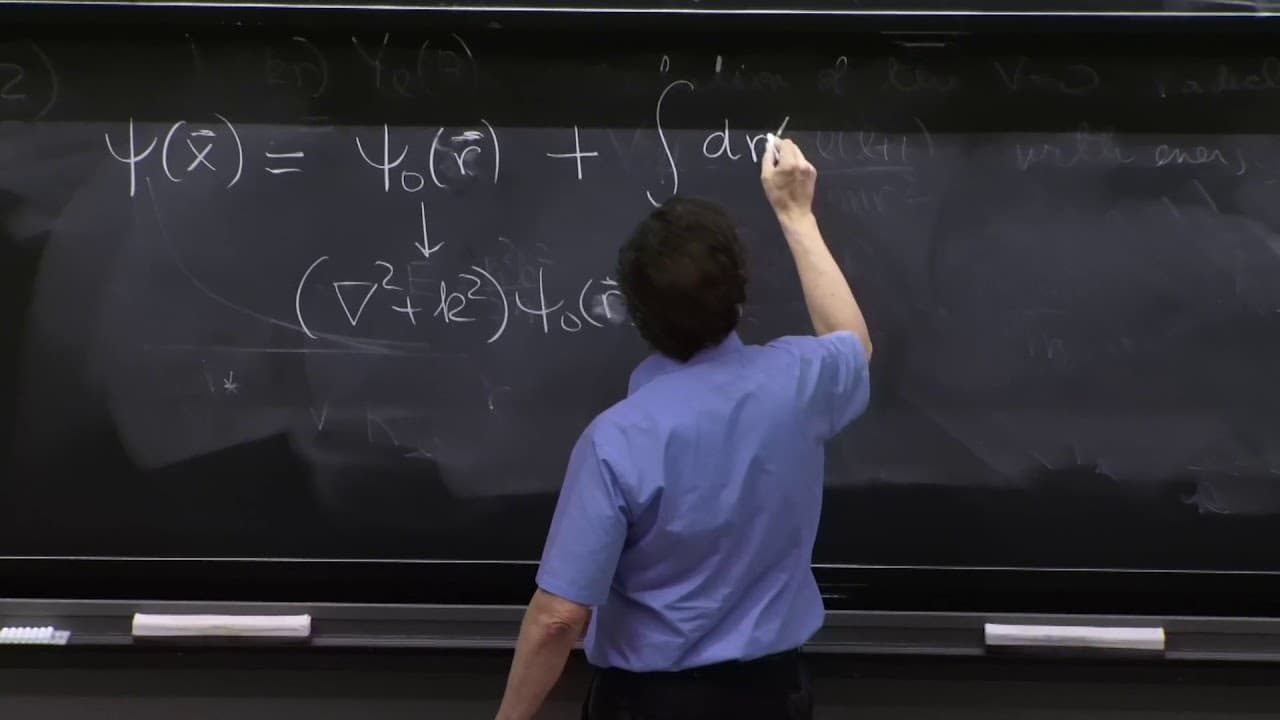
L21.3 Integral equation for scattering and Green's function
TL;DR
Integral equations and Green's functions are used to solve complicated scattering problems in quantum mechanics.
Transcript
PROFESSOR: A new way of thinking about this is based on integral equations. So it's a nice method. It's less complicated than it seems, suddenly leads to some expressions for the scattering amplitude. We'll find another formula for this quantity, f of k of theta, when we cannot calculate it with phase shifts. But phase shifts is very powerful if yo... Read More
Key Insights
- ❓ Integral equations provide a simpler alternative to directly solving the Schrodinger equation for scattering problems.
- 🇬🇱 Green's functions are used to solve integral equations and provide insight into the system's response to localized disturbances.
- 🍉 By using the appropriate Green's function, a solution for the scattering equation can be obtained without explicitly solving for the potential term.
- 🅰️ The choice of Green's function depends on the specific scattering problem and the type of solution desired.
Install to Summarize YouTube Videos and Get Transcripts
Explore YouTube Video Summarizer or Get YouTube Transcript Extractor
Questions & Answers
Q: What is the advantage of using integral equations in solving scattering problems?
Integral equations provide a simpler way to solve complicated scattering problems compared to directly solving the Schrodinger equation with the potential term included.
Q: How is the Green's function defined in this context?
The Green's function is a function that solves a similar equation to the scattering equation, but with a delta function as the source term. It represents the response of the system to a localized disturbance.
Q: How are integral equations and Green's functions related?
Integral equations are solved using Green's functions, which are designed to give solutions that satisfy the equation with a delta function as the source term. The Green's function acts as a kind of "kernel" in the integral equation.
Q: Can integral equations be used for all scattering problems?
Integral equations are especially useful when the potential is not spherical and when the problem does not have spherical symmetry. However, for problems with spherical symmetry, phase shifts can be a more powerful method.
Summary & Key Takeaways
-
The professor introduces integral equations as a new way of thinking about solving the scattering amplitude in quantum mechanics.
-
The integral scattering equation is derived and explained in terms of the Schrodinger equation.
-
The concept of Green's functions is introduced as a way to solve integral equations and simplify the solution of the scattering equation.
Read in Other Languages (beta)
Share This Summary 📚
Summarize YouTube Videos and Get Video Transcripts with 1-Click
Try YouTube Summary with ChatGPT & Claude or YouTube Transcript Generator
Explore More Summaries from MIT OpenCourseWare 📚
Summarize YouTube Videos and Get Video Transcripts with 1-Click
Try YouTube Summary with ChatGPT & Claude or YouTube Transcript Generator