How Do Non-Transitive Interactions Impact Populations?
TL;DR
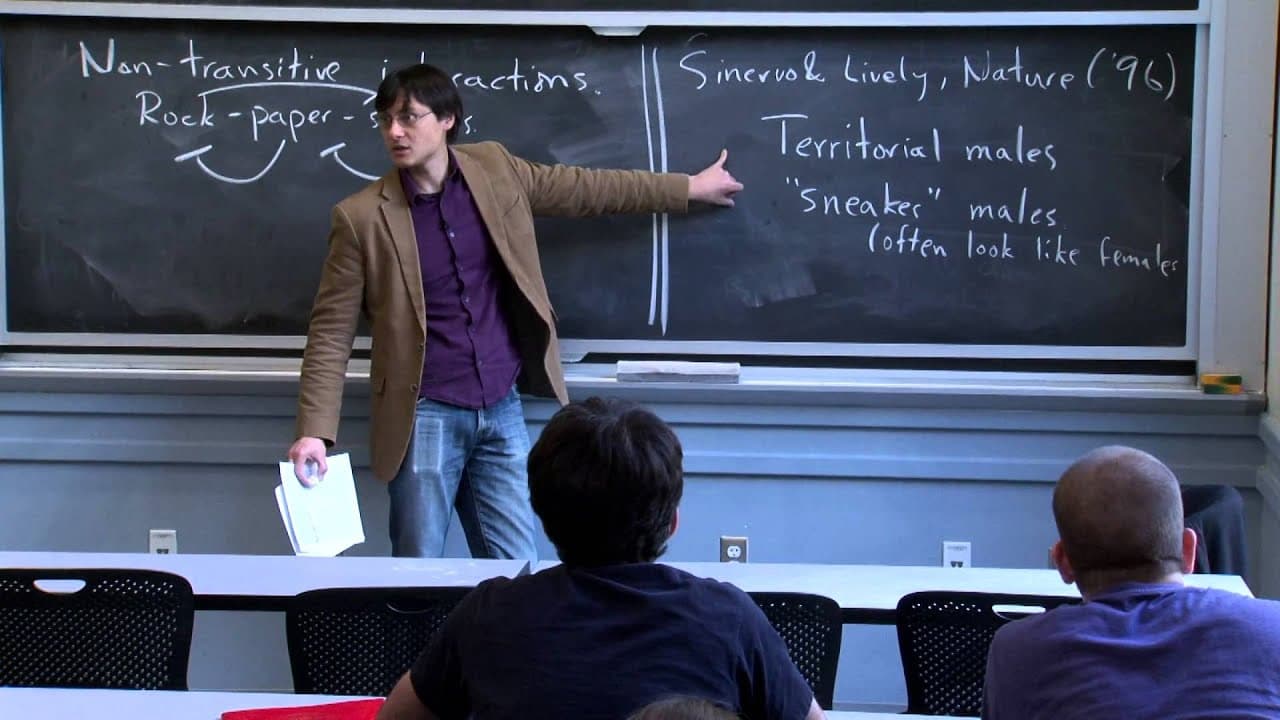
Non-transitive interactions like rock-paper-scissors can enhance species diversity in populations by allowing coexistence in competitive environments. This video discusses Lotka-Volterra models, examining how spatial structures influence these dynamics and explores real-world examples, including lizard mating strategies and bacterial colicin production.
Transcript
The following content is provided under a Creative Commons license. Your support will help MIT OpenCourseWare continue to offer high quality, educational resources for free. To make a donation or view additional materials from hundreds of MIT courses, visit MIT OpenCourseWare at ocw.mit.edu. PROFESSOR: Today, what we want to do is finish off our di... Read More
Key Insights
- 👨🎤 Lotka-Volterra competition models can exhibit non-transitive interactions, such as rock-paper-scissors, which may contribute to the maintenance of diversity in populations.
- 👨🎤 The presence of spatial structure can influence the outcomes of rock-paper-scissors dynamics, and it may be necessary for the coexistence of multiple strategies.
- ☠️ Population waves describe the spreading of populations in space, and they can be influenced by growth rates, diffusion, and local carrying capacities.
Install to Summarize YouTube Videos and Get Transcripts
Explore YouTube Video Summarizer or Get YouTube Transcript Extractor
Questions & Answers
Q: How can more than two species coexist in a Lotka-Volterra competition model?
Coexistence can occur when the species weakly interfere with each other, with each species suppressing the growth of the other species only slightly. This allows for stable coexistence without one species dominating over the others.
Q: Do the outcomes of Lotka-Volterra competition models depend on the division rates of the species?
No, the outcomes are independent of the division rates of the species. The result of two-species interactions depends on the relative ordering of the competitive coefficients (beta) and carrying capacities (K) of the species.
Q: How did the researchers in the lizard mating strategies paper demonstrate the existence of three male mating strategies?
They observed three male mating strategies (aggressive, non-aggressive with small territories, and sneaker males) over seven years in a population of side-blotched lizards. They measured the frequency of each strategy and showed that it went through an oscillation pattern, indicating the presence of rock-paper-scissors dynamics.
Q: Can non-transitive interactions lead to coexistence in a well-mixed environment?
In some cases, non-transitive interactions alone may not lead to coexistence in a well-mixed environment. Other factors, such as spatial structure, may be necessary to maintain diversity in populations.
Summary & Key Takeaways
- The discussion covers Lotka-Volterra competition models, their general properties, and the outcomes of two-species interactions. It also explores non-transitive interactions, like rock-paper-scissors, that can maintain diversity in populations. Two papers are discussed: one on male mating strategies in lizards and another on colicin production in bacteria. The lecture also introduces the concept of population waves and their connection to spatial dynamics.
Read in Other Languages (beta)
Share This Summary 📚
Summarize YouTube Videos and Get Video Transcripts with 1-Click
Try YouTube Summary with ChatGPT & Claude or YouTube Transcript Generator
Explore More Summaries from MIT OpenCourseWare 📚


Summarize YouTube Videos and Get Video Transcripts with 1-Click
Try YouTube Summary with ChatGPT & Claude or YouTube Transcript Generator