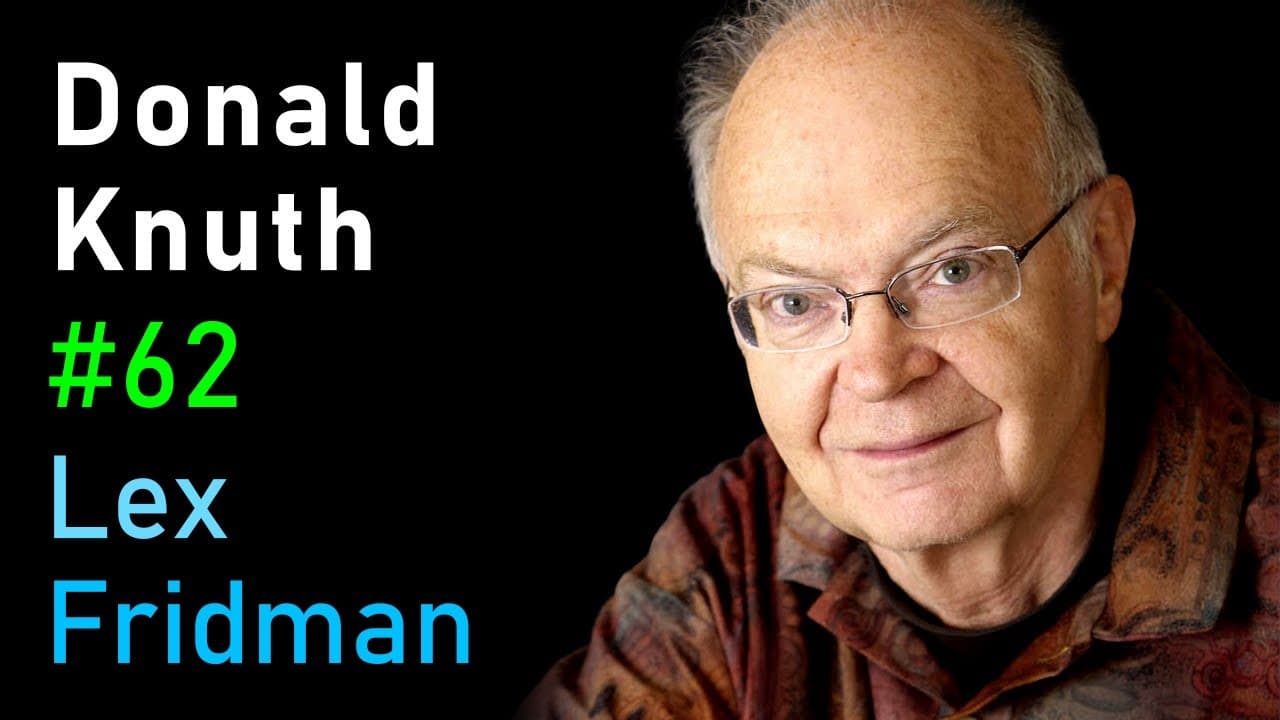
Donald Knuth: Algorithms, Complexity, and The Art of Computer Programming | Lex Fridman Podcast #62
TL;DR
A fascinating conversation with computer scientist Donald Knuth, discussing his experiences and insights on the field of computer programming and the development of algorithms.
Transcript
the following is a conversation with donald knuth one of the greatest and most impactful computer scientists and mathematicians ever he's the recipient of the 1974 Turing award considered the Nobel Prize of computing he's the author of the multi-volume work the magnum opus the art of computer programming he made several key contributions to the rig... Read More
Key Insights
- 🔍 Donald Knuth is a highly influential computer scientist and mathematician, known for his contributions to algorithms and the development of the TeX typesetting system.
- 🖥️ The IBM 650 computer sparked Knuth's interest in computing when he first saw it as a freshman, and he fell in love with the field.
- 💡 Knuth's work in the rigorous analysis of algorithms led to the popularization of asymptotic notation, or Big O notation.
- 💻 Knuth's creation of the TeX typesetting system revolutionized the way technical papers are written and made beautiful.
- 🎙️ Lex Friedman, the podcast host, had a conversation with Knuth that meant a lot to him and was recorded months prior to the discussion.
- 📃 Knuth has been working on his magnum opus, "The Art of Computer Programming," for over 57 years and is currently in the middle of Volume 4B.
- 🤓 Knuth discusses the unique thinking style of geeks or individuals who gravitate towards computational thinking, highlighting their ability to jump levels of abstraction.
- 📚 Knuth mentions the importance of combining formalism with natural language in his work, as seen in literate programming, which aims to make programs more understandable for humans.
Install to Summarize YouTube Videos and Get Transcripts
Explore YouTube Video Summarizer or Get YouTube Transcript Extractor
Questions & Answers
Q: How did Donald Knuth's experiences with the IBM 650 shape his career in computer science?
Donald Knuth's early experiences with the IBM 650 sparked his love for computing and set him on the path to becoming one of the most influential figures in computer science. The machine's size and noise may not have been impressive, but it was the lights flashing on it and the opportunity to work with it that captivated Knuth. He describes the machine's limited memory and the challenges it presented, but also its power and the joy he found in programming and problem-solving. From those early experiences, Knuth knew that computers would be his life's work.
Q: How did Knuth develop the idea of literate programming?
Knuth developed the idea of literate programming as a way to enhance understanding and communication in programming. He wanted to bridge the gap between formal and informal descriptions of algorithms, as well as provide insight into the thought process behind the code. By combining code and explanatory text in a readable format, Knuth believed that programmers could gain a deeper understanding of the algorithms they were working with. The goal was to make programming more than just a means to an end, but a form of artistic expression.
Q: What are some surprising and transformative discoveries Knuth has made throughout his career?
Knuth's work on the BDD (Boolean Decision Diagram) data structure in the field of combinatorial algorithms was a transformative discovery. He was initially surprised by the power and efficiency of BDDs, which revolutionized the representation of Boolean functions. Knuth also mentions the discovery of SAT solvers, which are algorithms used to solve the Boolean satisfiability problem. These solvers have had a significant impact on solving difficult problems in computer science and beyond. Overall, Knuth's work has involved constantly pushing the boundaries of what is possible and finding new ways to approach complex problems.
Q: How does Knuth view the field of artificial intelligence and its development over the years?
Knuth sees the field of artificial intelligence as a source of inspiration and a rich area of research. He recognizes the significant contributions made by the AI community in advancing computer science and pushing the boundaries of what is possible. However, he also emphasizes the importance of understanding the limits of AI and the challenges in truly mimicking human intelligence. He believes that there is still much to be learned and discovered in the field, and that the gap between intelligence and artificial intelligence is vast. Knuth's focus remains on algorithmic and computational thinking, rather than replicating human cognition.
Summary
This is a conversation with Donald Knuth, a renowned computer scientist and mathematician. Knuth is the author of "The Art of Computer Programming", a multi-volume work that covers various topics in computer science. In this conversation, he discusses his early experiences with computers, the influence of Alan Turing on his work, the concept of literate programming, and the evolution of combinatorial algorithms. He also shares insights into his writing process and the importance of combining formalism and informality in programming.
Questions & Answers
Q: Can you take me back to the moment when you fell in love with computing?
When I first saw the IBM 650 computer through a window, I was captivated by the flashing lights. I had a job with the statistics group in college, and I was fascinated by the possibilities of the new computer. Despite its limited memory and power, it sparked my interest and set me on a path to pursue computer science.
Q: Have you ever tried to predict the future of computing?
The hardest question I've been asked is what I could have predicted about computing. While I could list numerous surprising developments in the field, I couldn't think of anything I would have predicted with certainty. The IBM 650 was the first machine with widespread use, and the field of computing has evolved significantly since then, making it difficult to predict future advancements.
Q: What is it about computational thinking that makes someone a geek?
Geeks have the ability to jump between levels of abstraction and fluently navigate different perspectives. They can see a problem at different levels, from a high-level view to a low-level understanding, and easily transition between these perspectives. Geeks also excel at dealing with non-uniformity and can handle complex systems with multiple rules or variations.
Q: How has Alan Turing influenced your work?
I initially thought Turing had only done formal work, but later discovered he had practical experience and wrote subroutines for Manchester machines. His ability to think like a computer and his hands-on approach resonated with me. Turing's combination of formalism and practicality influenced my own approach to computer programming and research.
Q: The concept of literate programming combines formalism and informality. How do you see these two approaches coexisting?
I believe in the power of combining formal and informal approaches in programming. Literate programming allows programmers to understand a complex problem by presenting it from multiple perspectives. By explaining the logic behind code and giving insight into the programmer's thought process, we can make programs more understandable and maintainable.
Q: How do you view natural language and the messiness of human expression in programming?
Using natural language can help make programming more accessible to different types of brains. While natural language may introduce complexity, it can also provide a bridge between the formalism of programming and the messiness of human expression. The goal is to make programming more understandable and create algorithms that can effectively communicate complex ideas.
Q: Can you summarize the four volumes of "The Art of Computer Programming"?
Volume 1 covers fundamental algorithms, including basic concepts, input/output, and subroutines. It also introduces the structured representation of data and information. Volume 2 focuses on numerical algorithms, such as arithmetic, matrices, and random numbers. Volume 3 explores sorting and searching algorithms. Volume 4 delves into combinatorial algorithms, which deal with problems involving non-random structures. Each volume presents a combination of theoretical analysis and practical applications.
Q: What is your writing process like for "The Art of Computer Programming"?
I spend seven days a week working on my books. I have a chair where I write my initial ideas on paper, and then I have a stand-up desk for typing and revising. I write programs to test and understand the concepts I'm exploring. My routine involves reading, editing, and rewriting until I feel confident in the material. I also reach out to colleagues for their expertise and feedback. Each day brings new challenges and discoveries, but I find joy in the process.
Q: Are there any particular challenges or difficult parts of the writing process?
Writing can be challenging at times, especially when I strive for high standards. I find myself questioning why I can't be more sloppy or write more quickly. However, I know that maintaining high standards is important, and I want to produce the best work possible. There are also challenges in ensuring mathematical accuracy, finding the right balance between formalism and informality, and making the text visually appealing.
Q: What is the role of art in computer programming?
The use of the word "art" in computer programming refers to the creative and elegant aspects of the craft. It involves the synthesis of ideas, the expression of beauty, and the mastery of techniques. Programming can be a form of art when it is done well and brings joy to both the programmer and the audience. It encompasses the skillful combination of formalism and informality to create programs that are both efficient and inspiring.
Q: Have there been any surprising ideas or breakthroughs that have changed your view of a particular field?
I continue to be surprised and challenged by bugs in my programs, but there have been transformative moments in my work. One example is the discovery of boolean decision diagrams (BDDs) in volume 4 of "The Art of Computer Programming". BDDs were a surprise to me and presented new possibilities for solving certain problems. The field of combinatorics, in general, has undergone significant developments and continues to surprise me with new ideas and methods.
Takeaways
Donald Knuth's work in computer science and his book series "The Art of Computer Programming" exemplify the intersection of formalism and informality in programming. His ability to fluidly navigate levels of abstraction and his dedication to precision and elegance have made his work influential. Knuth's writing process involves constant refinement and combining multiple perspectives, making his books engaging and informative. The concept of literate programming, combining informal explanations with formal algorithms, highlights the importance of clarity and understanding in programming. The field of combinatorics continues to evolve, providing new insights and approaches to solving complex problems. Overall, Knuth's work emphasizes the beauty and artistry of computer programming and the endless possibilities for innovation and creativity.
Summary & Key Takeaways
-
Donald Knuth is a pioneer and influential figure in computer science and mathematics.
-
He made significant contributions to the analysis of computational complexity and created the widely used typesetting system, TeX.
-
The conversation delves into his early experiences with computers, his writing process, and his views on artificial intelligence.
-
Donald Knuth's early experiences with computers include working with the IBM 650 and falling in love with computing.
-
He discusses the importance of understanding and being able to jump between different levels of abstraction in problem-solving.
-
Knuth shares his thoughts on the use of natural language in programming, the concept of literate programming, and the balance between formalism and informality in writing code.
Read in Other Languages (beta)
Share This Summary 📚
Summarize YouTube Videos and Get Video Transcripts with 1-Click
Try YouTube Summary with ChatGPT & Claude or YouTube Transcript Generator
Explore More Summaries from Lex Fridman Podcast 📚
Summarize YouTube Videos and Get Video Transcripts with 1-Click
Try YouTube Summary with ChatGPT & Claude or YouTube Transcript Generator