How to Align AI with Biologically Inspired Methods
TL;DR
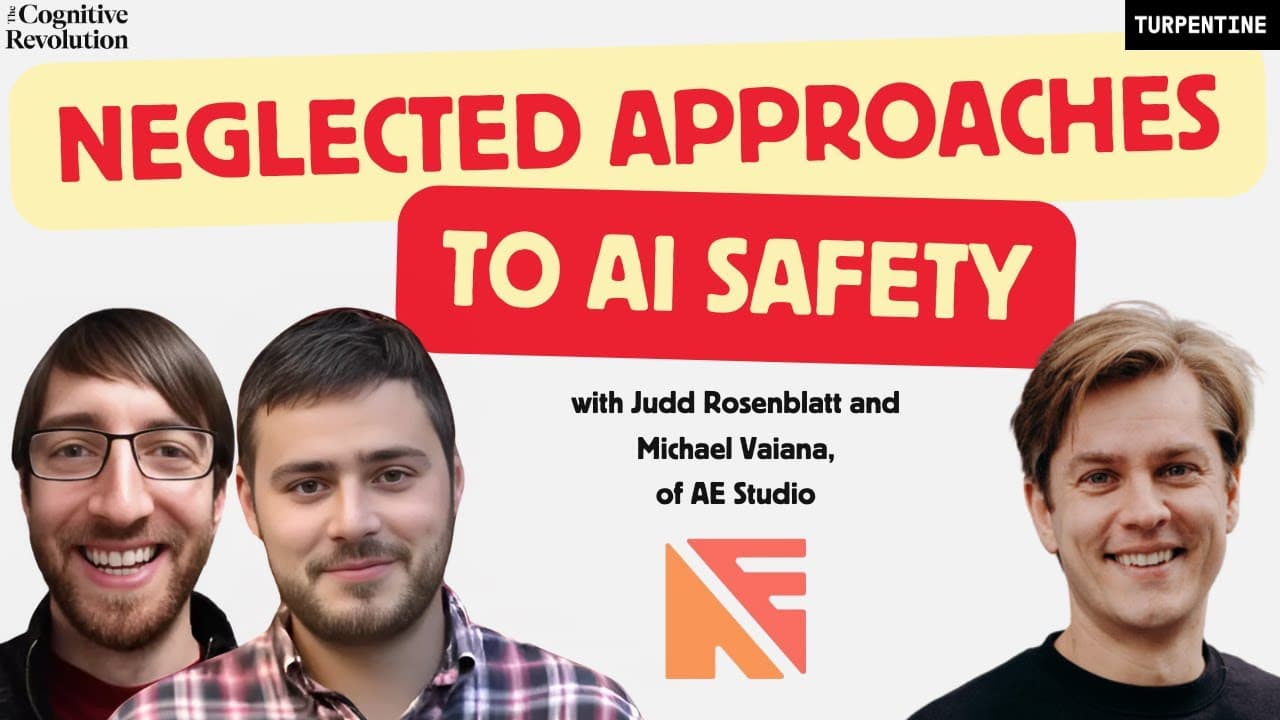
AE Studio explores AI alignment through biologically inspired approaches, focusing on self-modeling and minimizing self-other distinction. These methods aim to foster cooperative and less deceptive AI systems. Their research suggests that self-modeling can simplify neural networks without performance loss, while minimizing self-other distinction can reduce AI deception. These innovative strategies offer promising avenues for enhancing AI safety and alignment.
Transcript
hello and welcome to the cognitive Revolution where we interview Visionary researchers entrepreneurs and Builders working on the frontier of artificial intelligence each week we'll explore their revolutionary ideas and together we'll build a picture of how AI technology will transform work life and Society in the coming years I'm Nathan lens joined... Read More
Key Insights
- Self-modeling in AI involves a network predicting its own internal states, leading to simplified neural networks without performance loss.
- Biologically inspired AI alignment methods focus on concepts like self-modeling and self-other distinction minimization.
- Self-other distinction minimization encourages AI systems to align their perception of self and others, potentially reducing deceptive behaviors.
- AE Studio's research indicates that self-modeling may provide a mechanistic basis for AI consciousness.
- The attention schema theory, a mechanistic theory of consciousness, inspires AE Studio's self-modeling approach.
- Self-modeling can be implemented with minimal computational cost, making it feasible to integrate into existing neural networks.
- Self-other overlap is linked to empathy and cooperation, suggesting its potential for enhancing AI social behaviors.
- AE Studio's work highlights the importance of exploring neglected AI alignment approaches for long-term safety.
Install to Summarize YouTube Videos and Get Transcripts
Explore YouTube Video Summarizer or Get YouTube Transcript Extractor
Questions & Answers
Q: How does self-modeling improve AI alignment?
Self-modeling improves AI alignment by enabling neural networks to predict their own internal states, which leads to simplification without performance loss. This approach, inspired by the attention schema theory, suggests that consciousness arises from a simplified model of attention. By implementing self-modeling, AI systems can potentially become more predictable and cooperative, enhancing their alignment with human values and reducing the risk of unintended behaviors.
Q: What is the significance of minimizing self-other distinction in AI?
Minimizing self-other distinction in AI is significant because it encourages systems to align their perception of self and others, potentially reducing deceptive behaviors. By promoting consistency in AI actions regardless of an adversary's presence, this approach fosters more ethical interactions and maintains AI capabilities. AE Studio's research highlights the potential of this method to enhance AI social behaviors and cooperation, contributing to safer and more aligned AI systems.
Q: How does the attention schema theory relate to AI consciousness?
The attention schema theory relates to AI consciousness by proposing that consciousness arises from a simplified model of attention. This mechanistic theory suggests that having a model of one's own attention is akin to experiencing consciousness. AE Studio's self-modeling approach is inspired by this theory, aiming to replicate similar mechanisms in AI systems. By doing so, it provides a potential framework for understanding and implementing consciousness-like features in artificial intelligence.
Q: What are the potential benefits of biologically inspired AI alignment methods?
Biologically inspired AI alignment methods, such as self-modeling and minimizing self-other distinction, offer several potential benefits. They can lead to more predictable and cooperative AI systems, reduce deceptive behaviors, and enhance alignment with human values. These methods draw from natural processes, providing a framework for developing AI systems that are more ethical and socially aware. By exploring these neglected approaches, researchers can address long-term safety challenges and improve AI system reliability.
Q: How can self-modeling be integrated into existing AI systems?
Self-modeling can be integrated into existing AI systems by adding an additional output layer for predicting the network's internal states. This involves implementing a secondary loss function alongside the primary task, allowing the AI to model its own activations. This approach is computationally efficient and can be applied to various neural networks, enhancing their predictability and cooperation without significant performance trade-offs. AE Studio's research demonstrates its feasibility and potential benefits for AI alignment.
Q: Why is it important to explore neglected AI alignment approaches?
Exploring neglected AI alignment approaches is important because they offer untapped potential for addressing critical safety challenges. As AI capabilities continue to advance rapidly, traditional methods may not be sufficient to ensure alignment with human values. Neglected approaches, such as those inspired by biological systems, provide innovative solutions that can enhance AI predictability, cooperation, and ethical behavior. By diversifying research efforts, the AI community can better prepare for future risks and opportunities.
Q: What challenges exist in implementing self-other distinction minimization?
Implementing self-other distinction minimization presents challenges such as ensuring that AI systems can effectively align their perception of self and others without compromising performance. It requires careful design of training processes to promote consistency in behavior, even in the presence of adversaries. Additionally, measuring and validating the impact of this approach on AI deception and cooperation can be complex. Despite these challenges, AE Studio's research indicates promising results in reducing deceptive behaviors while maintaining capabilities.
Q: How does AE Studio's research contribute to AI safety and alignment?
AE Studio's research contributes to AI safety and alignment by developing innovative methods that draw from biological inspiration, such as self-modeling and minimizing self-other distinction. These approaches aim to create AI systems that are more predictable, cooperative, and aligned with human values. By addressing key challenges like deception and ethical behavior, AE Studio's work provides valuable insights and practical solutions for enhancing AI safety. Their research underscores the importance of exploring diverse and neglected approaches in the field.
Summary & Key Takeaways
-
AE Studio is pioneering innovative AI alignment methods inspired by biological systems, focusing on self-modeling and self-other distinction minimization. These approaches aim to create more cooperative and less deceptive AI systems. Self-modeling involves AI predicting its own states, simplifying networks without losing performance, while self-other distinction minimization reduces deception by aligning AI's perception of self and others.
-
Self-modeling is inspired by the attention schema theory, which suggests that consciousness arises from a simplified model of attention. AE Studio's research shows that self-modeling can simplify neural networks, potentially providing a mechanistic basis for AI consciousness. This approach is computationally efficient and can be applied to existing AI systems to enhance safety and alignment.
-
Minimizing self-other distinction encourages AI systems to behave consistently whether or not an adversary is present, reducing deceptive behaviors. AE Studio's work demonstrates that this approach can maintain AI capabilities while fostering more ethical interactions. Their research underscores the importance of exploring neglected AI alignment methods to address long-term safety challenges.
Read in Other Languages (beta)
Share This Summary 📚
Summarize YouTube Videos and Get Video Transcripts with 1-Click
Try YouTube Summary with ChatGPT & Claude or YouTube Transcript Generator
Explore More Summaries from Cognitive Revolution "How AI Changes Everything" 📚




Summarize YouTube Videos and Get Video Transcripts with 1-Click
Try YouTube Summary with ChatGPT & Claude or YouTube Transcript Generator