What Are Infinity Paradoxes and Gödel's Theorems?
TL;DR
Infinity in mathematics presents mind-bending paradoxes, such as the idea that some infinities are larger than others. Cantor's work on set theory revolutionized mathematics, leading to the development of Gödel's incompleteness theorems, which show that no consistent system can prove all truths. These concepts challenge our understanding of mathematical reality and truth.
Transcript
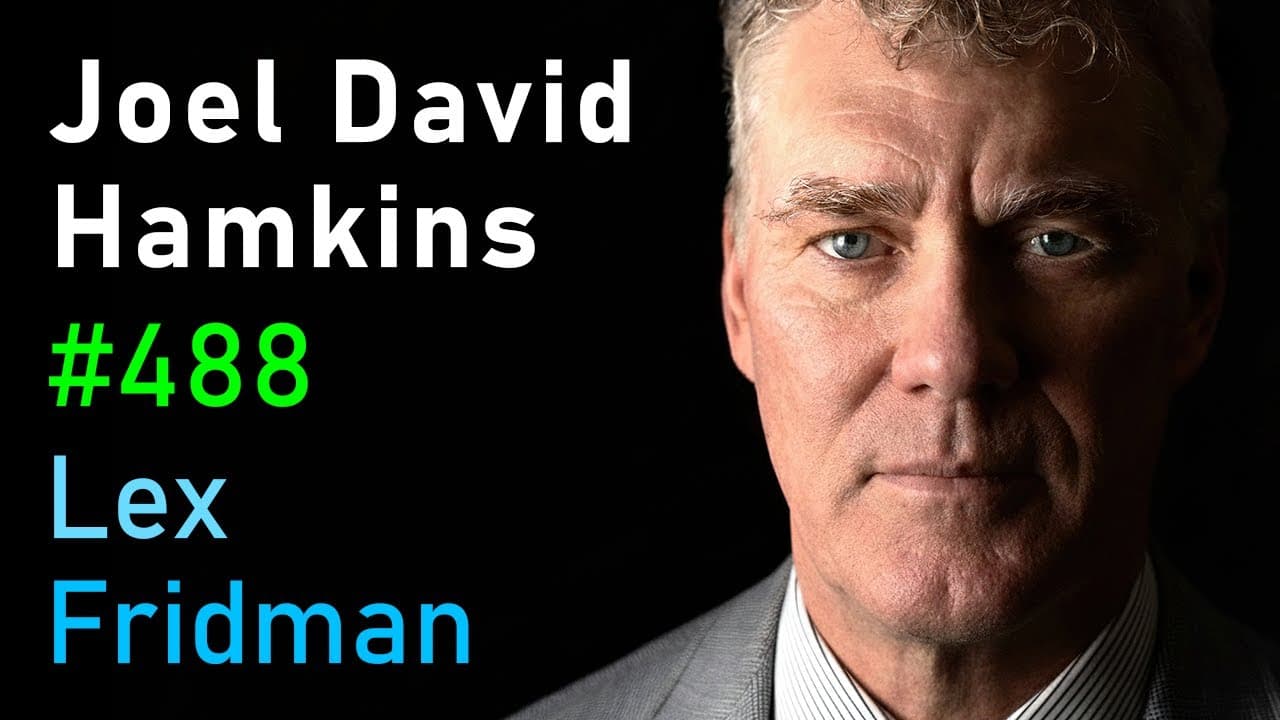
- The following is a conversation with Joel David Hamkins, a mathematician and philosopher specializing in set theory, the foundation of mathematics and the nature of infinity. He is the number one highest rated user on MathOverflow, which I think is a legendary accomplishment. MathOverflow, by the way, is like StackOverflow but for research mathem... Read More
Key Insights
- Infinity in mathematics is not a single concept; some infinities are larger than others, as demonstrated by Cantor's work.
- Cantor's diagonal argument shows that the set of real numbers is uncountable, meaning it is a larger infinity than the set of natural numbers.
- Gödel's incompleteness theorems demonstrate that in any consistent axiomatic system, there are true statements that cannot be proven within the system.
- Hilbert's program aimed to formalize all of mathematics in a consistent system, but Gödel's theorems proved this impossible.
- Set theory serves as a foundational framework for modern mathematics, allowing the construction of mathematical concepts from basic axioms.
- The axiom of choice is a controversial yet fundamental principle in set theory, allowing the selection of elements from sets without a specific rule.
- Russell's paradox highlights the limitations of naive set theory, leading to the development of more rigorous axiomatic systems.
- The Halting Problem, proven undecidable by Turing, shows that there is no algorithm to determine whether all programs will halt, reflecting limits in computation.
Install to Summarize YouTube Videos and Get Transcripts
Explore YouTube Video Summarizer or Get YouTube Transcript Extractor
Questions & Answers
Q: How does Cantor's diagonal argument show that some infinities are larger than others?
Cantor's diagonal argument demonstrates that the set of real numbers is uncountable, meaning it cannot be put into a one-to-one correspondence with the set of natural numbers. By constructing a new real number not on any given list of real numbers, Cantor showed that there are more real numbers than natural numbers, proving that some infinities are indeed larger than others.
Q: What are Gödel's incompleteness theorems?
Gödel's incompleteness theorems state that in any consistent axiomatic system capable of expressing basic arithmetic, there are true statements that cannot be proven within the system. The first theorem shows that such systems are incomplete, while the second theorem states that a system cannot prove its own consistency. These theorems highlight the inherent limitations of formal mathematical systems.
Q: Why was Hilbert's program ultimately unsuccessful?
Hilbert's program aimed to formalize all of mathematics in a consistent axiomatic system and prove its consistency using finitary methods. However, Gödel's incompleteness theorems showed that no such system can be both complete and consistent, as there will always be true statements that cannot be proven. This refuted the possibility of achieving Hilbert's goals, demonstrating the limitations of formal systems.
Q: What role does set theory play in modern mathematics?
Set theory serves as a foundational framework for modern mathematics, providing a way to construct mathematical concepts from basic axioms. It allows mathematicians to define collections of objects as single entities and develop complex structures from simple principles. Set theory underlies much of mathematical logic, enabling the formalization of mathematical ideas and the exploration of infinite sets and their properties.
Q: What is the axiom of choice and why is it controversial?
The axiom of choice is a principle in set theory that states for any collection of non-empty sets, it is possible to select one element from each set, even without a specific rule. It is controversial because it allows for the construction of sets that cannot be explicitly defined, leading to counterintuitive results like the Banach-Tarski paradox. Despite this, it is essential for many mathematical proofs and theorems.
Q: How does Russell's paradox challenge naive set theory?
Russell's paradox shows that naive set theory, which allows for the unrestricted formation of sets, leads to contradictions. The paradox arises when considering the set of all sets that do not contain themselves, which both must and must not contain itself. This contradiction prompted the development of more rigorous axiomatic systems, such as Zermelo-Fraenkel set theory, to avoid such inconsistencies.
Q: What is the Halting Problem and why is it significant?
The Halting Problem is a decision problem that asks whether a given computer program will eventually halt or run indefinitely. Turing proved that there is no algorithm that can solve the Halting Problem for all possible programs, demonstrating the limits of computation. This result is significant because it shows that there are fundamental limitations to what can be computed, impacting fields like computer science and mathematical logic.
Q: How do Gödel's incompleteness theorems impact the philosophy of mathematics?
Gödel's incompleteness theorems challenge the notion of mathematical completeness and certainty, showing that no formal system can capture all mathematical truths. This has profound implications for the philosophy of mathematics, as it suggests that mathematical knowledge is inherently limited and that there may always be truths beyond formal proof. It impacts debates on the nature of mathematical reality and the limits of human knowledge.
Summary & Key Takeaways
-
Infinity in mathematics is a complex concept, with some infinities being larger than others. Cantor's work on set theory revealed that the set of real numbers is uncountable, introducing the idea of different sizes of infinity. This discovery was transformative, leading to significant developments in mathematical logic.
-
Gödel's incompleteness theorems show that no consistent axiomatic system can prove all truths, challenging the notion of mathematical completeness. Hilbert's program, which aimed to formalize all mathematics, was ultimately refuted by Gödel's work, highlighting the inherent limitations in mathematical systems.
-
Set theory provides a foundation for modern mathematics, allowing the construction of mathematical concepts from basic axioms. The axiom of choice, while controversial, is a crucial principle in set theory. Russell's paradox and the Halting Problem further illustrate the complexities and limitations in mathematical logic and computation.
Read in Other Languages (beta)
Share This Summary 📚
Summarize YouTube Videos and Get Video Transcripts with 1-Click
Try YouTube Summary with ChatGPT & Claude or YouTube Transcript Generator
Explore More Summaries from Lex Fridman 📚



Summarize YouTube Videos and Get Video Transcripts with 1-Click
Try YouTube Summary with ChatGPT & Claude or YouTube Transcript Generator