Can Ecological and Info Processing Theories Be Reconciled?
TL;DR
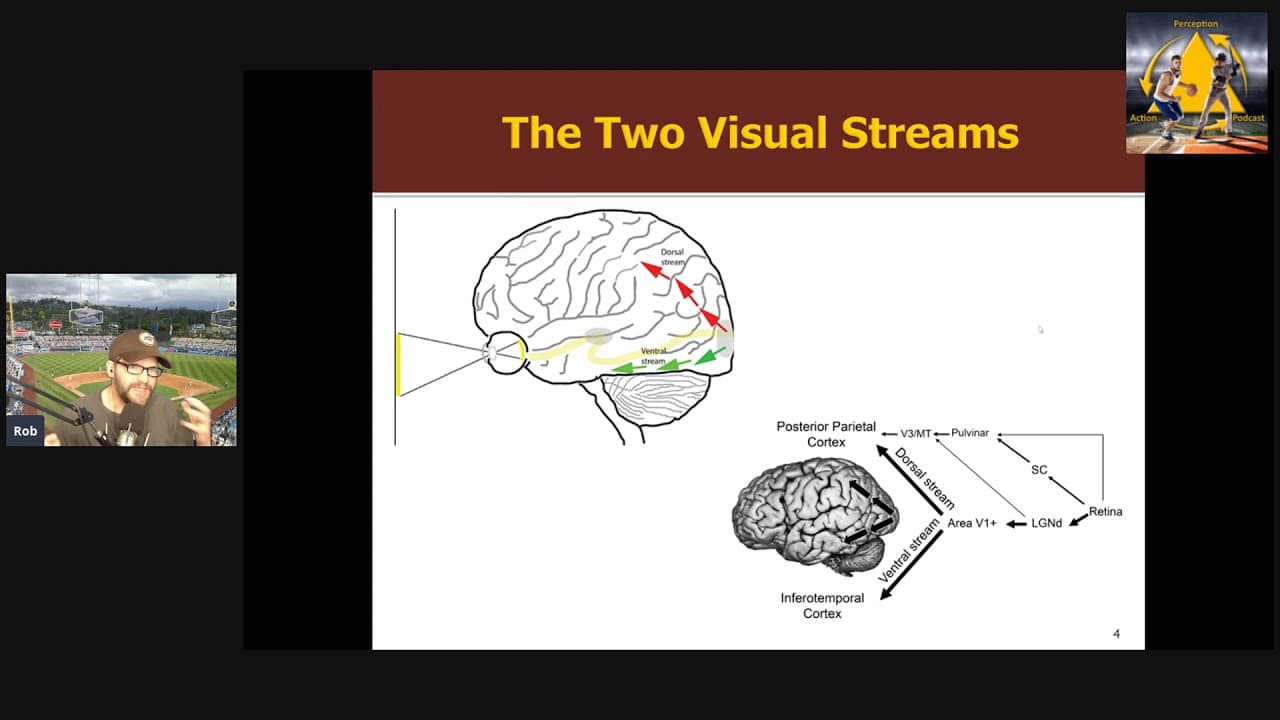
Rob Gray reviews a 2002 paper by Joel Norman that attempts to reconcile ecological and information processing theories of perception-action by mapping them onto the brain's two visual streams. Gray critiques the paper, arguing that the theories are fundamentally incompatible due to different starting points and misinterpretations of ecological psychology.
Transcript
hi everyone this is rob gray from asu and the perception in action podcast again back for another article review this article instead of doing a new research paper this is a fairly old article that was suggested that i have a go at by shane pill on twitter and i thank you very much for its article that i i read many years ago but i haven't revisite... Read More
Key Insights
- The brain has two visual streams: dorsal and ventral, which process visual information differently.
- The dorsal stream is associated with ecological psychology, focusing on perception for action and affordances.
- The ventral stream aligns with information processing, involving conscious object recognition and memory.
- Norman proposes that skill acquisition transitions from ventral (conscious) to dorsal (automatic) processing.
- Critics argue that Norman's model oversimplifies and misinterprets ecological psychology principles.
- Integration of ecological and information processing theories is challenging due to differing foundational assumptions.
- Commentaries on Norman's paper largely disagree with his reconciliation attempt, citing oversimplification.
- Ecological psychology can address object recognition without relying on information processing models.
Install to Summarize YouTube Videos and Get Transcripts
Explore YouTube Video Summarizer or Get YouTube Transcript Extractor
Questions & Answers
Q: How does the brain's two visual streams relate to perception theories?
The brain's two visual streams, dorsal and ventral, are proposed to align with ecological and information processing theories, respectively. The dorsal stream is associated with ecological psychology, focusing on perception for action and affordances. The ventral stream aligns with information processing, involving conscious object recognition, memory, and inferential processing. This mapping is debated, with critics arguing it oversimplifies and misinterprets ecological principles.
Q: What is the main criticism of Norman's reconciliation attempt?
The main criticism of Norman's reconciliation attempt is that it oversimplifies and misinterprets the principles of ecological psychology. Critics argue that the theories of ecological and information processing are fundamentally incompatible due to differing foundational assumptions about the nature of visual information and perception. The integration of these theories is seen as unlikely because they start from different conceptual points.
Q: What role does the ventral stream play in perception according to Norman?
According to Norman, the ventral stream in the brain is associated with information processing theories. It is responsible for conscious object recognition and identification, relying on memory and inferential processes. This stream processes visual information in a way that involves constructing perceptions from cues and learned associations, which is consistent with the principles of information processing models.
Q: How do ecological psychology and information processing differ?
Ecological psychology and information processing theories differ fundamentally in their approach to perception. Ecological psychology, based on Gibson's ideas, emphasizes direct perception and the pickup of affordances without reliance on memory or inferential processes. In contrast, information processing involves constructing perceptions through memory, cues, and learned associations. These differences make integration challenging, as they start from different assumptions about visual information.
Q: Why is the integration of perception theories challenging?
The integration of ecological and information processing theories is challenging because they are based on fundamentally different assumptions about the nature of visual information and perception. Ecological psychology emphasizes direct perception and affordances, while information processing involves memory and inferential processes. These differing starting points make it difficult to reconcile the two theories into a coherent model, as they propose different mechanisms for perception.
Q: What evidence supports the two visual streams hypothesis?
The two visual streams hypothesis is supported by anatomical and functional evidence. The dorsal stream is linked to motion perception and action, while the ventral stream is involved in object recognition and conscious perception. Studies on brain-damaged patients, such as patient DF, show distinct impairments in object recognition versus action, supporting the separation of these streams. However, the hypothesis is debated, particularly regarding how these streams interact and share information.
Q: How does Norman's model relate to skill acquisition?
Norman's model suggests that skill acquisition involves a transition from ventral stream processing, associated with conscious and deliberate control, to dorsal stream processing, which is automatic and unconscious. This transition aligns with ecological principles, where skilled actions become fast and efficient, occurring within the dorsal stream. Critics argue that this model oversimplifies the complexity of skill acquisition and misinterprets ecological psychology principles.
Q: What is the ecological psychology view on object recognition?
Ecological psychology, based on Gibson's ideas, posits that object recognition can occur through direct perception without reliance on memory or inferential processes. It emphasizes the pickup of affordances and invariants in the environment, allowing for recognition and interaction with objects. This view challenges the need for a separate information processing model for object recognition, suggesting that ecological principles can address these perceptual phenomena.
Summary & Key Takeaways
-
Rob Gray critiques Joel Norman's 2002 paper attempting to reconcile ecological and information processing theories through the brain's two visual streams. Gray argues that the theories are fundamentally incompatible due to different foundational assumptions, particularly regarding the nature of visual information and perception.
-
Norman's model suggests that the dorsal stream operates on ecological principles, focusing on action and affordances, while the ventral stream follows information processing principles, involving conscious recognition and memory. Critics, including Gray, argue that this oversimplifies and misinterprets ecological psychology.
-
Commentaries on Norman's paper largely disagree with his attempt, highlighting oversimplification and misinterpretation of ecological principles. Gray concludes that integrating these theories is unlikely, as they start from fundamentally different points and assumptions about visual information.
Read in Other Languages (beta)
Share This Summary 📚
Summarize YouTube Videos and Get Video Transcripts with 1-Click
Try YouTube Summary with ChatGPT & Claude or YouTube Transcript Generator
Explore More Summaries from Rob Gray 📚
Summarize YouTube Videos and Get Video Transcripts with 1-Click
Try YouTube Summary with ChatGPT & Claude or YouTube Transcript Generator