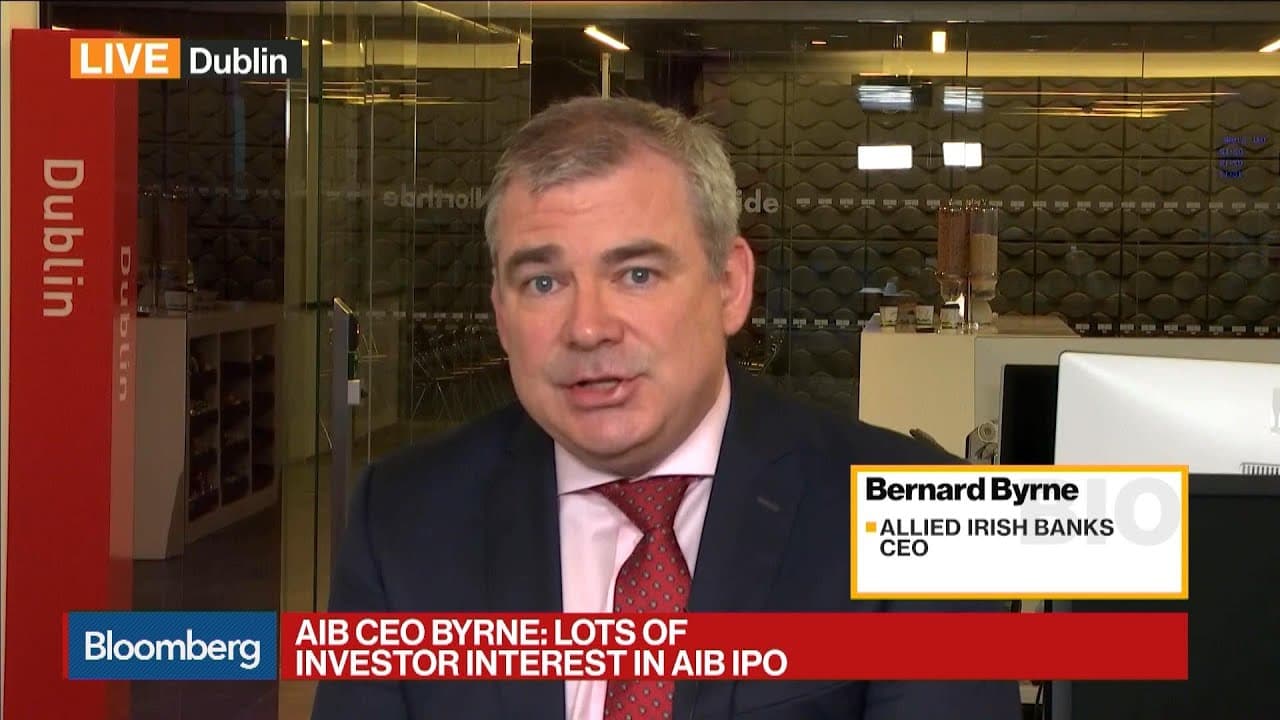
AIB's Byrne Says Market Is in a Sweet Spot for Banks
TL;DR
AIB is poised for an IPO amid favorable market conditions.
Transcript
quarter of a billion back to the government Mr nun in the finance ministry is on the tape in email statement you're ready for an IPO we can smell it let's tie down the timeline will you go for an IPO do you think it's appropriate the Market's in a Sweet Spot will we get it away before the first half so I think the minister uh his statement um from ... Read More
Key Insights
- AIB is preparing for an IPO, with the Irish market currently in a favorable position, potentially launching by Q2.
- The bank has shown strong financial performance, including profitability, net interest margin, and lending growth, supporting its readiness for an IPO.
- Political factors could influence the timing of the IPO, but most parties agree on the benefits of state divestment in banking.
- AIB has significantly reduced its impaired loans from nearly 30 billion to 9 billion over four years, aiming to lower them further.
- There is significant interest in AIB's IPO, with the bank seen as a good investment in the Irish economy, not necessarily requiring cornerstone investors.
- Despite past poor stress test performance, AIB's improved financial metrics and capital restructuring are expected to reassure investors.
- The bank's net interest margin improved to 242 basis points, with growth expected from the housing market and overall economic activity.
- Brexit's impact on AIB has been limited, with some sector-specific effects, but overall business has normalized, and potential relocations to Dublin could benefit the economy.
Install to Summarize YouTube Videos and Get Transcripts
Explore YouTube Video Summarizer or Get YouTube Transcript Extractor
Questions & Answers
Q: What factors are influencing AIB's decision to go for an IPO?
AIB's decision to pursue an IPO is influenced by favorable market conditions in Ireland, strong financial performance, and political considerations. The bank has demonstrated profitability, a strong net interest margin, and growth in lending activity, indicating readiness for an IPO. Additionally, political consensus on the benefits of state divestment in banking supports the decision.
Q: How has AIB managed to reduce its impaired loans?
AIB has significantly reduced its impaired loans from nearly 30 billion to 9 billion over four years through effective restructuring and solutions. The bank employs 1,500 people dedicated to working on solutions for impaired loans, and it is exploring options such as portfolio sales to further reduce the remaining impaired loans, aiming to get well below the European norm.
Q: What is the level of interest in AIB's IPO?
There is a strong level of interest in AIB's IPO, as the bank is seen as a good investment in the Irish economy. AIB is perceived as a reliable barometer for the Irish economy, offering a good income stock with growth potential. The bank does not necessarily require cornerstone investors to move forward with the IPO, as traditional long funds are expected to take positions.
Q: How does AIB address concerns about past stress test performance?
AIB addresses concerns about past stress test performance by highlighting improvements in financial metrics and capital restructuring. The bank generated 1.7 billion in profit and retired a convertible instrument, significantly enhancing its capital position. Investors are expected to understand these changes and recognize the bank's fast-paced improvements, alleviating concerns about past stress test results.
Q: What are the growth expectations for AIB in the current market?
AIB expects growth in the current market, driven by an improved net interest margin and increased economic activity. The bank's net interest margin improved to 242 basis points, with targets set in the mid-twos. The housing market is expected to double in activity over the next three years, and AIB holds a 36% share, contributing to anticipated balance sheet growth.
Q: What impact has Brexit had on AIB's business operations?
Brexit's impact on AIB has been limited, with some initial slowdown in SME activity in the UK market, which constitutes about 10% of AIB's income. However, the market has since normalized, with currency-sensitive businesses experiencing some effects. The Irish economy has seen muted impacts, except for specific sectors like agriculture, which heavily export to the UK.
Q: How might potential bank relocations to Dublin affect AIB?
Potential bank relocations to Dublin could positively impact AIB by enhancing the local financial ecosystem. While Dublin is smaller in scale compared to London, any relocations would be meaningful for the Irish economy. AIB could benefit from increased financial activity and opportunities resulting from these relocations, although a complete relocation of London's financial center is unlikely.
Q: What is AIB's strategy for maintaining growth in a low-interest-rate environment?
In a low-interest-rate environment, AIB focuses on maintaining growth through an improved net interest margin and leveraging economic activity. The bank achieved a net interest margin of 242 basis points and targets mid-twos. Growth is expected from the housing market, projected to double in activity, and overall economic activity, including job creation and increased loan volumes, supports growth.
Summary & Key Takeaways
-
AIB is preparing for an IPO, potentially in Q2, with the Irish market in a favorable position. The bank has demonstrated strong financial performance, including profitability and lending growth, supporting its readiness for an IPO. Political factors could influence the timing, but most parties agree on the benefits of state divestment.
-
AIB has significantly reduced impaired loans from nearly 30 billion to 9 billion over four years and aims to lower them further. There is significant interest in AIB's IPO, with the bank seen as a good investment in the Irish economy, not necessarily requiring cornerstone investors.
-
Despite past poor stress test performance, AIB's improved financial metrics and capital restructuring are expected to reassure investors. The bank's net interest margin improved to 242 basis points, with growth expected from the housing market and overall economic activity. Brexit's impact has been limited, with potential relocations to Dublin possibly benefiting the economy.
Read in Other Languages (beta)
Share This Summary 📚
Summarize YouTube Videos and Get Video Transcripts with 1-Click
Try YouTube Summary with ChatGPT & Claude or YouTube Transcript Generator
Explore More Summaries from Bloomberg Originals 📚






Summarize YouTube Videos and Get Video Transcripts with 1-Click
Try YouTube Summary with ChatGPT & Claude or YouTube Transcript Generator