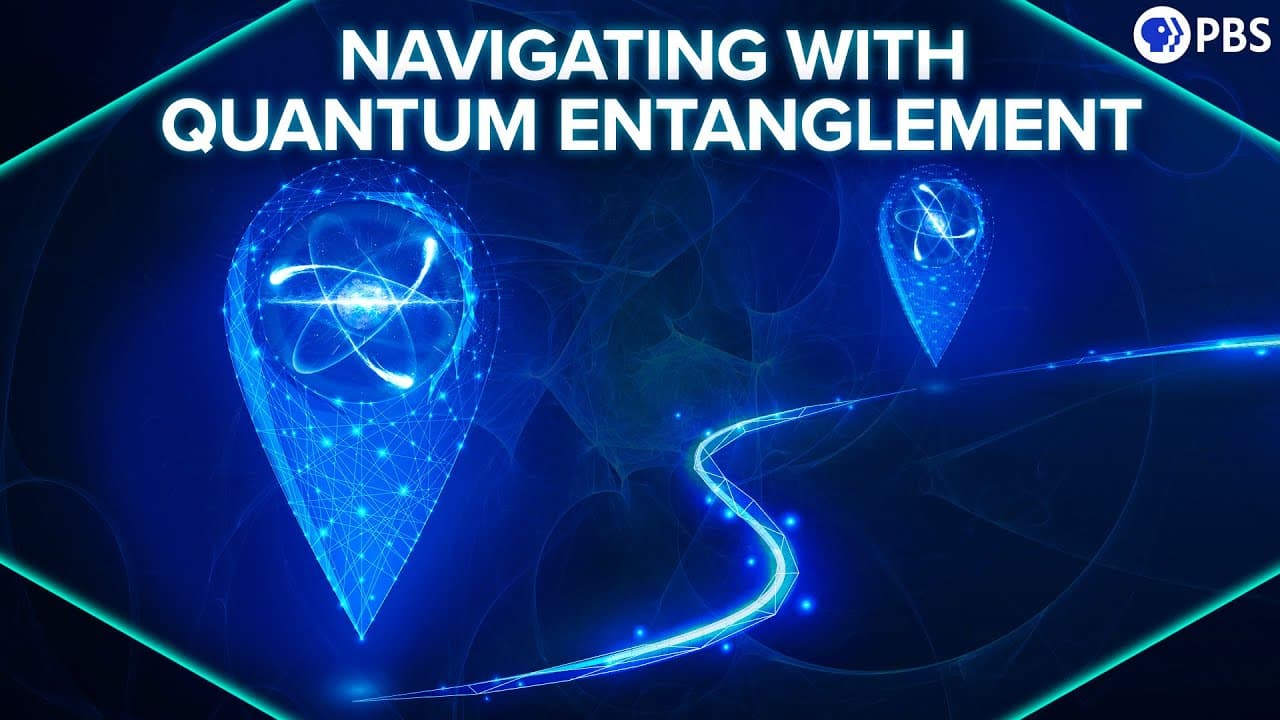
Navigating with Quantum Entanglement
TL;DR
Quantum mechanics may explain birds' magnetic navigation abilities.
Transcript
We often think of quantum mechanics as only affecting only the smallest scales of reality, with classical reality taking over at some intermediate level. But in his 1944 book, What is Life?, the quantum physicist Erwin Schrödinger suggested that “incredibly small groups of atoms, much too small to display exact statistical laws, do play a dominatin... Read More
Key Insights
- Quantum mechanics, typically affecting small scales, might play a role in larger biological systems, like bird navigation, as suggested by Schrödinger.
- Carrier pigeons, like All Alone, demonstrated remarkable navigational abilities during wartime, suggesting a deeper biological mechanism.
- Birds may use Earth's magnetic field for navigation, a concept first proposed in 1855 and evidenced by experiments in the 1960s.
- The radical pair hypothesis suggests that quantum entanglement in birds' eyes could allow them to 'see' magnetic fields.
- Cryptochrome proteins in birds' eyes might facilitate magnetoreception, though direct evidence in birds remains elusive.
- Quantum biology, such as quantum tunneling in enzyme catalysis, shows that quantum effects can influence biological processes.
- The avian compass hypothesis posits that entangled electron spins in radical pairs are sensitive to Earth's magnetic field.
- Quantum biology challenges the notion that quantum effects are restricted to isolated or controlled environments, suggesting biological systems may exploit quantum phenomena.
Install to Summarize YouTube Videos and Get Transcripts
Explore YouTube Video Summarizer or Get YouTube Transcript Extractor
Questions & Answers
Q: How do birds navigate using Earth's magnetic field?
Birds are thought to navigate using Earth's magnetic field through a process called magnetoreception. This involves detecting the magnetic field's orientation, though not its polarity, to determine direction. The radical pair hypothesis suggests that quantum entanglement in birds' eyes allows them to 'see' the magnetic field, aiding in navigation.
Q: What is the radical pair hypothesis?
The radical pair hypothesis posits that birds can perceive Earth's magnetic field through entangled electron spins in radical pairs. When light hits certain proteins in birds' eyes, it creates radical pairs with entangled electrons. These spins oscillate between singlet and triplet states, influenced by the magnetic field, potentially allowing birds to navigate.
Q: What role does quantum mechanics play in bird navigation?
Quantum mechanics may play a crucial role in bird navigation through the radical pair mechanism. This involves quantum entanglement of electron spins in radical pairs, allowing birds to detect Earth's magnetic field. Such quantum effects in biological systems challenge the traditional view that quantum phenomena are restricted to small, isolated environments.
Q: What evidence supports the idea of quantum biology in birds?
The idea of quantum biology in birds is supported by the radical pair hypothesis and experiments showing cryptochromes' sensitivity to weak magnetic fields. While direct evidence in birds is lacking, studies on fruit flies and the theoretical framework suggest that quantum entanglement could play a role in magnetoreception, hinting at quantum effects in biological processes.
Q: How does the Earth's magnetic field influence radical pairs?
Earth's magnetic field influences radical pairs by affecting the oscillation between singlet and triplet states of entangled electron spins. Even the weak geomagnetic field can alter the time spent in these states if the field's orientation is correct, potentially affecting chemical reactions and allowing birds to perceive the magnetic field's orientation.
Q: What is the significance of cryptochrome in bird navigation?
Cryptochrome is a protein in birds' eyes that may facilitate magnetoreception. When light hits cryptochrome, it generates radical pairs with entangled electrons. The spins of these electrons can be influenced by Earth's magnetic field, potentially affecting chemical reactions and enabling birds to navigate by perceiving the magnetic field's orientation.
Q: Why is quantum biology considered controversial?
Quantum biology is considered controversial because it challenges the traditional view that quantum effects are limited to isolated, controlled environments. The idea that biological systems, like birds, can exploit quantum phenomena such as entanglement and tunneling in warm, complex environments is still debated, with some hypotheses lacking direct experimental evidence.
Q: What are some other examples of quantum biology?
Other examples of quantum biology include quantum tunneling in enzyme catalysis and the hypothesis of long-range quantum coherence in photosynthesis. While some cases, like enzyme catalysis, are well-supported, others, such as quantum entanglement in brain microtubules influencing consciousness, remain highly contentious and are subjects of ongoing research.
Summary & Key Takeaways
-
Quantum mechanics, often associated with small scales, might influence bird navigation, as posited by Schrödinger. Birds like carrier pigeons exhibit remarkable navigational abilities, potentially explained by quantum phenomena. This challenges the traditional view of quantum effects being limited to isolated systems.
-
Birds may navigate using Earth's magnetic field, a concept supported by historical proposals and experiments. The radical pair hypothesis suggests that quantum entanglement in birds' eyes allows them to perceive magnetic fields, though direct evidence in birds is still lacking.
-
Cryptochrome proteins in birds' eyes might facilitate magnetoreception, indicating a form of quantum biology. This suggests that quantum effects can influence biological processes, challenging the idea that such effects are restricted to highly controlled environments.
Read in Other Languages (beta)
Share This Summary 📚
Summarize YouTube Videos and Get Video Transcripts with 1-Click
Try YouTube Summary with ChatGPT & Claude or YouTube Transcript Generator
Explore More Summaries from PBS Space Time 📚
Summarize YouTube Videos and Get Video Transcripts with 1-Click
Try YouTube Summary with ChatGPT & Claude or YouTube Transcript Generator