Is Quantum Tunneling Faster than Light? | Space Time | PBS Digital Studios
TL;DR
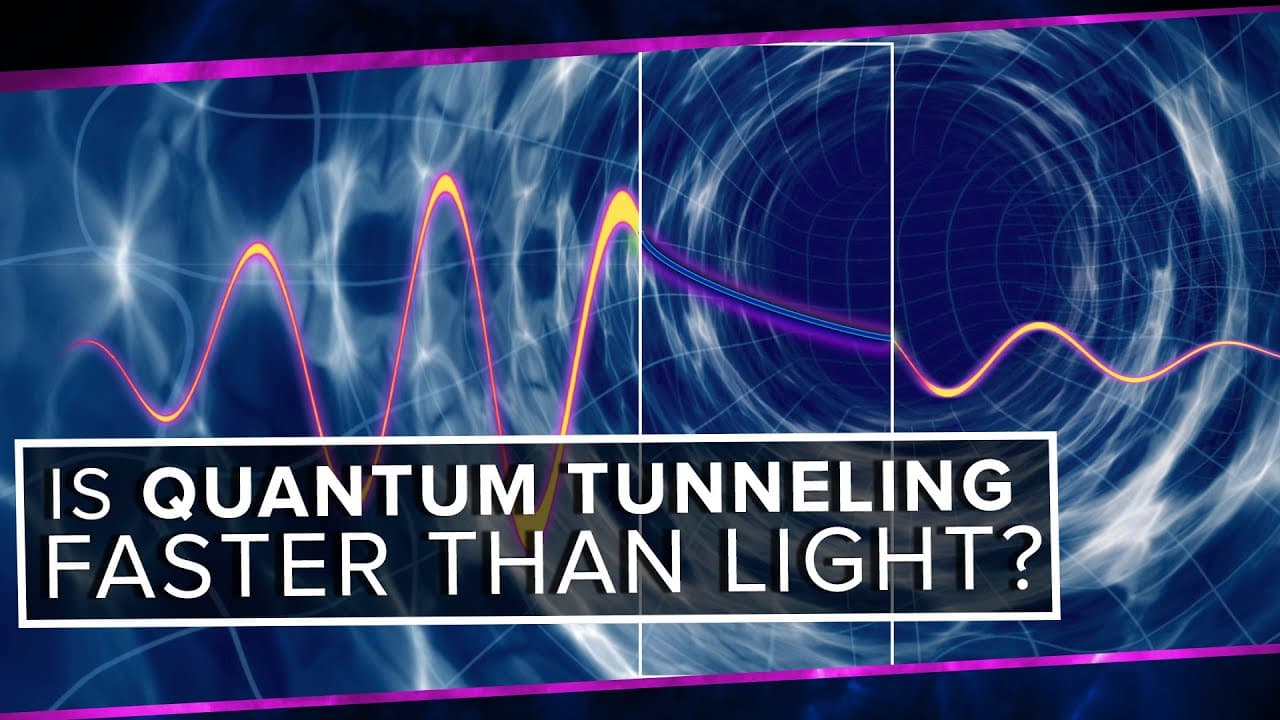
Quantum tunneling may allow particles to move faster than light.
Transcript
This episode is sponsored by Audible. Wouldn't it be nice to be everywhere at once? According to quantum mechanics you are, at least a little bit. [THEME MUSIC] Quantum mechanics is a spectacularly weird theory. One of its basic tenets is that certain properties of an object are fundamentally uncertain. They don't hold well-defined values, but inst... Read More
Key Insights
- Quantum mechanics suggests particles exist in multiple states until observed, described by a wave function and probability distribution.
- The de Broglie wavelength determines how well-defined an object's position is, with smaller wavelengths indicating more precise positions.
- Quantum tunneling allows particles to pass through barriers, crucial for processes like radioactive decay and nuclear fusion.
- Experiments suggest tunneling particles may move faster than light, challenging relativity at the quantum level.
- Photon tunneling experiments use interferometers to measure potential faster-than-light travel, requiring precise path length adjustments.
- Quantum entanglement is key to measuring photon travel time differences, hinting at faster-than-light influences.
- The Heisenberg uncertainty principle underlies quantum tunneling, allowing instantaneous motion within quantum limits.
- Macroscopic objects adhere to a speed limit, but quantum mechanics suggests possible causality violations at the quantum scale.
Install to Summarize YouTube Videos and Get Transcripts
Explore YouTube Video Summarizer or Get YouTube Transcript Extractor
Questions & Answers
Q: What is the basic premise of quantum mechanics discussed in the video?
Quantum mechanics suggests that particles exist in multiple states simultaneously, described by a probability distribution and wave function. This means that until a quantum object interacts with something, all possible states are equally real, although not necessarily equally likely. This fundamental uncertainty is a key aspect of quantum theory.
Q: How does the de Broglie wavelength relate to an object's position?
The de Broglie wavelength is a measure of how well-defined an object's position is. A large wavelength indicates a highly uncertain position, while a small wavelength suggests a more precise position. This concept applies to subatomic particles and affects their behavior, including phenomena like quantum tunneling.
Q: What is quantum tunneling and why is it important?
Quantum tunneling is a phenomenon where particles pass through barriers they seemingly shouldn't be able to cross. It's crucial for processes like radioactive decay and nuclear fusion, as it allows particles to move in ways that classical physics doesn't permit. This tunneling is a fundamental aspect of quantum mechanics.
Q: What did experiments reveal about the speed of quantum tunneling?
Experiments suggest that particles undergoing quantum tunneling may move faster than light, which challenges the principles of relativity. This apparent faster-than-light travel occurs at the quantum level, where traditional speed limits don't apply, and is difficult to measure due to the need for precise instruments.
Q: How are photon tunneling experiments conducted?
Photon tunneling experiments use interferometers to measure potential faster-than-light travel. These setups involve sending individual photons along paths and blocking one path with a barrier. The experiment measures the arrival time of photons to determine if tunneling photons arrive earlier than expected, indicating faster-than-light travel.
Q: What role does quantum entanglement play in measuring tunneling effects?
Quantum entanglement is crucial for measuring photon travel time differences in tunneling experiments. It ensures that the path lengths in the interferometer are precisely equal, allowing for accurate detection of any discrepancies in photon arrival times, which might suggest faster-than-light influences.
Q: How does the Heisenberg uncertainty principle relate to quantum tunneling?
The Heisenberg uncertainty principle underlies quantum tunneling by allowing for instantaneous motion within quantum limits. This principle suggests that particles have inherent uncertainties in their positions and velocities, enabling phenomena like tunneling and challenging the classical understanding of causality and speed limits.
Q: What implications does quantum mechanics have for macroscopic objects?
While macroscopic objects adhere to a well-defined speed limit, quantum mechanics presents a different set of rules at the quantum level. It suggests that within quantum limits, particles can exhibit behaviors like instantaneous motion and potential causality violations, offering new insights into the nature of space-time and reality.
Summary & Key Takeaways
-
Quantum mechanics posits that particles exist in multiple states simultaneously, described by a wave function. The de Broglie wavelength determines position precision, affecting how particles behave, including quantum tunneling, where particles pass through barriers, essential for nuclear processes.
-
Experiments indicate that quantum tunneling may allow particles to travel faster than light, challenging relativity. Photon tunneling experiments using interferometers can measure these effects, relying on quantum entanglement to ensure precise measurements.
-
The Heisenberg uncertainty principle allows for instantaneous motion at the quantum level, suggesting potential causality violations. While macroscopic objects follow a speed limit, quantum mechanics offers a different set of rules, with implications for space-time understanding.
Read in Other Languages (beta)
Share This Summary 📚
Summarize YouTube Videos and Get Video Transcripts with 1-Click
Try YouTube Summary with ChatGPT & Claude or YouTube Transcript Generator
Explore More Summaries from PBS Space Time 📚



Summarize YouTube Videos and Get Video Transcripts with 1-Click
Try YouTube Summary with ChatGPT & Claude or YouTube Transcript Generator