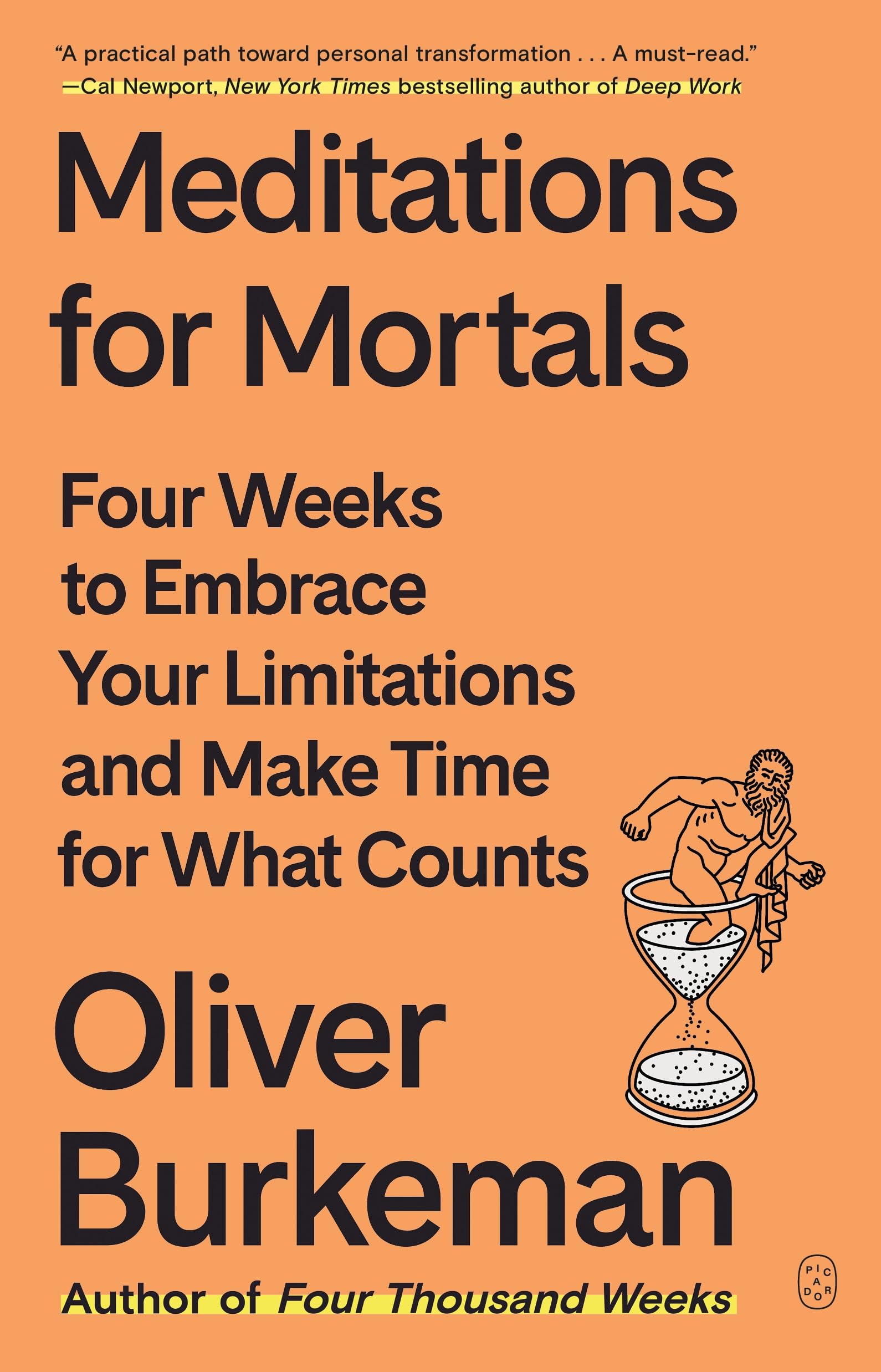
Meditations for Mortals: Four Weeks to Embrace Your Limitations and Make Time for What Counts
About This Book
Meditations for Mortals is Oliver Burkeman's four-week guide to what he calls imperfectionism: a freeing outlook built on the conviction that you will never get on top of everything, and that this is good news rather than a problem to solve. The book opens from a deliberately bracing premise — that life as a finite human is worse than you think. You'll only ever do a fraction of what you'd like, you'll never feel fully in control, and the day when everything is finally "out of the way" is never coming. Once you accept this, anxiety subsides and you can pour your limited time into the handful of things that truly count.
Drawing on thinkers like Hartmut Rosa, Sartre, Heidegger and Marcus Aurelius, Burkeman argues that modern life's drive to make reality ever more controllable drains it of resonance — the capacity to be moved and absorbed — and fuels burnout. His antidote is to act now.
Key moves recur throughout the daily chapters:
- Just do the thing once, today, rather than becoming "the kind of person" who does it.
- Treat your to-do list as a menu and your reading backlog as a river, not a bucket.
- Keep a "done list" to escape the feeling of daily "productivity debt."
- Befriend the tasks you avoid (Loomans's "gnawing rats") instead of attacking them.
- Accept that there are no solutions, only trade-offs — freedom in limitation, not freedom from it.
- Set quantity goals to defeat perfectionism, and ask "What if this were easier than I assumed?"
The closing weeks turn to letting go, releasing the need to manage others' emotions, and recognizing that this, here and now, is real life — not a rehearsal for some future when everything finally runs smoothly.
Key Takeaways
- 1.The most empowering move is to just do something today, as a one-off, rather than embarking on the counterproductive project of becoming the kind of person who does it.
- 2.There are no solutions, only trade-offs — freedom isn't freedom from limitation but the freedom to choose which price you're willing to pay.
- 3.Modern life's drive to make reality ever more controllable drains it of resonance, fueling burnout and a sense of deadness; meaning requires reciprocity, not domination.
- 4.Replace "productivity debt" with a done list and treat your to-do list as a menu to pick from, not a container to empty.
- 5.Perfectionism is best defeated by setting quantity goals — eight hundred words, ten ideas, fifteen minutes — so the part of you that craves control has something harmless to do.
- 6.Avoidance grows problems; befriend the tasks you fear by turning toward them rather than attacking or fleeing them.
- 7.This, here and now — before everything is sorted out — is real life, not a rehearsal for some future when things finally run smoothly.
Top Highlights
the driving force of modern life is the fatally misguided idea that reality can and should be made ever more controllable
Highlighted by 5 people
The main point – though it took me years to realize it – is to develop the willingness to just do something, here and now, as a one-off, regardless of whether it’s part of any system or habit or routine.
Highlighted by 5 people
The greatest achievements often involve remaining open to serendipity, seizing unplanned opportunities, or riding unexpected bursts of motivation. To be delighted by another person, or moved by a landscape or a work of art, requires not being in full control.
Highlighted by 4 people
Rather than fueling the fantasy of one day bringing everything under control, this book takes it as a given that you’ll never get on top of everything. It starts from the position that you’ll never feel fully confident about the future, or fully understand what makes other people tick – and that there will always be too much to do.
Highlighted by 3 people
It was a central insight of the philosopher Jean-Paul Sartre that there’s a secret comfort in telling yourself you’ve got no options, because it’s easier to wallow in the ‘bad faith’ of believing yourself trapped than to face the dizzying responsibilities of your freedom.
Highlighted by 3 people
Whatever choice you make, so long as you make it in the spirit of facing the consequences, the result will be freedom in the only sense that finite humans ever get to
Highlighted by 3 people
‘One never notices what has been done; one can see only what remains to be done.’ – MARIE CURIE
Highlighted by 3 people
As the philosopher Byung-Chul Han has written, ‘we produce against the feeling of lack.’
Highlighted by 3 people
The first is to treat your to-read pile like a river, not a bucket.
Highlighted by 3 people
The second piece of advice is to resist the urge to stockpile knowledge.
Highlighted by 3 people
AI Review
Across 9 readers' highlights, Glasp's analysis finds unusually strong consensus around a single liberating idea — just do the thing today — with passages on finitude, trade-offs and "bad faith" drawing the heaviest highlighting. The resonance and quotability of the marked passages point to a book readers found genuinely transformative.
Pros
- +Strong reader consensus on a memorable core insight: prioritize just doing something now over becoming "the kind of person who does that sort of thing"
- +Reframes limitation as freedom in limitation rather than a deficiency, which readers found liberating
- +Concrete, portable practices: the done list, treating the to-do list as a menu, reading as a river, befriending avoided tasks
- +Philosophically rich, weaving Sartre, Heidegger, Rosa and Marcus Aurelius into everyday advice
- +Designed as a four-week daily retreat, encouraging lived practice rather than passive reading
Cons
- −The deliberately bleak framing ("life is worse than you think") may feel discouraging before it feels freeing
- −Ideas overlap heavily with Burkeman's earlier work and with broader contemplative self-help, so some will find them familiar
- −Offers shifts in perspective rather than a concrete system, which readers seeking a step-by-step method may find frustrating
Glasp AI analysis based on highlights from 9 readers.
Who Should Read This
Ideal for the insecure overachiever who wakes up already feeling in "productivity debt," the chronic planner who keeps adopting new systems that fizzle, and the perfectionist paralyzed by exacting standards. Knowledge workers, creatives, people-pleasers, and anyone burned out by the pressure to optimize everything will find it especially resonant. Readers of Burkeman's Four Thousand Weeks, or of Stoic and contemplative self-help, will feel at home — though those wanting a step-by-step productivity blueprint should look elsewhere.
Frequently Asked Questions
What is Meditations for Mortals about?
Who is this book for?
What are the key lessons?
Is it worth reading?
What does Burkeman mean by 'productivity debt'?
How is this different from typical productivity books?
What does 'befriending your rats' mean?
How to Apply What You Read
- 1.Start a done list today: record completed tasks as the day goes on instead of tracking an ever-growing to-do list.
- 2.Choose one thing you genuinely care about and do fifteen minutes of it right now, with no commitment to ever repeat it.
- 3.Ask "What if this were easier than I assumed?" before any task you've been treating as a looming obstacle.
- 4.Limit intense mental focus to three or four hours on your peak work, and treat your reading backlog as a river you sample, not a bucket you must empty.
- 5.Withdraw your attention from causes and notifications outside the few battles you've deliberately chosen to fight.
Discussion Questions
- Q1.Which of your current "long-term projects" might actually be a way of avoiding doing the scary thing today?
- Q2.Where in your life are you living in "bad faith," telling yourself you have no options when you're really avoiding the responsibility of choosing?
- Q3.What would change if you accepted that getting through all your tasks is not merely hard but genuinely impossible?
- Q4.Think of a task you keep avoiding — what would it mean to befriend it rather than attack or flee it?
- Q5.How much of your busyness is driven by a need to feel like a "minimally acceptable member of society" rather than genuine desire?
- Q6.Whose emotions are you over-managing, and what might it free up if you let them own their own feelings?
- Q7.If this — your unfinished, imperfect present — is real life rather than preparation for it, what would you do differently today?
Recommended Books
Revisit Your Highlights, Deepen Your Understanding
Import your Kindle highlights to review, organize, and share the ideas that matter most to you.
Get the free browser extension