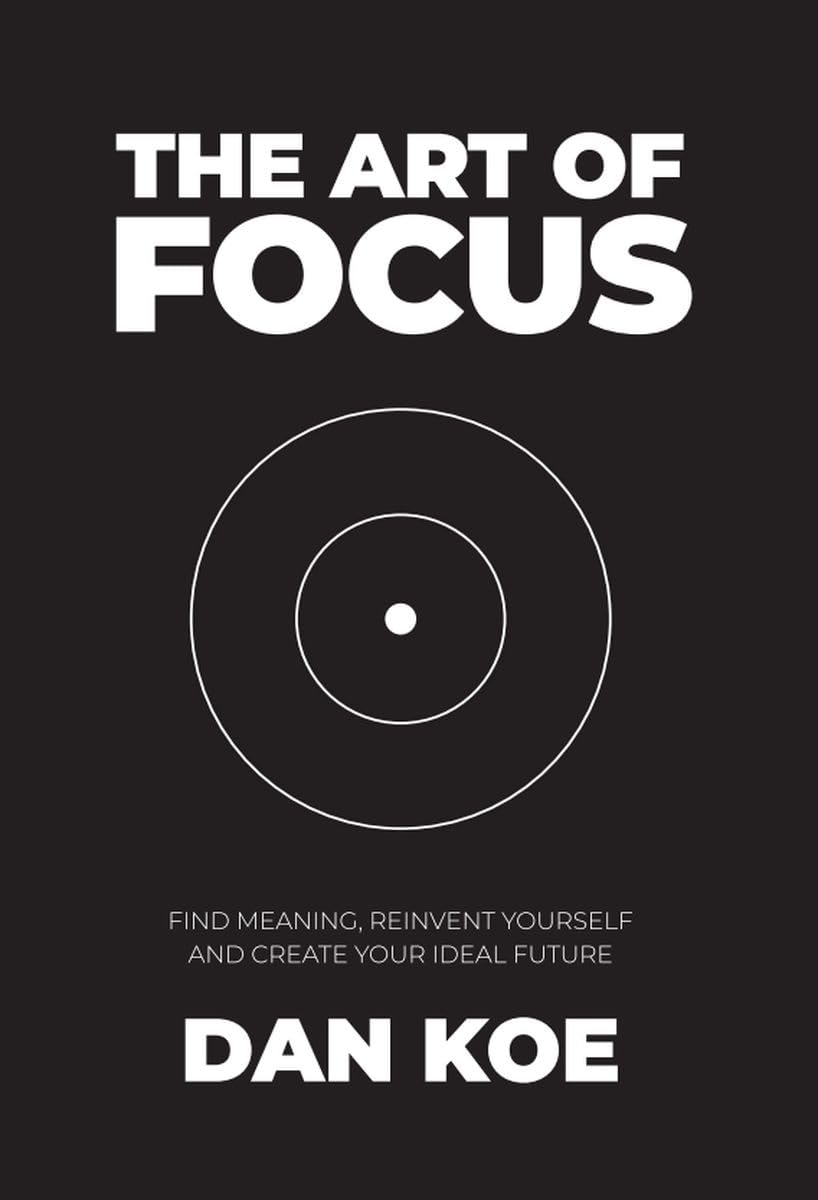
The Art of Focus: Find Meaning, Reinvent Yourself and Create Your Ideal Future
About This Book
The Art of Focus argues that attention is the single most valuable and controllable resource you possess — "Focus is attention with intention" — and that mastering it is the path to a meaningful, self-authored life. The book's central warning is that if you don't consciously choose where your focus goes, society will choose for you: "If you don't have a plan, society does, and it's been planning your life for decades."
The author builds the argument across several interlocking ideas:
- The default path vs. a self-created life. Without conscious goals, you inherit the beliefs, habits, and "safe and secure" route marketed to you at birth.
- Systems over willpower. You must build and maintain systems across four domains — health, wealth, relationships, and happiness — because entropy will erode any system left untended.
- Problems as fuel. Life is an "infinite game" of solving an ever-evolving string of problems, starting with the superficial ones "staring at you in the mirror."
- Conscious focus states. Narrow focus produces flow and deep work; open focus produces creativity and peace. The unconscious versions produce stress and feeling lost.
Running underneath is a philosophical layer: radical acceptance ("things aren't supposed to be anything other than what they are"), the idea that feelings are feedback, the self as a constructed bundle of mental "strings," and the universe as nested wholes and parts. The closing chapters turn practical and entrepreneurial — crafting a valuable message, a distribution medium, and results-oriented skills (writing, speaking, marketing, sales) to transfer value to others. The throughline: train focus like a muscle, build systems, solve real problems, and you will create rather than discover your purpose and ideal future.
Key Takeaways
- 1.Focus is your only controllable resource — it shapes your thoughts, emotions, actions, and ultimately your future self.
- 2.If you don't define your own goals, society assigns them to you; the default path quietly plans your life for decades.
- 3.Build and maintain systems in health, wealth, relationships, and happiness, because every system decays to entropy without sustained attention.
- 4.You create your passion and purpose by investing mental energy into a goal — you don't passively discover it.
- 5.Life is an infinite game of solving an ever-evolving string of problems; fall in love with that process and start with the problems staring at you in the mirror.
- 6.Radical acceptance — seeing things as they are rather than as they "should be" — dissolves the tension between expectation and reality.
- 7.Treat feelings as feedback, not as your master; follow a disturbance back to its source to gain clarity.
Top Highlights
When people hear the word “work,” they cower in fear, hoping that the weekend will extend a few days so they can cuddle up on the couch until further notice. When people hear the word “rest,” they grab an unhealthy snack, pour some fermented grape juice, and fall into a vegetative state, hoping that they never have to come out.
Highlighted by 2 people
Focus is attention with intention.
Highlighted by 2 people
Your focus is the only thing you have control over. It influences your thoughts, emotions, actions, and the positive or negative direction of them all. If you do not focus on one thing that brings awareness to the next, you may not create the chain reaction that allows for certain thoughts, emotions, and actions. Your long-term and short-term options are created by when, where, on what, how, and why you focus your attention.
Highlighted by 2 people
Clarity is your savior, and we must prioritize programming, maintaining, and evolving the systems our mind runs on. This is done through self-generated goals, creating a path to achieve them, and focusing on solving the problems that arise without being consumed by distractions.
Highlighted by 2 people
Experimentation leads to true experience, and true experience is how you differentiate yourself in the marketplace.
Highlighted by 2 people
Open-mindedness is how you explore the depths, while most people exist on the surface.
Highlighted by 2 people
The space between expectation and reality is tension, pain, and suffering. We often interpret a situation as difficult when it isn’t supposed to be any other way.
Highlighted by 2 people
The greatest artists, thinkers, and scientists did not impact the world by performing the same repetitive, manual, and replaceable tasks day after day. They prioritized rest, sought to expand their minds, and prioritized creativity to solve big problems.
Highlighted by 2 people
Tactical stress is the conscious decision to break out of your familiar routine, put yourself in a do-or-die situation, and realize that the only thing stopping you from reaching the next level is fear.
Highlighted by 2 people
Focus is a muscle, and success is reserved for those that train it.
Highlighted by 2 people
AI Review
Based on Glasp's analysis of highlights from 5 readers, this is a resonant, highly quotable book whose ideas about focus, systems, and self-authored purpose clearly struck a chord. Reader attention clustered heavily around its practical mindset frameworks.
Pros
- +Strong central thesis that focus is your only controllable resource, repeated and reinforced throughout
- +Highly quotable, aphoristic prose — many passages drew multiple highlighters
- +Actionable systems framework across health, wealth, relationships, and happiness
- +Reframes purpose as something you create through invested energy, not passively discover
- +Blends practical productivity with deeper philosophy on identity, acceptance, and entropy
- +Closing entrepreneurial chapters connect inner work to creating real-world value
Cons
- −Abstract and sometimes mystical passages (consciousness, "strings," the Universe) may feel ungrounded to some readers
- −Deliberately avoids step-by-step prescriptions, which can frustrate readers wanting a concrete plan
- −Ideas overlap heavily, so the message can feel repetitive across chapters
Glasp AI analysis based on highlights from 5 readers.
Who Should Read This
This book suits self-improvement readers, creators, solopreneurs, and anyone feeling stuck on the conventional "default path" of school, job, and retirement. It will resonate with people drawn to systems thinking, deep work, and personal philosophy who want frameworks rather than quick-fix hacks. Readers comfortable with abstract, sometimes spiritual reflection on consciousness, identity, and entropy will gain the most. It is less ideal for those seeking rigorous scientific citations or a tightly prescriptive step-by-step program, since the author deliberately pushes you to forge your own method.
Frequently Asked Questions
What is The Art of Focus about?
Who is this book for?
What are the key lessons?
Is it worth reading?
What does the author mean by the default path?
How does the book define focus?
Does the book offer practical exercises?
How to Apply What You Read
- 1.Journal your daily activities for 10 minutes across morning, afternoon, and night to identify unconscious "time and energy suckers."
- 2.Write an anti-vision: every outcome, person, and environment you don't want, why, and how you'll avoid it — then reverse-engineer the life you do want.
- 3.Set goals in all four domains (health, wealth, relationships, happiness) and break each into yearly, monthly, weekly, and daily steps.
- 4.Structure your day to fill your mind (reading, learning), empty your mind (walks, training, contemplation), and use your mind (creation, output, focus).
- 5.Design a distraction-free environment — wake earlier, stick to a routine, and protect focused work sessions as the lever that changes your life fastest.
Discussion Questions
- Q1.Which goals in your life are genuinely yours, and which were assigned to you by the "default path"?
- Q2.Do you agree that passion is created through invested effort rather than discovered? How does that change how you act?
- Q3.Where in your life are you fighting reality instead of practicing radical acceptance, and what would change if you stopped?
- Q4.The book says "feelings are feedback." When was the last time a negative feeling pointed you to a real problem worth solving?
- Q5.How well do your current systems hold up against entropy in health, wealth, relationships, and happiness?
- Q6.The author argues comparison can be a tool for clarity rather than something to demonize. Do you find that liberating or risky?
- Q7.What "superficial" problem are you sweeping under the rug, and how might solving it bring you closer to your deeper goals?
Recommended Books




Revisit Your Highlights, Deepen Your Understanding
Import your Kindle highlights to review, organize, and share the ideas that matter most to you.
Get the free browser extension