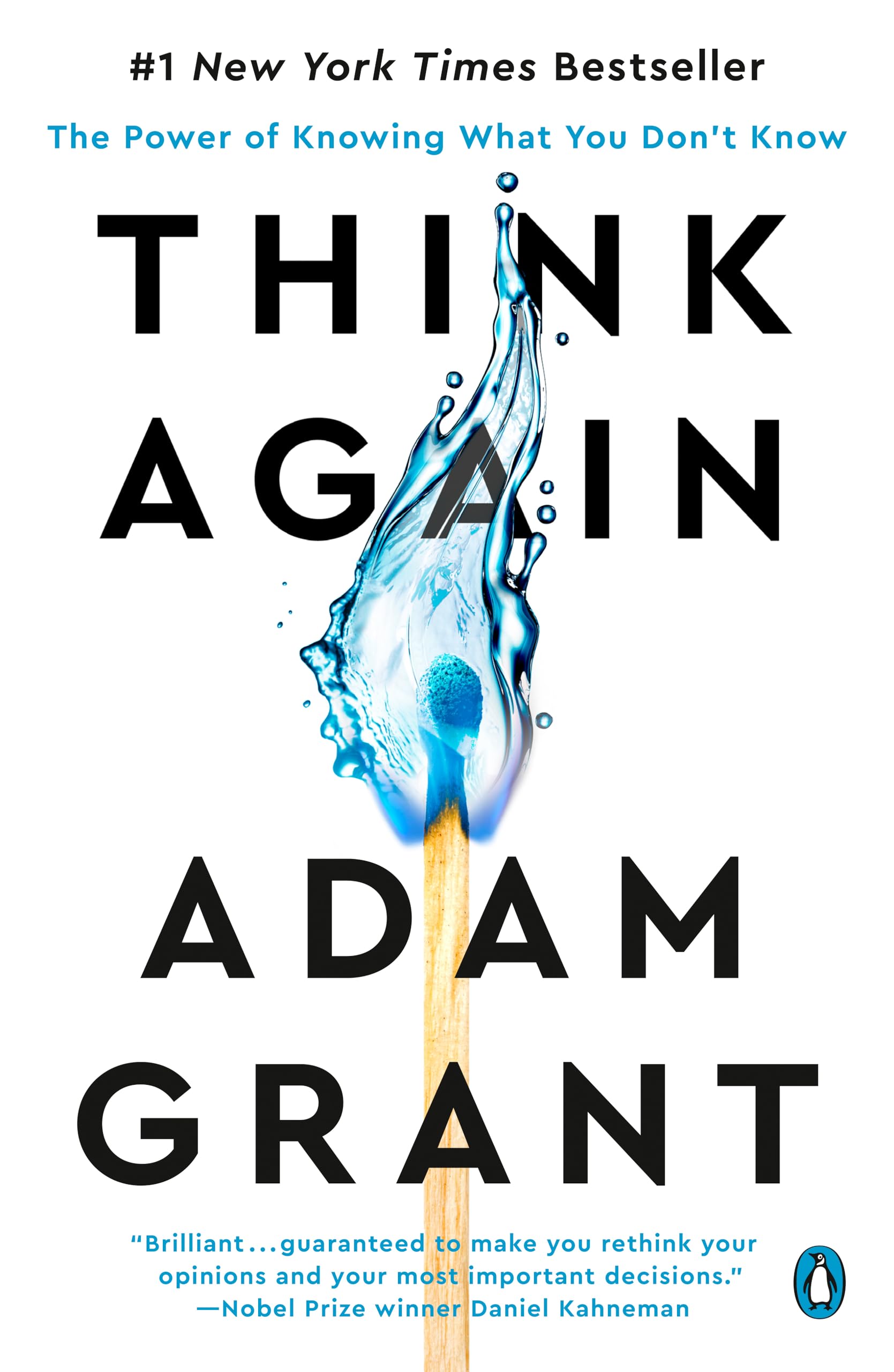
Think Again: The Power of Knowing What You Don't Know
About This Book
Adam Grant's Think Again argues that in a turbulent, fast-changing world, the ability to rethink and unlearn matters more than raw intelligence. We are "mental misers" who favor the comfort of conviction over the discomfort of doubt, clinging to old beliefs because questioning ourselves feels threatening to our identity. Grant's central framework contrasts three defensive mindsets—preacher, prosecutor, and politician—with the ideal scientist mode, in which we treat our opinions as hypotheses to be tested rather than truths to defend.
The book unfolds across three levels.
- Individual rethinking: cultivating confident humility, escaping the overconfidence trap of "Mount Stupid," and learning to experience the joy of being wrong.
- Interpersonal rethinking: persuading others by listening, asking questions, finding common ground, arguing about "how" rather than "why," and building a challenge network rather than just a support network.
- Collective rethinking: fostering psychological safety, process accountability, and "learning zones" in organizations, schools, and communities.
A recurring theme is that identity should rest on values, not opinions—you can detach your present from your past and your beliefs from your sense of self. Grant draws on research about superforecasters who update their views often, expert negotiators who ask more questions and present fewer reasons, and motivational interviewing techniques that help people find their own motivation to change. The closing chapters extend rethinking to careers and happiness, urging readers to throw out rigid ten-year plans, schedule "life checkups," and pursue meaning over the direct chase for happiness. The overarching message: if knowledge is power, knowing what we don't know is wisdom.
Key Takeaways
- 1.In a turbulent world, the ability to rethink and unlearn can matter more than raw intelligence or being right the first time.
- 2.We resist changing our minds because beliefs become tied to identity; the fix is to anchor your self-concept in values, not opinions.
- 3.Avoid preaching, prosecuting, and politicking—adopt scientist mode, treating opinions as hypotheses to be tested with evidence.
- 4.Confident humility—believing in your capacity to learn while doubting your current answers—is the sweet spot that fuels growth.
- 5.Beware the overconfidence trap: progressing from novice to amateur creates a false sense of mastery ("Mount Stupid").
- 6.To persuade, listen and ask questions rather than pile on reasons; acknowledge common ground and let people's own curiosity do the work.
- 7.Build a challenge network of thoughtful critics, and in organizations combine psychological safety with process accountability to create a learning zone.
Top Highlights
anchor your sense of self in flexibility rather than consistency.
Highlighted by 4 people
Visions for change are more compelling when they include visions of continuity.
Highlighted by 4 people
Questioning ourselves makes the world more unpredictable.
Highlighted by 3 people
we’re mental misers: we often prefer the ease of hanging on to old views over the difficulty of grappling with new ones.
Highlighted by 3 people
Under acute stress, people typically revert to their automatic, well-learned responses.
Highlighted by 3 people
We’re swift to recognize when other people need to think again.
Highlighted by 3 people
As we think and talk, we often slip into the mindsets of three different professions: preachers, prosecutors, and politicians.
Highlighted by 3 people
sacred beliefs are in jeopardy: we deliver sermons to protect and promote our ideals.
Highlighted by 3 people
Thinking like a scientist involves more than just reacting with an open mind. It means being actively open-minded. It requires searching for reasons why we might be wrong—not for reasons why we must be right—and revising our views based on what we learn.
Highlighted by 3 people
Visions for change are more compelling when they include visions of continuity. Although our strategy might evolve, our identity will endure.
Highlighted by 3 people
AI Review
Across 13 readers' highlights, Think Again shows remarkably strong consensus around its core ideas, with the preacher-prosecutor-politician-scientist framework and "confident humility" resonating most. A highly quotable, research-grounded book that readers found genuinely actionable.
Pros
- +Memorable central framework of preacher, prosecutor, politician, and scientist mindsets
- +Strong emphasis on confident humility as a teachable, balanced state
- +Highly quotable, aphoristic prose that readers highlighted heavily
- +Concrete persuasion tactics: asking "how" not "why," presenting fewer reasons, building a challenge network
- +Extends rethinking from the individual to teams, schools, and society
- +Closes with 30 practical action items readers can apply immediately
Cons
- −Some readers pushed back on specific claims (one note simply marked a passage "Wrong")
- −The idea that constant rethinking can be more burdensome is underexplored
- −Heavy reliance on anecdotes and studies may feel familiar to readers of similar pop-psychology titles
Glasp AI analysis based on highlights from 13 readers.
Who Should Read This
Ideal for leaders, managers, and entrepreneurs who must adapt strategy under uncertainty, and for teachers, negotiators, and anyone in persuasion-heavy roles. It suits readers drawn to behavioral science and self-improvement who want practical tools for changing their own minds and others'. No prior psychology background is needed. Especially valuable for perfectionists, strong-minded experts prone to overconfidence, and people facing career or life pivots who want to question entrenched assumptions rather than double down on them.
Frequently Asked Questions
What is Think Again about?
Who is the book for?
What are the key lessons?
What is the preacher-prosecutor-politician-scientist framework?
How does the book say we should persuade others?
What is confident humility?
Is Think Again worth reading?
How to Apply What You Read
- 1.Keep a list of factors or evidence that would change your mind, and revisit your opinions when reality shifts.
- 2.Build a challenge network of disagreeable givers who will question your thinking, and tell them why you respect their pushback.
- 3.Argue about "how" rather than "why," present your few strongest reasons, and ask "What evidence would change your mind?" in disagreements.
- 4.Schedule a life or career checkup once or twice a year to rethink your aspirations instead of clinging to a rigid ten-year plan.
- 5.Practice the joy of being wrong: when you discover a mistake, treat it as learning and resist defending your past self.
Discussion Questions
- Q1.Which mindset—preacher, prosecutor, or politician—do you slip into most often, and what triggers it?
- Q2.Can you recall a recent time you changed your mind? What made that possible, and how did it feel?
- Q3.How do you currently define your identity: by your beliefs or by your values? Would shifting toward values change how you handle disagreement?
- Q4.Who is in your challenge network, and who is merely in your support network? What's missing?
- Q5.Is there a risk that constant rethinking becomes burdensome or paralyzing? Where should one draw the line?
- Q6.Where in your life might you be at the "summit of Mount Stupid," mistaking experience for expertise?
- Q7.How could your workplace, family, or community better combine psychological safety with accountability to encourage rethinking?
Recommended Books



Revisit Your Highlights, Deepen Your Understanding
Import your Kindle highlights to review, organize, and share the ideas that matter most to you.
Get the free browser extension