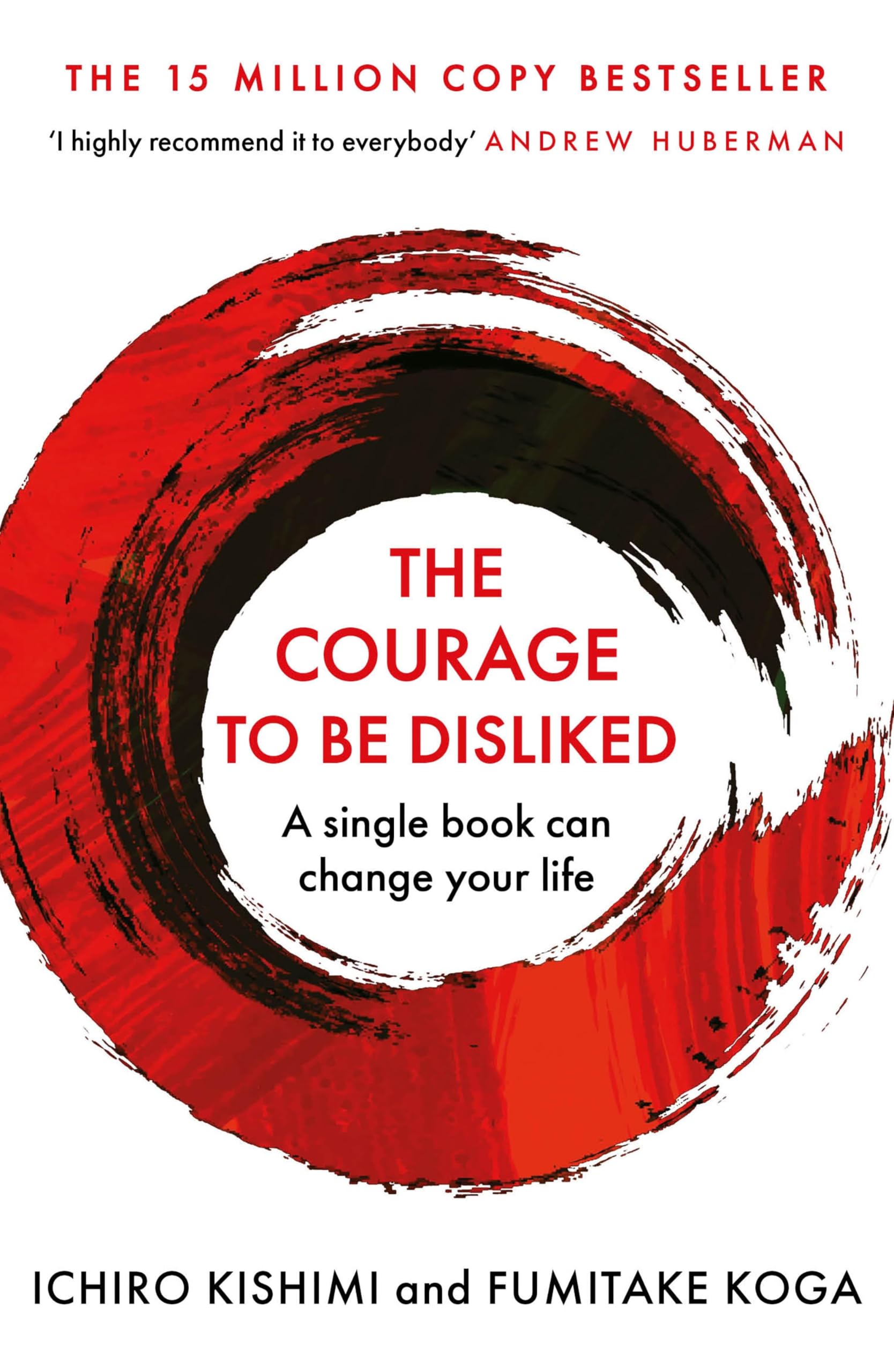
The Courage To Be Disliked: The life changing multi-million copy global bestseller (Courage To series Book 1)
About This Book
Presented as a dialogue between a philosopher and a skeptical young man, The Courage To Be Disliked introduces Adlerian psychology as a practical philosophy of freedom, responsibility, and interpersonal courage. The most-highlighted passages show the book’s central claim clearly: people are not determined by their past, their trauma, or their inborn traits, but by the meaning they give those experiences and by the goals they choose now. In that sense, life is not something handed to us; it is something we choose.
From there, the book argues that much suffering comes from avoiding change. We keep familiar habits and identities because they feel safer than uncertainty, even when they make us unhappy. Adler’s answer is courage: the courage to change one’s “lifestyle,” to stop using inferiority, anger, or misfortune as excuses, and to act despite fear.
A second major thread is the idea that all problems are interpersonal relationship problems. Inferiority feelings arise through comparison, competition turns others into enemies, and the desire for recognition traps us in other people’s expectations. The book repeatedly contrasts vertical, judgmental relationships with horizontal, equal ones built on respect, gratitude, and encouragement.
Its most practical teaching is the separation of tasks:
- Ask, “Whose task is this?”
- Do not intrude on other people’s tasks.
- Do not let others intrude on yours.
This becomes the basis for freer relationships, less resentment, and less fear of being disliked.
Finally, the book moves toward Adler’s positive ideal: community feeling. Human flourishing means becoming self-reliant while living in harmony with society, seeing others as comrades, accepting oneself honestly, trusting others, and finding worth through contribution rather than praise. Its conclusion is simple but demanding: happiness is not victory, approval, or specialness, but the felt sense that you are of use to others while living as yourself, here and now.
Key Takeaways
- 1.Your past does not mechanically determine your future; the meaning you assign to experience shapes how you live now.
- 2.Change requires courage because familiar unhappiness often feels safer than uncertain growth.
- 3.Feelings of inferiority are not inherently bad; they become valuable when they push you toward effort rather than excuses.
- 4.Most recurring suffering is tied to interpersonal relationships, especially comparison, competition, and approval-seeking.
- 5.Separation of tasks is a practical boundary tool that reduces resentment, control, and anxiety about others’ judgments.
- 6.Seeking recognition can make you live by other people’s standards, while contribution creates a steadier sense of worth.
- 7.Happiness comes less from being special than from self-acceptance, equal relationships, and the feeling that others are your comrades.
Top Highlights
but what use one makes of that equipment.’
Highlighted by 7 people
‘No experience is in itself a cause of our success or failure. We do not suffer from the shock of our experiences—the so-called trauma—but instead we make out of them whatever suits our purposes. We are not determined by our experiences, but the meaning we give them is self-determining.’
Highlighted by 6 people
When we try to change our lifestyles, we put our great courage to the test.
Highlighted by 6 people
You were so afraid of interpersonal relationships that you came to dislike yourself. You’ve avoided interpersonal relationships by disliking yourself.
Highlighted by 6 people
First, there are two objectives for behaviour: to be self-reliant and to live in harmony with society. Then, the objectives for the psychology that supports these behaviours are the consciousness that I have the ability and the consciousness that people
Highlighted by 6 people
something you choose yourself, and you are the one who decides how you live.
Highlighted by 5 people
‘People are not driven by past causes, but move toward goals that they themselves set’—that
Highlighted by 5 people
Your unhappiness cannot be blamed on your past or your environment. And it isn’t that you lack competence. You just lack courage. One might say you are lacking in the courage to be happy.
Highlighted by 5 people
in your life up to this point, it should have no bearing at all on how you live from now on.’ That you, living in the here and now, are the one who determines your own life.
Highlighted by 5 people
Adler is saying that the pursuit of superiority and the feeling of inferiority are not diseases, but stimulants to normal, healthy striving and growth. If it is not used in the wrong way, the feeling of inferiority, too, can promote striving and growth.
Highlighted by 5 people
AI Review
Glasp’s AI analysis of 14 reader highlights suggests strong resonance: readers repeatedly marked the book’s core Adlerian ideas on choice, courage, inferiority, and task separation. The highlight patterns indicate a highly quotable, perspective-shifting book, though some claims may feel overly absolute or confrontational to certain readers.
Pros
- +Highly resonant core ideas on freedom, responsibility, and change
- +Memorable framework of separation of tasks
- +Strong challenge to approval-seeking and people-pleasing
- +Practical reframing of inferiority as fuel for growth
- +Clear emphasis on relationships, community, and contribution
- +Dialogue format makes philosophical ideas accessible
Cons
- −Some arguments about trauma and teleology may feel too sweeping
- −The philosopher’s tone can come across as blunt or reductive
- −Less evidence-based than readers expecting modern clinical psychology may want
Glasp AI analysis based on highlights from 14 readers.
Who Should Read This
This book is especially useful for readers stuck in self-doubt, people-pleasing, comparison, or difficult relationships with parents, partners, coworkers, or friends. It fits fans of practical philosophy, counseling-minded psychology, and mindset books more than clinical psychology textbooks.
It will resonate with:
- people who feel trapped by their past
- professionals dealing with conflict or approval-seeking
- readers exploring boundaries and self-worth
- anyone interested in Adlerian or constructivist-style thinking
No prior psychology background is required, but you should be open to a direct, sometimes provocative challenge to familiar beliefs about trauma, anger, and responsibility.
Frequently Asked Questions
What is the book about?
Who is it for?
What are the key lessons of the book?
Is it worth reading?
What does the book mean by separation of tasks?
Why does the book say freedom is being disliked?
How does the book define happiness?
How to Apply What You Read
- 1.Ask “Whose task is this?” the next time you feel responsible for someone else’s reaction or approval.
- 2.Identify one area where you are using your past, environment, or a weakness as an excuse to avoid action.
- 3.Replace one comparison-with-others habit with a comparison to your ideal self and next step forward.
- 4.Practice horizontal communication by expressing gratitude or respect instead of praise, blame, or anger.
- 5.Choose one concrete act of contribution this week that does not depend on recognition or applause.
Discussion Questions
- Q1.Which idea in the book is more liberating than it first appears, and which feels too extreme?
- Q2.How convincing is the book’s rejection of trauma as a determining cause of present unhappiness?
- Q3.When does separating tasks create healthy boundaries, and when might it risk emotional detachment?
- Q4.What is the difference between self-acceptance and self-affirmation in practice?
- Q5.How much of your self-worth currently depends on recognition from others?
- Q6.Do competition and comparison motivate growth, or do they mainly create anxiety and resentment?
- Q7.What would change in your life if you truly acted as though some people’s dislike was not your task?
Recommended Books







Revisit Your Highlights, Deepen Your Understanding
Import your Kindle highlights to review, organize, and share the ideas that matter most to you.
Get the free browser extension