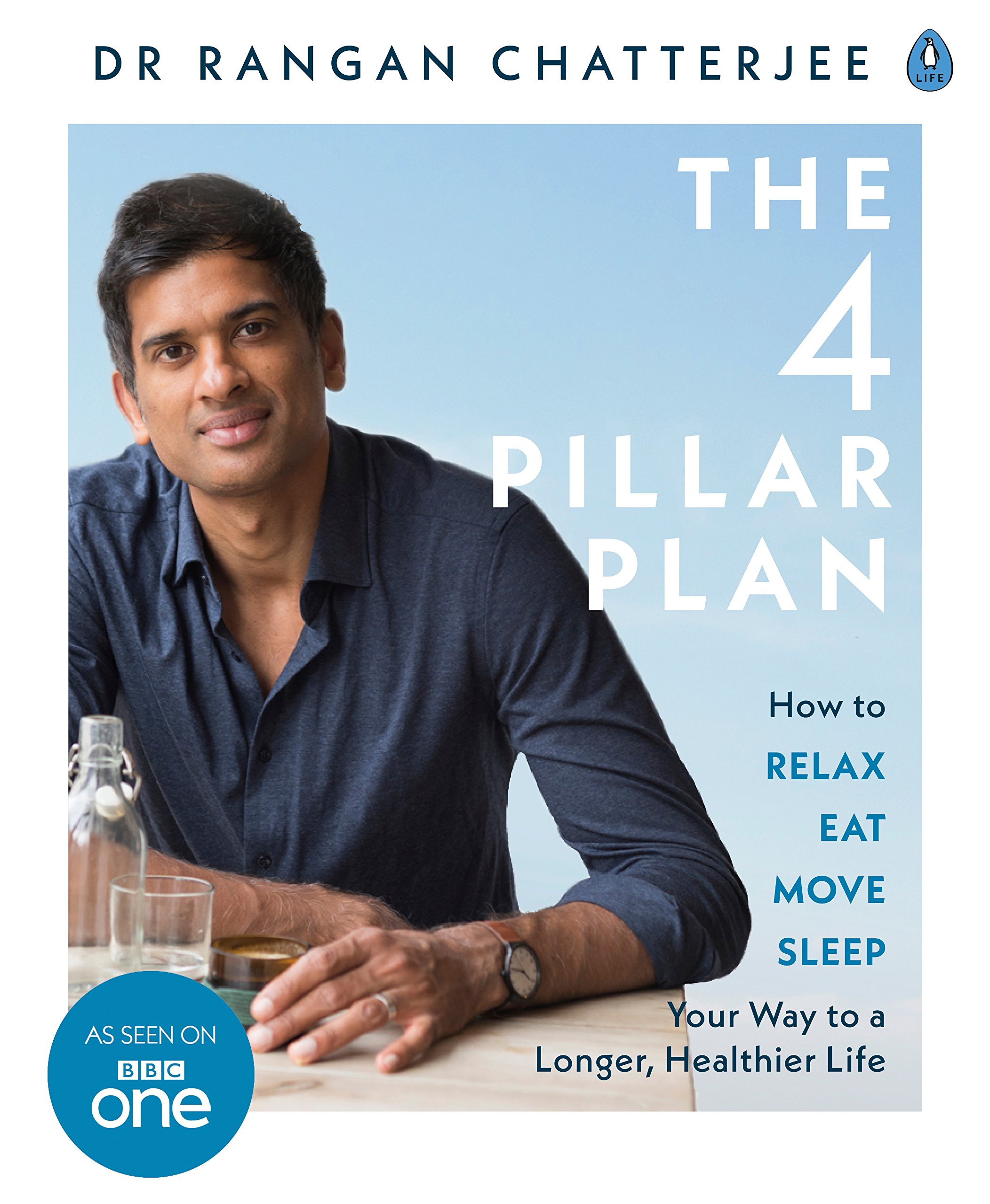
The 4 Pillar Plan: How to Relax, Eat, Move and Sleep Your Way to a Longer, Healthier Life

The 4 Pillar Plan: How to Relax, Eat, Move and Sleep Your Way to a Longer, Healthier Life

2 highlighters49 highlights3.6 / 5
Paul Tayloranchal1919

About This Book

The 4 Pillar Plan by Dr Rangan Chatterjee argues that the majority of modern health problems are driven not by germs or genetics but by lifestyle. As a practising GP, the author noticed that most patients' ailments stem from how they live: chronically stressed, over-busy, sedentary, poorly fed and sleep-deprived. His solution is built around four interlocking pillars — Relax, Eat, Move and Sleep — each with five practical interventions. The goal is balance across all four, not perfection in any single one.

Under Relax, he explains the dangers of chronic stress, including the "cortisol steal" (where cortisol production drains the cholesterol needed for other hormones) and how stress shuts down digestion and immune function. He offers tools like 3–4–5 breathing and daily selfish "me-time" away from screens.

Under Eat, he champions time-restricted feeding — eating within a twelve-hour window — and warns against blood-sugar spikers like white bread. Fasting periods let the liver repair cells and burn fat.

Under Move, he reframes fitness around frequent low-intensity movement (breaking up sitting), strength training (anti-inflammatory, builds mitochondria and insulin receptors) and short HIIT bursts that boost BDNF and shed dangerous visceral fat. He includes glute-activating mobility movements.

Under Sleep, he draws on Matt Walker's research, explaining how sleep enables autophagy and clears beta-amyloid. His central recommendations: get morning daylight and always wake at the same time.

Throughout, the message is consistent — small, sustainable changes compound. Light is described as a drug, sitting as lethal, and movement as medicine no pharmaceutical can match. The book is less a rigid program than a flexible toolkit for redesigning daily habits toward a longer, healthier life.

Key Takeaways

Top Highlights

What have you done today to make someone else happy? What has somebody else

Highlighted by 2 people

Firstly, there’s something called the ‘cortisol steal’. All the hormones in your body are made from the same basic stuff, which is called LDL cholesterol. We naturally have a limited supply of LDL cholesterol and, when things are working well, it all gets portioned off nicely, so there’s enough to go round – enough to make your oestrogen, your progesterone, your testosterone – and also your cortisol. But what happens when you’re in one of these long-term states of stress is that cortisol steals the other hormones’ LDL cholesterol. Because it thinks you’re under attack, and in a state of crisis, your body prioritizes the generation of cortisol. It thinks you need it to cope with the drama and just makes more and more of it. That upsets the finely tuned balance of hormones in your body.

But it’s not just the cortisol steal we need to be concerned about. When we’re constantly stressed, our bodies respond as if we’re under attack, going into a kind of emergency mode and diverting resources to the processes most necessary for survival. To take just one example, digestion switches off. When you’re dealing with a lion flying at your head, the efficient processing of lunch is just an unnecessary diversion. A more pressing need is the generation of instant energy in your bloodstream. In the short term this is great, but when this becomes long term it creates a problem. It can lead to weight gain and sleep disruption and exhausts the immune system. Remember, all of this is happening because the body thinks it’s under attack all day.

The results confirm what other scientific research has been suggesting for years – that depression itself can be a symptom of biological changes in the body that are driven by inflammation. This is why antidepressants don’t work for these patients.

For those times when you do crave a sweet treat, try one of these alternatives: Drink two large glasses of water (some find sparkling water especially helpful) Do some deep breathing (such as 3–4–5 breathing, see here) Distract yourself with a complex task that focuses your attention elsewhere Have a piece of fruit Eat a handful of nuts

Get into the habit of eating all of your food within a twelve-hour time window.

why time-restricted feeding (TRF) assists our repair processes. However, one likely mechanism that’s been proposed is that when we don’t eat for several hours, the liver stops secreting glucose into the bloodstream and instead uses it to repair cell damage. The liver is simultaneously stimulated to release enzymes that break down stored fat and cholesterol. Therefore, during our fasting period, the liver is helping to repair our bodies and burn off fat!

And these are by no means the only benefits of restricting our hours of eating. An incredible American neurologist, Professor Dale Bredesen, has actually managed to reverse memory loss in early-Alzheimer’s patients by taking a multipronged approach that has, as an essential component, regular twelve-hour fasts. Yet more compelling research is coming out of the lab of Dr Satchidananda Panda, a biologist at the Salk Institute for Biological Studies in San Diego. Dr Panda is a passionate promoter of the idea that restricting the timing of our food intake may be an extremely effective public health stratagem. He argues that simply trying to eliminate unhealthy foods and restrict calories hasn’t really proved successful – so perhaps a limited eating window might work better. If all that wasn’t enough, early studies are showing that when animals are given exactly the same diets over varying time periods, the metabolic effects on their body are significantly different – they put on less fat and have larger muscle mass when they are fed over a shorter period. This is hugely exciting. Human trials are under way.

It is possible to enhance these benefits by shortening our eating window even further,

When I stopped eating during the evenings I felt more energetic, had better sleep and was just generally a little lighter in myself. I came to think of that evening craving for food as having a kind of ‘itchy mouth’. That’s become the way we talk about it in my house now. Am I really hungry? Or do I just have an itchy mouth?

AI Review

3.6/ 5

Based on Glasp's analysis of highlights from 2 readers, this is a clear, actionable lifestyle-medicine guide whose practical movement, eating and sleep tips resonated most. The limited highlighter pool means consensus signal is modest.

Pros

  • +Clear, memorable four-pillar framework covering Relax, Eat, Move and Sleep
  • +Emphasis on small, sustainable habits over perfection
  • +Practical tools like 3–4–5 breathing, time-restricted eating and consistent wake times
  • +Strong science-backed sections on HIIT, strength training and sleep
  • +Reframes everyday behaviors (sitting, screen use, meal timing) in actionable ways

Cons

  • Heavy emphasis on detailed exercise movement instructions that are hard to follow in text form
  • Some claims are presented confidently despite ongoing or early-stage research

Glasp AI analysis based on highlights from 2 readers.

Who Should Read This

Ideal for busy people who feel chronically stressed, tired or stuck in unhealthy routines and want practical, low-effort changes rather than extreme diets or gym regimes. It suits readers new to lifestyle medicine, those managing weight, sleep or energy issues, and anyone over thirty wanting to preserve muscle and brain health. No medical background is needed — the advice is accessible, concrete and designed to fit into ordinary daily life.

Frequently Asked Questions

What is the book about?

It presents a four-pillar plan for health — Relax, Eat, Move and Sleep — arguing that most modern illness is driven by lifestyle and can be improved through simple, balanced daily habits.

Who is it for?

It's for busy, stressed people who want approachable, sustainable health changes without extreme diets or complicated gym programs.

What are the key lessons?

Aim for balance across the four pillars rather than perfection, eat within a twelve-hour window, break up sitting with movement, do strength and HIIT training, and protect sleep by getting morning daylight and a consistent wake time.

Is it worth reading?

Yes, especially if you want a practical starting framework. The advice is concrete and beginner-friendly, though motivated readers may find some sections introductory.

What is time-restricted feeding and why does it matter?

It means eating all your food within roughly a twelve-hour window. During the fasting period the liver repairs cell damage and burns stored fat, and studies link it to better sleep, energy and metabolic health.

What does the book say about exercise?

It values frequent low-intensity movement and strength training over the gym alone. Strength training reduces inflammation, builds mitochondria and insulin receptors, while short HIIT bursts boost BDNF and burn dangerous visceral fat.

What is the single most important sleep tip?

Always get up at the same time, no matter how late you went to bed, and seek morning daylight — light is described as a powerful drug that regulates the body.

How to Apply What You Read

Discussion Questions

Recommended Books

Revisit Your Highlights, Deepen Your Understanding

Import your Kindle highlights to review, organize, and share the ideas that matter most to you.

Get the free browser extension

Share This Book