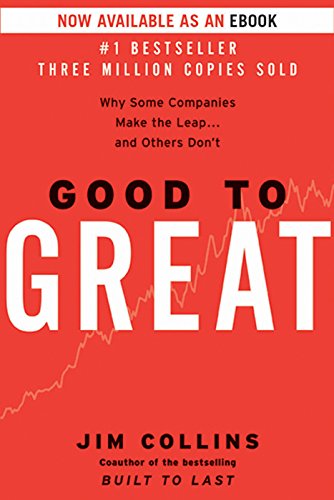
Good to Great: Why Some Companies Make the Leap...And Others Don't
About This Book
Good to Great distills a five-year research project in which Jim Collins and his team studied eleven companies that made a sustained leap from merely good performance to great results (at least three times the market for fifteen years), contrasting each against a comparison company that did not. The central message—"good is the enemy of great"—frames greatness not as a matter of circumstance or luck, but of conscious choice and disciplined execution.
The book is built around a framework of buildup followed by breakthrough, organized into three stages:
- Disciplined people — Level 5 Leadership (humility plus fierce professional will) and "First Who, Then What" (get the right people on the bus before deciding where to drive it).
- Disciplined thought — Confront the Brutal Facts via the Stockdale Paradox (unwavering faith plus brutal honesty), and the Hedgehog Concept (the intersection of what you can be best at, what drives your economic engine, and what you are deeply passionate about).
- Disciplined action — A Culture of Discipline and Technology Accelerators that serve the Hedgehog Concept rather than driving it.
Collins emphasizes that the findings are empirical, deduced from data rather than imposed by theory. Many conclusions defy conventional wisdom: celebrity outside CEOs are negatively correlated with greatness, executive compensation structure does not drive transformation, and dramatic restructurings rarely produce lasting leaps. Instead, transformation resembles relentlessly pushing a heavy flywheel until momentum builds into breakthrough.
Level 5 leaders "look out the window" to credit others and luck for success, and "look in the mirror" to assume responsibility for failure—the opposite of egocentric comparison leaders. The book closes by positioning itself as a prequel to Built to Last, arguing that almost any organization can become great if it conscientiously applies these timeless principles.
Key Takeaways
- 1.Good is the enemy of great—greatness is largely a matter of conscious choice and discipline, not favorable circumstance or industry.
- 2.Level 5 leaders combine deep personal humility with ferocious professional will, channeling ambition into the institution rather than themselves.
- 3.First Who, Then What: getting the right people on the bus precedes vision and strategy; the right people are self-motivated and adaptable.
- 4.The Stockdale Paradox requires holding unwavering faith you will prevail while confronting the most brutal facts of your current reality.
- 5.The Hedgehog Concept is an understanding—not a goal—at the intersection of what you can be best at, what drives your economics, and what you're passionate about.
- 6.A culture of discipline means disciplined people, thought, and action, removing the need for hierarchy, bureaucracy, and excessive controls.
- 7.Transformation works like a flywheel—relentless cumulative pushes building momentum, not a single dramatic program or miracle moment.
Top Highlights
Level 5 leaders channel their ego needs away from themselves and into the larger goal of building a great company.
Highlighted by 4 people
those who have the potential to evolve to Level 5;
Highlighted by 4 people
good-to-great companies did not focus principally on what to do to become great; they focused equally on what not to do and what to stop doing.
Highlighted by 3 people
Level 5 Leadership. We were surprised, shocked really, to discover the type of leadership required for turning a good company into a great one. Compared to high-profile leaders with big personalities who make headlines and become celebrities, the good-to-great leaders seem to have come from Mars. Self-effacing, quiet, reserved, even shy—these leaders are a paradoxical blend of personal humility and professional will. They are more like Lincoln and Socrates than Patton or Caesar.
Highlighted by 3 people
your most important asset. The right people are.
Highlighted by 3 people
Confront the Brutal Facts (Yet Never Lose Faith).
Highlighted by 3 people
Every good-to-great company embraced what we came to call the Stockdale Paradox: You must maintain unwavering faith that you can and will prevail in the end, regardless of the difficulties, AND at the same time have the discipline to confront the most brutal facts of your current reality, whatever they might be.
Highlighted by 3 people
The Hedgehog Concept (Simplicity within the Three Circles).
Highlighted by 3 people
A Culture of Discipline. All companies have a culture, some companies have discipline, but few companies have a culture of discipline. When you have disciplined people, you don’t need hierarchy. When you have disciplined thought, you don’t need bureaucracy. When you have disciplined action, you don’t need excessive controls.
Highlighted by 3 people
The Flywheel and the Doom Loop. Those who launch revolutions, dramatic change programs, and wrenching restructurings will almost certainly fail to make the leap from good to great.
Highlighted by 3 people
AI Review
Based on Glasp's analysis of highlights from 14 readers, Good to Great shows strong consensus around its core frameworks, with Level 5 Leadership and "First Who, Then What" emerging as the most resonant, frequently quoted ideas.
Pros
- +Frameworks built on empirical research rather than untested theory
- +Level 5 Leadership concept reframes effective leadership around humility plus will
- +Memorable, actionable metaphors like the bus, Hedgehog Concept, and Flywheel
- +Counterintuitive findings that challenge conventional wisdom about celebrity CEOs and compensation
- +Principles framed as timeless and applicable beyond business
Cons
- −Reader notes raise the correlation versus causation question—whether the same variables applied elsewhere also fail
- −Survivorship concerns: the study examines winners without showing companies that applied the principles and stalled
- −Some celebrated companies and leaders have since faltered, testing the durability of the conclusions
Glasp AI analysis based on highlights from 14 readers.
Who Should Read This
This book is essential for executives, founders, and managers leading organizational transformation, as well as board members making CEO and hiring decisions. It rewards anyone responsible for building teams and culture—not just in business, but in nonprofits, schools, and government agencies, since Collins frames good-to-great as a human problem. Readers who appreciate evidence-based management over guru hype will find the most value. No prior business theory is required, though leaders facing strategy, people, and discipline challenges will draw the deepest practical lessons.
Frequently Asked Questions
What is Good to Great about?
Who is this book for?
What are the key lessons?
Is Good to Great worth reading?
What is a Level 5 leader?
What is the Hedgehog Concept?
Why does Collins say good is the enemy of great?
How to Apply What You Read
- 1.Audit your team by asking, for each person, whether you would enthusiastically hire them again—and act decisively when the answer is no.
- 2.Define your Hedgehog Concept by honestly mapping what you can be best in the world at, what drives your economics, and what ignites your passion.
- 3.Create a "stop doing" list alongside your to-do list, and systematically unplug activities that fall outside your three circles.
- 4.Build a climate where truth is heard by leading with questions, conducting blameless autopsies, and installing red-flag mechanisms.
- 5.Look in the mirror to own failures and out the window to credit others—practice Level 5 attribution in your own leadership.
Discussion Questions
- Q1.Does the good-to-great pattern reflect genuine causation, or could it be correlation—are there companies that applied these principles and still failed?
- Q2.Can Level 5 humility-plus-will leadership be developed, or is it largely innate as Collins's "two categories" hypothesis suggests?
- Q3.How do you reconcile "First Who, Then What" with situations where direction must be set before you can attract the right people?
- Q4.Where in your own organization are you settling for good when greatness is possible, and what is the cost of that comfort?
- Q5.Some companies celebrated in the book later struggled—does that undermine the framework or simply prove that greatness must be continually re-earned?
- Q6.How would you apply the Hedgehog Concept to your own career or life, not just to a company?
- Q7.What would it take for your leadership team to debate vigorously yet unify fully behind decisions, as Collins describes?
Recommended Books
Revisit Your Highlights, Deepen Your Understanding
Import your Kindle highlights to review, organize, and share the ideas that matter most to you.
Get the free browser extension