Vera Rubin's Big Milestone // How To Watch The Eclipse // New Moon Rovers
TL;DR
- New camera for Ver Rubin Observatory, rogue planets from circumbinary systems, NASA's lunar rover, lunar landers' survival, and upcoming solar eclipse preparation.
Transcript
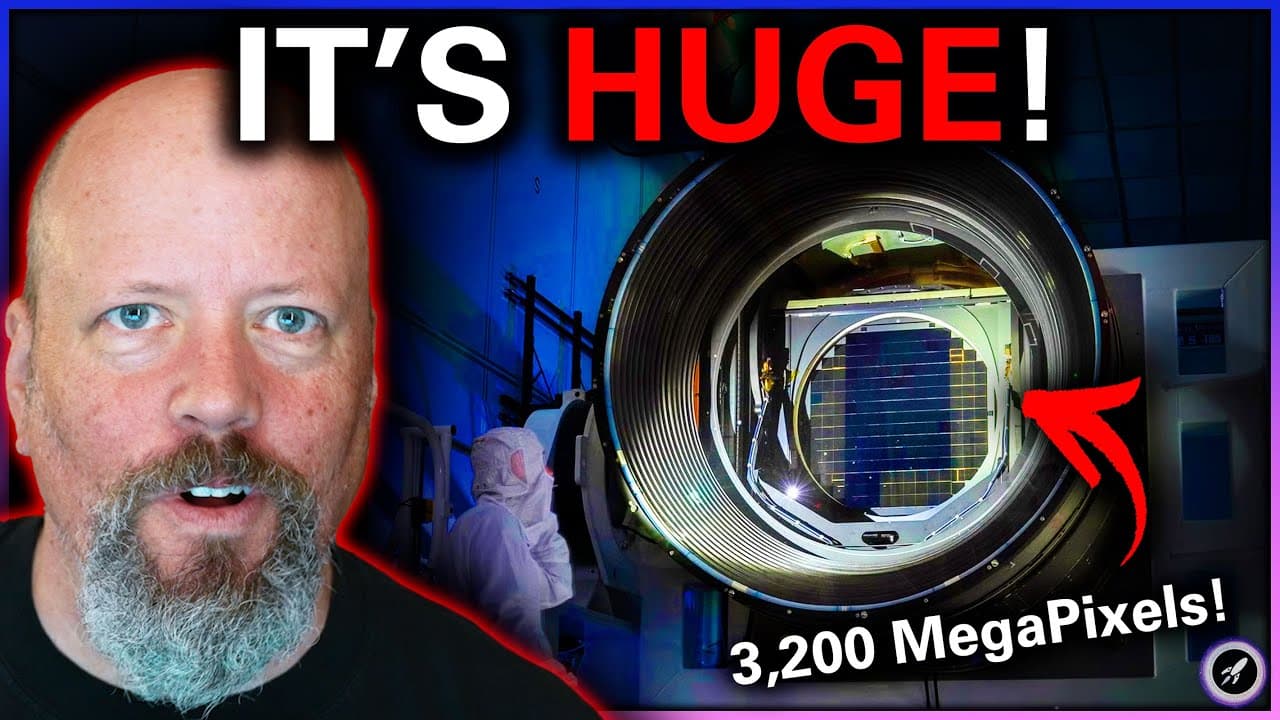
ver rubin's camera is complete where are all those rogue planets coming from NASA chooses suppliers for its new lunar rover and an earlier formation for the moon all this and more in this week's space bites all right you know that I love the ver ruin Observatory this is this incredible Observatory being built in Chile which will be able to observe ... Read More
Key Insights
- 🥃 Ver Rubin Observatory's advanced camera enhances deep sky observations with unprecedented capabilities.
- 🪐 Rogue planets found drifting in the Milky Way pose questions on their origins from circumbinary systems.
- 👶 NASA's new lunar rover project aims for autonomy by 2030, facilitating astronaut exploration on the Moon.
- 🌃 Lunar landers' resilience during lunar nights reflects engineering durability and survival in extreme conditions.
- 🤞 Intuitive Machines' IM2 mission tests hopping technology for reaching challenging lunar terrains, potential for future exploration applications.
- 💁 Early solar system models suggest the moon's formation around 50 million years after the Earth, based on geological evidence.
- 🤩 Simulations of neutron stars provide crucial insights into flare generation processes through complex surface conditions.
Install to Summarize YouTube Videos and Get Transcripts
Explore YouTube Video Summarizer or Get YouTube Transcript Extractor
Questions & Answers
Q: How advanced is the camera for Ver Rubin Observatory?
The camera has 3.2 gigapixels and 2011 separate CCDs, enabling deep and broad sky observation capabilities, set for testing in August.
Q: What are the potential sources of rogue planets in the Milky Way?
Rogue planets may originate from planetary ejections in circumbinary systems, shedding planets due to gravitational instability, as simulations indicate.
Q: What are NASA's plans for the new lunar rover?
NASA's lunar rover project aims for autonomous operation by 2030, enhancing astronaut mobility on the Moon's surface, with three companies awarded to develop concepts.
Q: How are JAXA's SLIM lander and Intuitive Machines' IM2 mission progressing?
SLIM survives lunar nights, while IM2 plans to test hopping on the Moon, showcasing advancements and challenges in lunar exploration technology.
Summary & Key Takeaways
-
Ver Rubin Observatory completed its 3.2 gigapixel camera for deep sky observations.
-
Rogue planets found drifting in the Milky Way, possibly from circumbinary systems.
-
NASA selects suppliers for the new lunar rover, aiming for autonomous capabilities by 2030.
Read in Other Languages (beta)
Share This Summary 📚
Summarize YouTube Videos and Get Video Transcripts with 1-Click
Try YouTube Summary with ChatGPT & Claude or YouTube Transcript Generator
Explore More Summaries from Fraser Cain / Universe Today Podcast 📚





Summarize YouTube Videos and Get Video Transcripts with 1-Click
Try YouTube Summary with ChatGPT & Claude or YouTube Transcript Generator