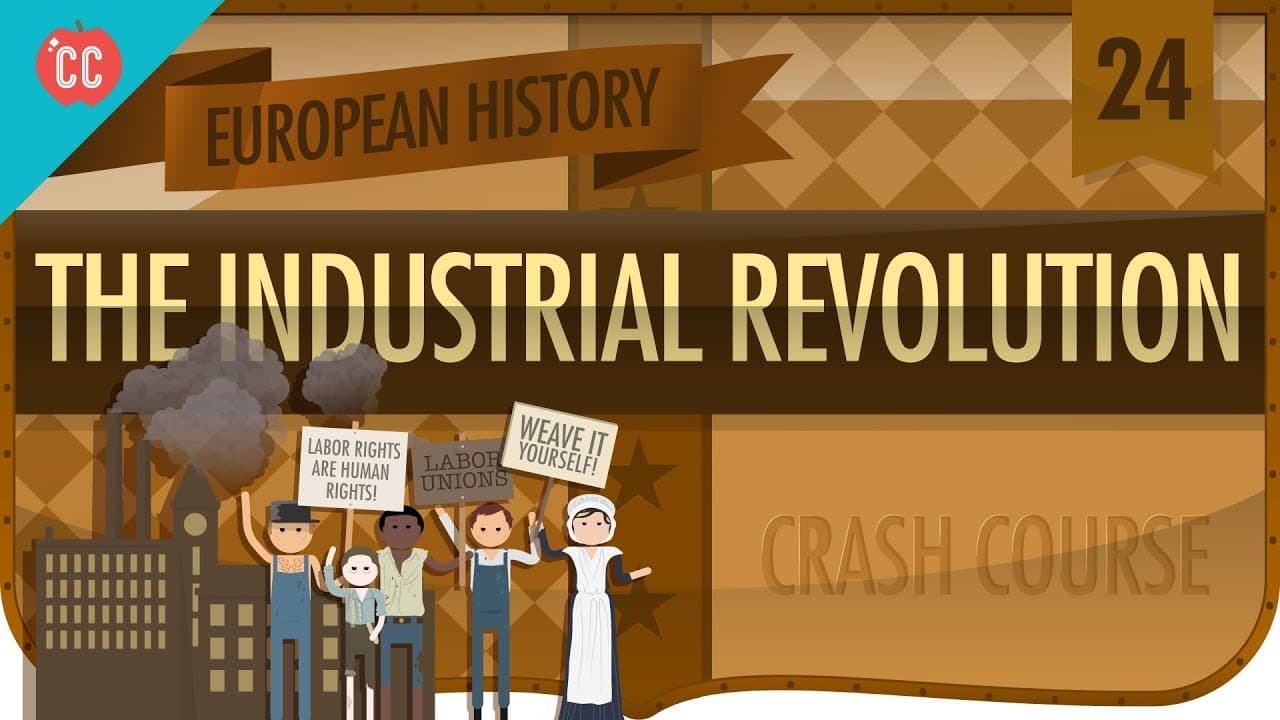
The Industrial Revolution: Crash Course European History #24
TL;DR
The Industrial Revolution drastically changed daily life, with technological advancements and social shifts leading to widespread impact.
Transcript
Hi I’m John Green and this is Crash Course European History. So we’re going to turn our attention now to the Industrial Revolution, one of the most significant developments in human history. Like, imagine with me that it’s 1820. I got this idea from the economist Robert Gordon by the way. You live in, say, England. You probably work in agriculture.... Read More
Key Insights
- 💦 Technological advancements like the spinning jenny and water frame revolutionized textile production, paving the way for mass industrialization.
- 👶 The emergence of bourgeoisie and proletariat classes highlighted new social structures and economic disparities.
- 🔬 Industrialization relied on slave labor, child labor, and the exploitation of women for economic growth.
- 🚨 Social movements like the Luddites emerged in response to industrial changes, highlighting resistance to technological advancements.
- 🥺 Industrialization led to urbanization, with towns growing rapidly around industrial hubs.
- 🏙️ Conditions in industrial cities were often abysmal, with poor sanitation and living conditions contributing to disease and unrest.
- 🛟 The Industrial Revolution was a significant event in human history, impacting daily life and shaping societal structures for generations.
Install to Summarize YouTube Videos and Get Transcripts
Explore YouTube Video Summarizer or Get YouTube Transcript Extractor
Questions & Answers
Q: What were some key inventions that revolutionized textile production during the Industrial Revolution?
Inventions like the spinning jenny and water frame dramatically increased productivity and efficiency in textile manufacturing, leading to the establishment of factories and mass production.
Q: How did the Industrial Revolution impact the social structure of European societies?
The emergence of the bourgeoisie and proletariat classes reflected a significant shift in societal dynamics, with factory owners and workers embodying new economic roles and challenges.
Q: What were some of the negative consequences of industrialization on the workforce?
Industrial accidents, child labor, and harsh working conditions were prevalent during the Industrial Revolution, leading to injuries, exploitation, and high rates of business failure.
Q: How did the Industrial Revolution impact women's roles in society?
Women transitioned from artisanal work to factory labor, facing challenges like long hours and low wages, while also being expected to fulfill traditional roles as "angels in the household".
Summary & Key Takeaways
-
The Industrial Revolution marked a shift from agrarian societies to industrialized economies, transforming the way people lived and worked.
-
Inventions like the spinning jenny and water frame revolutionized textile production, leading to the establishment of factories and mass production.
-
Social changes, such as the emergence of bourgeoisie and proletariat classes, highlighted new societal structures and challenges.
Read in Other Languages (beta)
Share This Summary 📚
Summarize YouTube Videos and Get Video Transcripts with 1-Click
Try YouTube Summary with ChatGPT & Claude or YouTube Transcript Generator
Explore More Summaries from CrashCourse 📚






Summarize YouTube Videos and Get Video Transcripts with 1-Click
Try YouTube Summary with ChatGPT & Claude or YouTube Transcript Generator