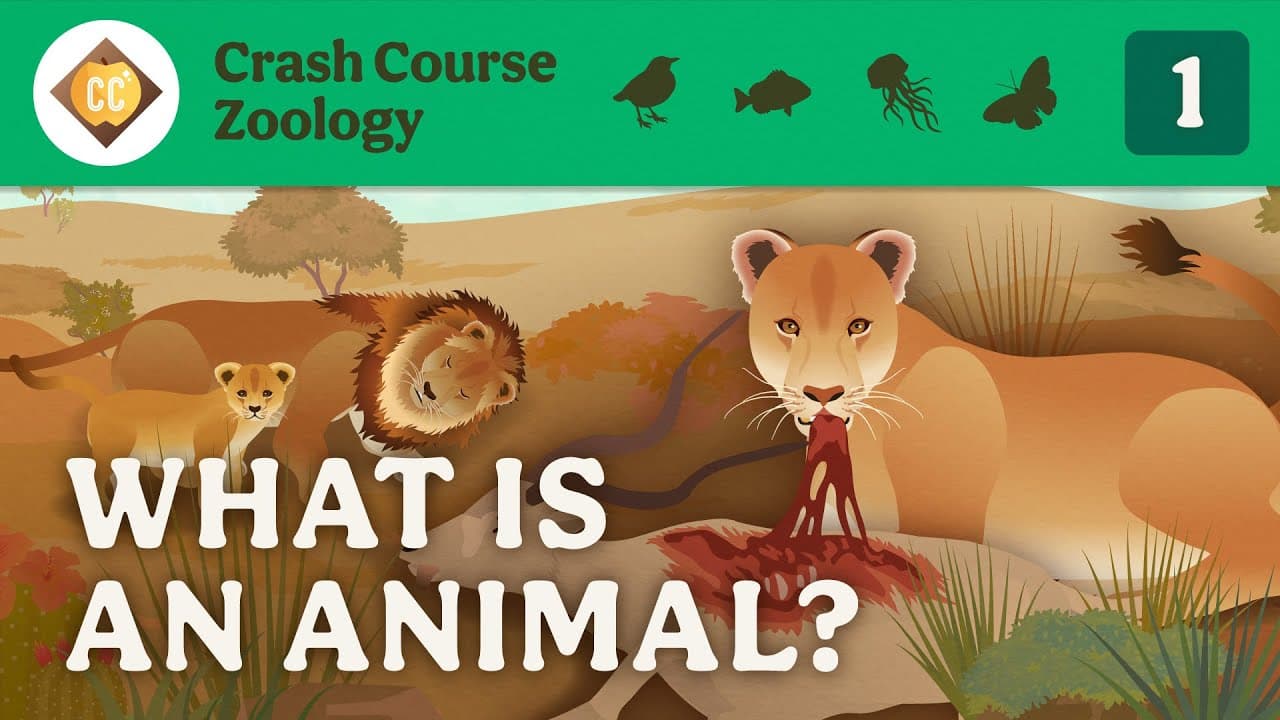
What is an Animal? Crash Course Zoology #1
TL;DR
Crash Course on Zoology explores the history of animals, zoology, and taxonomy to understand what defines an animal.
Transcript
Some of our earliest records of humanity are forty thousand year old cave paintings that show what was important to our ancestors: there are hand prints and little people figures, but there are also aurochs, bison, giant sloths, and camels. Thousands of years later, one of the most significant cultural and technological revolutions occured when far... Read More
Key Insights
- 🛟 Zoology explores the history and diversity of animal life on Earth.
- 🅰️ Taxonomy is essential for categorizing and organizing different types of animals.
- ❓ Phylogenetics provides insights into evolutionary relationships among animals.
- 🆘 Evolutionary history helps define what traits make an organism an animal.
- 🌲 Maximum parsimony and maximum likelihood are two approaches used in building phylogenetic trees.
- 🤱 Animals share common traits such as mobility, feeding, reproduction, and multicellularity.
- 🆘 Understanding phylogenetic relationships helps categorize animals into clades.
Install to Summarize YouTube Videos and Get Transcripts
Explore YouTube Video Summarizer or Get YouTube Transcript Extractor
Questions & Answers
Q: What is zoology, and why is it important?
Zoology is the study of animals, their behaviors, characteristics, and classification. It is crucial for understanding our relationship with animals and the natural world.
Q: How do zoologists classify and categorize animals?
Zoologists use taxonomy to name, describe, and classify organisms based on shared characteristics and evolutionary relationships, creating a systematic way to understand animal diversity.
Q: How do phylogenetic trees help zoologists understand animal relationships?
Phylogenetic trees visually represent the evolutionary relationships between species or clades, showing common ancestors and genetic similarities to determine animal classification.
Q: Why is understanding evolutionary history essential in zoology?
By studying evolutionary history through fossils and DNA, zoologists can trace the origins of animals, identify common ancestors, and determine what defines an animal.
Summary & Key Takeaways
-
Early records show ancient humans' connection to animals through cave paintings.
-
Zoology delves into the study and classification of animals.
-
Evolutionary history and phylogenetics help define what makes an animal.
Read in Other Languages (beta)
Share This Summary 📚
Summarize YouTube Videos and Get Video Transcripts with 1-Click
Try YouTube Summary with ChatGPT & Claude or YouTube Transcript Generator
Explore More Summaries from CrashCourse 📚



Summarize YouTube Videos and Get Video Transcripts with 1-Click
Try YouTube Summary with ChatGPT & Claude or YouTube Transcript Generator