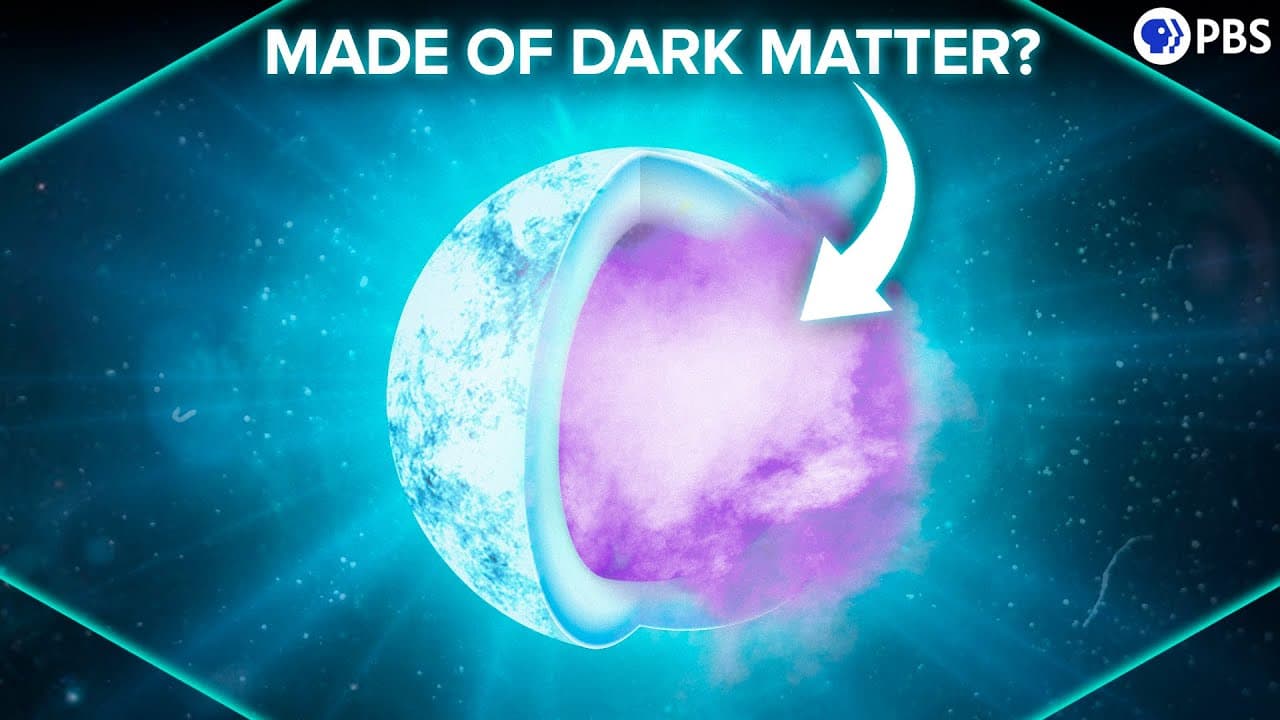
Did JWST Discover Dark Matter Stars?
TL;DR
JWST may have discovered stars powered by dark matter.
Transcript
We knew that the James Webb Space Telescope would find interesting stuff, especially about the mysterious early epoch of the universe. For example, there are hints that the galaxies we’re seeing there are brighter and more regular than expected given the short amount of time they’d had to grow. But perhaps no one was expecting that we would find ... Read More
Key Insights
- The James Webb Space Telescope (JWST) has discovered extremely distant objects, potentially the oldest known, which could be a new type of star powered by dark matter.
- These objects, part of the JWST Advanced Deep Extragalactic Survey (JADES), are among the most distant ever observed, with some over 30 billion light years away.
- The concept of dark stars, proposed in 2007, suggests stars could be powered by dark matter annihilation, emitting vast amounts of energy.
- Dark matter particles must have weak self-interactions and be capable of annihilation to form dark stars, which could explain the early universe's giant black holes.
- Dark stars may have prevented gas clouds from collapsing into traditional stars by producing more energy than regular stars.
- Spectral analysis can distinguish dark stars from galaxies by identifying specific absorption or emission lines in their light spectra.
- The existence of dark stars remains speculative but offers a potential explanation for rapid early universe black hole formation.
- Further observations and spectral data from JWST could confirm the existence of dark stars or provide insights into early cosmic structures.
Install to Summarize YouTube Videos and Get Transcripts
Explore YouTube Video Summarizer or Get YouTube Transcript Extractor
Questions & Answers
Q: What did the JWST discover about early universe objects?
The JWST discovered some of the most distant objects ever observed, potentially representing a new type of star powered by dark matter. These discoveries, part of the JWST Advanced Deep Extragalactic Survey (JADES), could provide insights into the formation of giant galaxies and black holes in the early universe.
Q: What are dark stars and how do they differ from regular stars?
Dark stars are theoretical objects powered by the annihilation of dark matter particles. Unlike regular stars, which rely on nuclear fusion, dark stars produce energy through dark matter interactions. This process could prevent gas clouds from collapsing into traditional stars, resulting in extremely bright objects observable by telescopes like JWST.
Q: How can we distinguish dark stars from galaxies?
Spectral analysis can help distinguish dark stars from galaxies by examining the light they emit or absorb. Dark stars would exhibit specific absorption lines in their spectra, while galaxies typically show emission lines. High-quality spectral data could confirm the presence of dark stars or identify them within galaxies.
Q: What role could dark stars play in the early universe?
Dark stars could have played a crucial role in the early universe by providing a mechanism for rapid black hole formation. These stars might have grown to massive sizes, eventually collapsing into black holes, which could explain the presence of supermassive black holes in the centers of galaxies shortly after the Big Bang.
Q: What are the requirements for dark matter to form dark stars?
For dark matter to form dark stars, it must consist of particles that have weak self-interactions and can annihilate each other. This allows dark matter to collapse under certain conditions, releasing energy that prevents gas clouds from forming traditional stars, leading to the formation of dark stars.
Q: What are the implications of discovering dark stars for our understanding of the universe?
Discovering dark stars could revolutionize our understanding of the early universe and the nature of dark matter. It would provide insights into how the first cosmic structures formed and evolved, potentially explaining rapid black hole formation and challenging existing models of star and galaxy development.
Q: How might JWST's observations impact future astronomical research?
JWST's observations of potential dark stars could guide future research by providing a new framework for understanding the early universe. Confirming dark stars would prompt further investigations into dark matter properties and its role in cosmic evolution, influencing both theoretical models and observational strategies.
Q: What are the challenges in confirming the existence of dark stars?
Confirming dark stars is challenging due to their speculative nature and the need for precise spectral data. Distinguishing them from galaxies requires high-quality observations to identify unique spectral lines. Additionally, understanding the specific conditions under which dark stars could form and persist remains a complex theoretical challenge.
Summary & Key Takeaways
-
The James Webb Space Telescope (JWST) has potentially discovered a new type of star powered by dark matter, providing insights into the universe's early epoch. These stars, if confirmed, could explain the rapid formation of giant galaxies and black holes shortly after the Big Bang.
-
Dark stars, proposed in 2007, require a specific type of dark matter that can annihilate itself to release energy. These stars could have formed in the early universe, emitting energy through dark matter annihilation, preventing gas clouds from collapsing into traditional stars.
-
Spectral analysis can help identify dark stars by their unique light absorption or emission lines. While the existence of dark stars is still speculative, JWST's observations offer a promising avenue to explore early cosmic phenomena and the nature of dark matter.
Read in Other Languages (beta)
Share This Summary 📚
Summarize YouTube Videos and Get Video Transcripts with 1-Click
Try YouTube Summary with ChatGPT & Claude or YouTube Transcript Generator
Explore More Summaries from PBS Space Time 📚
Summarize YouTube Videos and Get Video Transcripts with 1-Click
Try YouTube Summary with ChatGPT & Claude or YouTube Transcript Generator