How to Solve Time and Work Problems Using Shortcuts
TL;DR
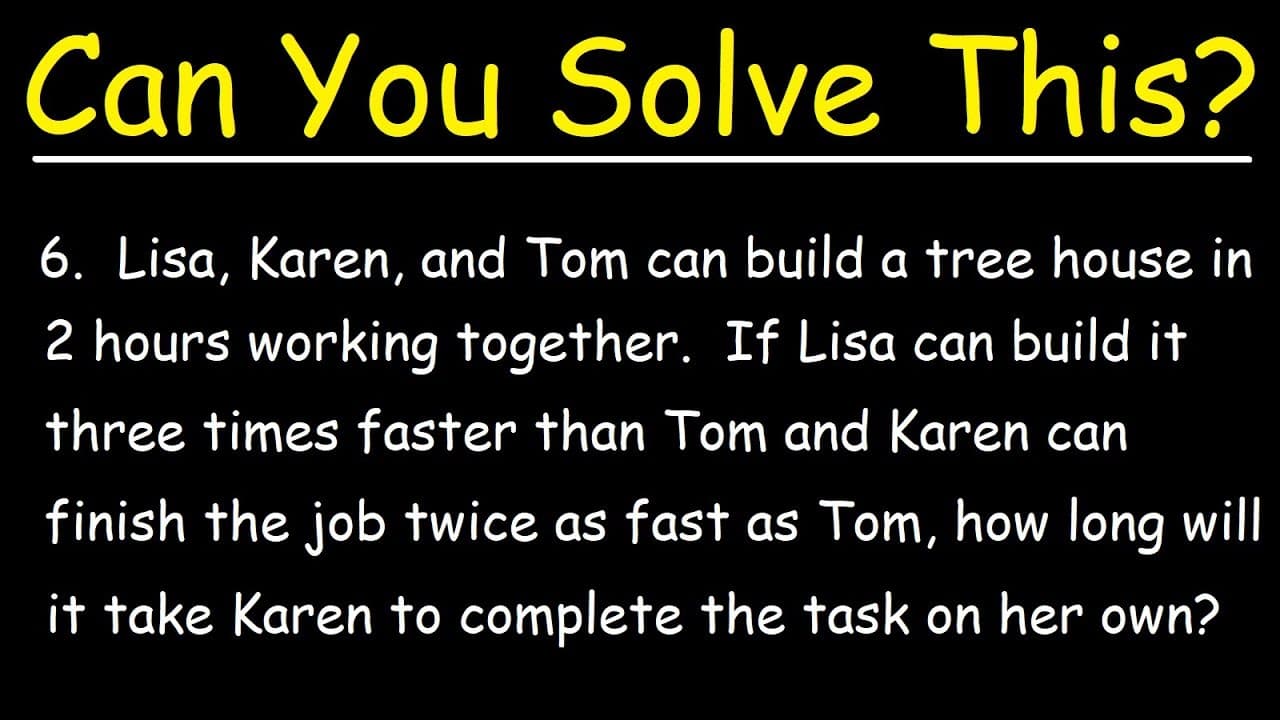
To solve time and work problems, use the formula 1/t(a) + 1/t(b) = 1/t(a+b), where t(a) and t(b) are the times it takes for individuals A and B to complete a task. This method can be extended for more individuals and involves finding the least common multiple to simplify calculations for quick answers.
Transcript
in this video we're going to work on some work in time problems and there is a simple formula that you could use that can help you to get the answer quickly and we're going to explore that today so let's begin with this problem and by the way for each of these problems i recommend that you pause the video and you know give it a shot try it out firs... Read More
Key Insights
- ⌛ Work in time problems involve determining the time it takes for multiple individuals to complete a task together.
- 💦 The formula 1/t(a) + 1/t(b) = 1/t(a+b) can be used to solve work in time problems.
- ❓ The formula can be extended to include more than two individuals.
- ⌛ The least common multiple of the given times is used to eliminate fractions in the equation.
- ✊ Using scientific calculators, the formula can be entered as 1/t(a) + 1/t(b) raised to the power of -1 to obtain the answer directly.
- 🎮 It is recommended to pause the video and attempt the problems to practice problem-solving skills.
- 💦 Algebraic calculations are involved in solving work in time problems.
- ⌛ The process involves substituting the given times into the formula, multiplying by the least common multiple, simplifying the equation, and solving for the unknown time.
- 💦 There are alternate methods to solve work in time problems, such as using scientific calculators for quicker calculations.
Install to Summarize YouTube Videos and Get Transcripts
Explore YouTube Video Summarizer or Get YouTube Transcript Extractor
Questions & Answers
Q: What is the formula used to calculate the time it takes for multiple people to complete a task together in work in time problems?
The formula is 1/t(a) + 1/t(b) = 1/t(a+b), where t(a) is the time it takes for person A to complete the task, t(b) is the time it takes for person B to complete the task, and t(a+b) is the time it takes for both persons A and B to complete the task working together. This formula can be extended to include more than two people.
Q: How do you solve work in time problems using the formula?
To solve work in time problems using the formula, substitute the given times for each person into the formula and solve for the unknown time. Multiply both sides of the equation by the least common multiple of the given times to eliminate the fractions, simplify the equation, and solve for the unknown time.
Q: Can you explain the step-by-step process of solving a work in time problem using the formula?
Sure. First, identify the given times for each individual and assign variables to represent them. Then, substitute these variables into the formula. Next, multiply both sides of the equation by the least common multiple of the given times to eliminate the fractions. Simplify the equation, combine like terms, and solve for the unknown time.
Q: Are there any shortcuts or alternate methods to solve work in time problems?
Yes, there is an alternate method using scientific calculators. The formula can be entered as 1/t(a) + 1/t(b) raised to the power of -1 in the calculator, and it will provide the time it takes for both individuals to complete the task working together. This method allows for quicker calculations.
Summary & Key Takeaways
-
This video discusses work in time problems and introduces a formula to quickly calculate the time it takes for multiple individuals to complete a task together.
-
The formula is 1/t(a) + 1/t(b) = 1/t(a+b), where t(a) is the time it takes for person A to complete the task, t(b) is the time it takes for person B to complete the task, and t(a+b) is the time it takes for both persons A and B to complete the task working together.
-
Examples are provided to demonstrate how to use the formula and solve work in time problems.
Read in Other Languages (beta)
Share This Summary 📚
Summarize YouTube Videos and Get Video Transcripts with 1-Click
Try YouTube Summary with ChatGPT & Claude or YouTube Transcript Generator
Explore More Summaries from The Organic Chemistry Tutor 📚



Summarize YouTube Videos and Get Video Transcripts with 1-Click
Try YouTube Summary with ChatGPT & Claude or YouTube Transcript Generator