Planet Size Limit, Solar Gravitational Lens, China's Telescopes | Q&A 218
TL;DR
Explore theoretical planet sizes, asteroid mining, telescopes, and the vast universe in a Q&A format.
Transcript
what is the biggest possible Planet how will we mine metal asteroids like psyche and will we ever see what's outside the observable universe all this and more in this week's question show hey everyone welcome to the question show your questions my answers now as always wherever you are across my channel if a question Pops in your brain just write i... Read More
Key Insights
- 🧑🏭 Planets like Jupiter are near the theoretical limit of size due to mass compression factors.
- ❓ Asteroid mining involves identifying the composition, utilizing railguns for extraction, and addressing economic implications.
- 🔭 Solar gravitational lens telescopes could revolutionize exoplanet discoveries but necessitate advanced propulsion technologies.
- 🕵️ Understanding magnetic fields beyond the solar system relies on detecting radiation from charged particles.
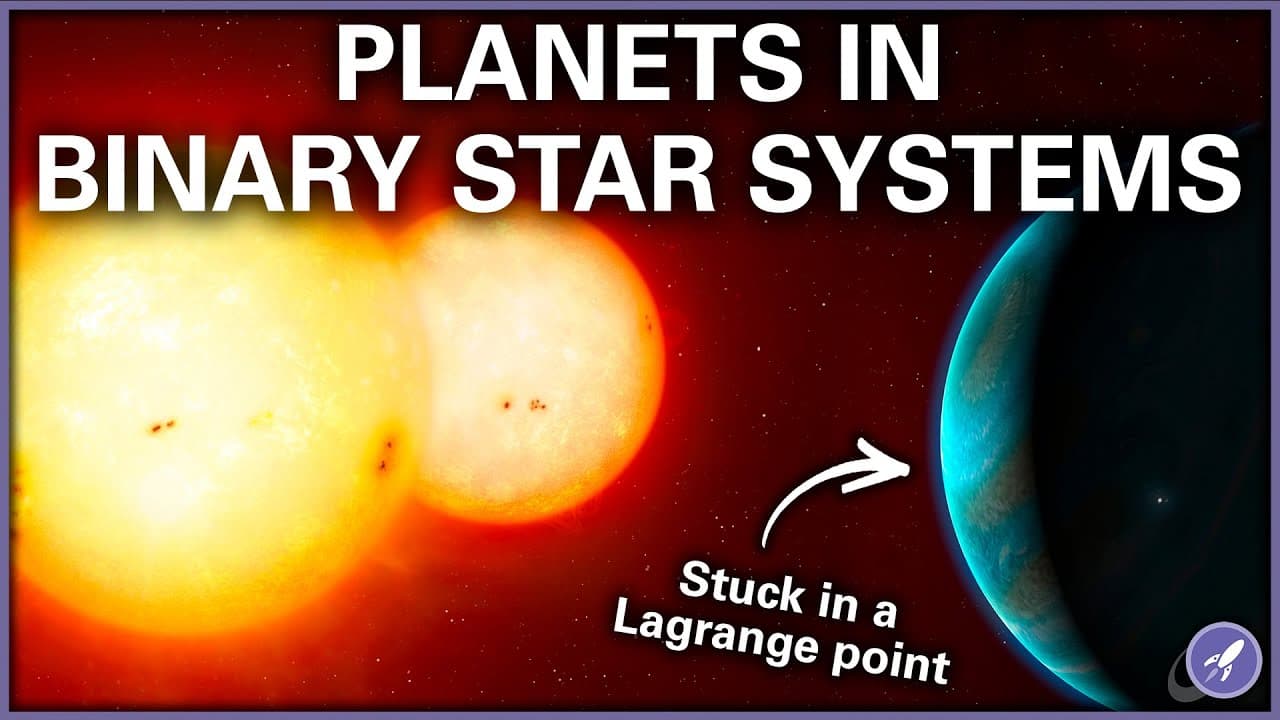
- 🔯 Applying LaGrange points to binary star systems reveals complex orbital dynamics and stability constraints.
- 🛰️ Geological theories on celestial bodies like 'Oumuamua present natural explanations over artificial origins.
- 🛟 Perspectives on artificial vs. organic intelligence highlight the diverse potential for intelligent life in the universe.
Install to Summarize YouTube Videos and Get Transcripts
Explore YouTube Video Summarizer or Get YouTube Transcript Extractor
Questions & Answers
Q: What is the theoretical size limit for a planet like Jupiter?
The largest possible planet is approximately the size of Jupiter, with additional mass causing compression rather than expansion.
Q: How intricate are spacecraft needed at 1,000 AU for solar gravitational lens utilization?
A vast distance like 1,000 AU requires rapid propulsion methods for spacecraft, such as solar sails or nuclear fusion, to achieve observations.
Q: How do astronomers detect magnetic fields outside the solar system?
Magnetic field detection relies on studying radiation emitted by particles following these fields, providing insights into space phenomena.
Q: Is planetary exploration beyond the observable universe feasible?
Due to the universe's vast size, exploring beyond the observable universe is impossible even with advanced technology and understanding.
Summary & Key Takeaways
-
Explanations on theoretical planet size, limiting factors for planetary growth, and comparison with star sizes.
-
Insights on asteroid mining techniques, complexities in extracting metal asteroids, and the potential economic impacts.
-
Discussions on solar gravitational lens telescopes, propulsion systems for deep-space exploration, and future observation capabilities.
Read in Other Languages (beta)
Share This Summary 📚
Summarize YouTube Videos and Get Video Transcripts with 1-Click
Try YouTube Summary with ChatGPT & Claude or YouTube Transcript Generator
Explore More Summaries from Fraser Cain / Universe Today Podcast 📚
Summarize YouTube Videos and Get Video Transcripts with 1-Click
Try YouTube Summary with ChatGPT & Claude or YouTube Transcript Generator