What Is Boiling Point Elevation and Freezing Point Depression?
TL;DR
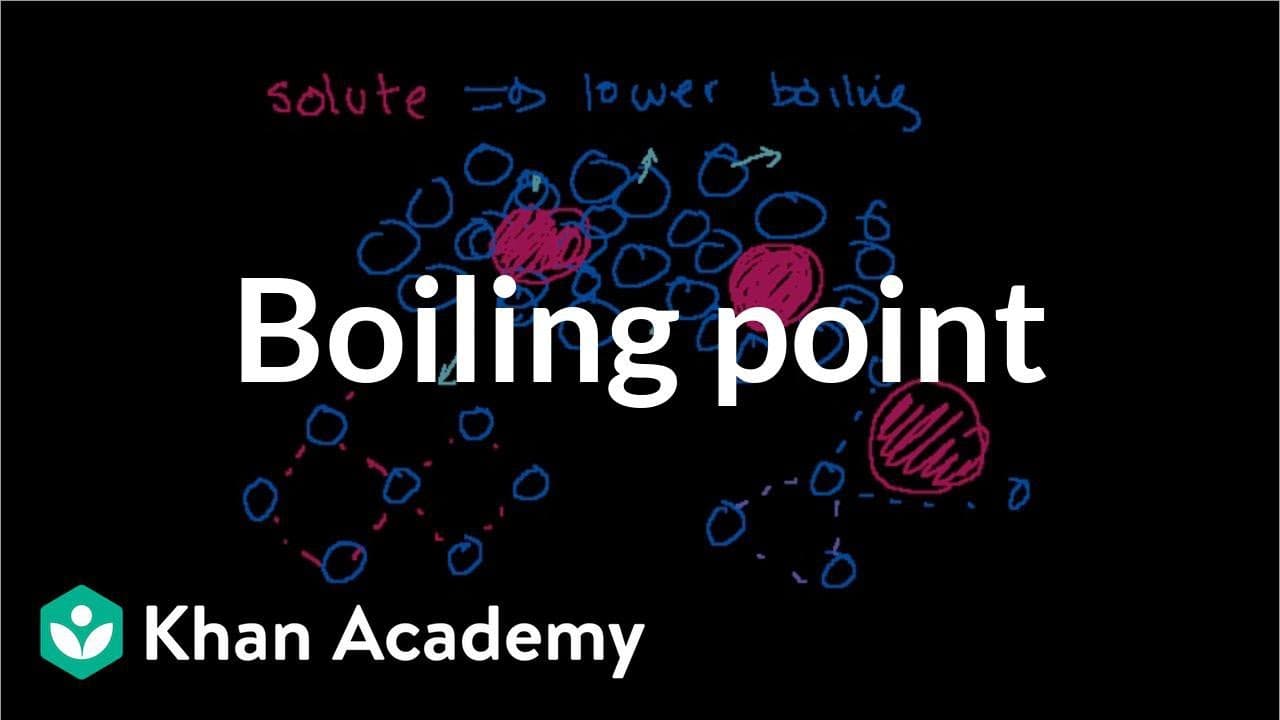
Boiling point elevation occurs when solute particles reduce the vapor pressure of a solution, requiring more heat to boil. Conversely, freezing point depression happens because solute disrupts the formation of a solid structure, lowering the temperature at which a solution solidifies. The changes in boiling and freezing points are proportional to the solute’s molality and the number of particles it forms in solution.
Transcript
Let's think about what might happen to the boiling point or the freezing point of any solution if we start adding particles, or we start adding solute to it. For our visualization, let's just think about water again. It doesn't have to be water. It can be any solvent, but let's just think about water in its liquid state. The particles are reasonabl... Read More
Key Insights
- 🫠 Adding solute to a solution can disrupt the organization of solvent molecules and lower the melting point.
- 😥 Solute particles occupy the surface area of the solvent, reducing the number of solvent molecules available for vaporization and increasing the boiling point.
- 😥 The change in boiling and freezing points of a solution is proportional to the molality of the solute and the number of particles it disassociates into.
Install to Summarize YouTube Videos and Get Transcripts
Explore YouTube Video Summarizer or Get YouTube Transcript Extractor
Questions & Answers
Q: How does adding solute affect the melting point of a solution?
Adding solute to a solvent disrupts the organization of solvent molecules, making it harder for them to form a crystalline structure and lowering the melting point of the solution.
Q: Why does adding solute raise the boiling point of a solution?
Solute particles take up surface area, reducing the number of solvent molecules available for vaporization. This decreases the vapor pressure and requires more heat to reach a boiling point.
Q: How does the disassociation of solute particles affect the change in boiling and freezing points?
When solute particles disassociate into multiple particles in a solution, it increases the number of particles per mole, resulting in a greater change in boiling and freezing points.
Q: Why can different solutes have different effects on the boiling and freezing points?
The effect of a solute on boiling and freezing points depends on its disassociation into particles and the number of particles it forms when dissolved in the solvent.
Summary & Key Takeaways
-
Adding solute to a solvent, such as water, can make it harder for the solvent molecules to organize and form a crystalline structure, thus lowering the melting point.
-
Solute particles take up surface area and reduce the number of solvent molecules available for vaporization, resulting in a higher boiling point.
-
The change in boiling or freezing point of a solution is proportional to the molality of the solute and the number of particles it disassociates into.
Read in Other Languages (beta)
Share This Summary 📚
Summarize YouTube Videos and Get Video Transcripts with 1-Click
Try YouTube Summary with ChatGPT & Claude or YouTube Transcript Generator
Explore More Summaries from Khan Academy 📚






Summarize YouTube Videos and Get Video Transcripts with 1-Click
Try YouTube Summary with ChatGPT & Claude or YouTube Transcript Generator