What Are Centripetal Forces and How Do They Work?
TL;DR
Centripetal forces are not a new type of force; they are any force directed toward the center of a circular path that causes an object to move in a circle. Gravity is a common example of centripetal force in action, such as when the moon orbits the Earth. Understanding centripetal acceleration and the relationship between mass and distance is crucial for grasping these concepts.
Transcript
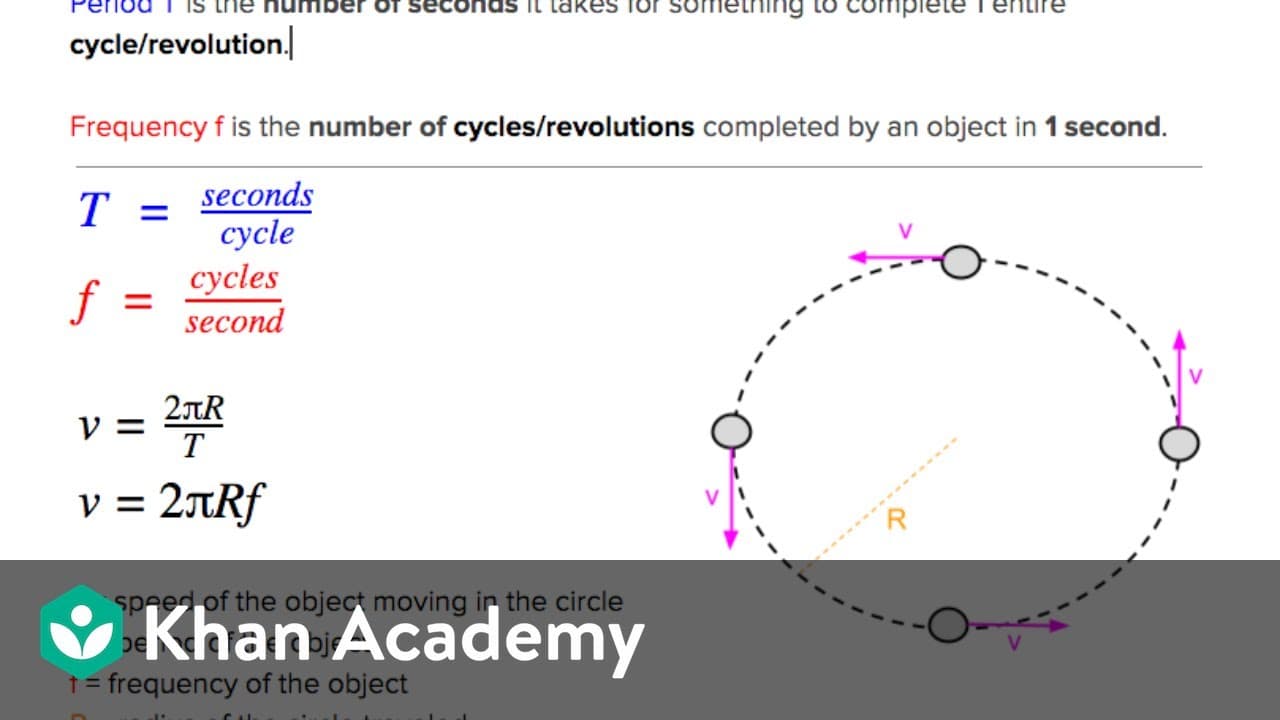
- [Voiceover] What does period and frequency mean? The period is the number of seconds it takes for a process to complete an entire cycle, circle, or revolution. So, if there's some repeating process, the time it takes that process to reset is the period, and it's measured in seconds. The frequency is the number of cycles, or circles, or revolution... Read More
Key Insights
- 🏍️ Period and frequency are inversely related, with the period being the time it takes for one cycle and the frequency being the number of cycles per second.
- 😥 Centripetal acceleration always points towards the center of the circle and is responsible for changing the direction of the velocity in circular motion.
- 🐎 Tangential acceleration, if present, changes the magnitude or speed of the velocity.
- 😥 Centripetal forces are not new forces but rather any force that points towards the center of the circle in circular motion.
- 🥮 Gravity is the centripetal force in situations like the moon orbiting the Earth.
- 👮 Newton's universal law of gravity states that all masses attract each other with a force proportional to their masses and inversely proportional to the square of the distance between them.
- 😥 Gravitational field represents the acceleration due to gravity and is created by masses, pointing radially inwards towards the mass.
- 💆 Density is the mass per unit volume and can be used to calculate mass if given the density and volume.
- 🛰️ Gravitational orbits are a special case of centripetal motion where an object is in orbit due to the gravitational force exerted by a larger mass.
Install to Summarize YouTube Videos and Get Transcripts
Explore YouTube Video Summarizer or Get YouTube Transcript Extractor
Questions & Answers
Q: What is the difference between period and frequency?
Period is the time it takes for a process to complete one cycle, while frequency is the number of cycles completed in one second. They are inversely related, with the period being equal to one over the frequency, and the frequency being equal to one over the period.
Q: How is centripetal acceleration different from tangential acceleration?
Centripetal acceleration is the acceleration that changes the direction of an object's velocity in circular motion, always pointing towards the center of the circle. Tangential acceleration, on the other hand, changes the magnitude or speed of the object's velocity.
Q: What are some examples of centripetal forces in everyday situations?
Gravity is a common centripetal force, such as the force that keeps the moon in orbit around the Earth. Other examples include tension in a yo-yo string, normal force in a loopty loop, and static frictional force for a car going around a roundabout.
Q: How does force influence the direction of centripetal acceleration?
If a force is directed radially inward towards the center of the circle, it is considered a positive force and will contribute to the centripetal acceleration. If a force points radially outward, it is considered a negative force. Tangential forces do not contribute to the centripetal acceleration.
Summary & Key Takeaways
-
Period is the time it takes for a process to complete one cycle, while frequency is the number of cycles completed in one second.
-
Centripetal acceleration is the acceleration that causes an object to move in a circular path, always pointing towards the center of the circle.
-
Centripetal forces are forces that point towards the center of the circle, causing an object to move in a circular path.
-
Gravity, described by Newton's universal law of gravity, is the force of attraction between masses and can be expressed as the product of the masses divided by the square of the distance between them.
Read in Other Languages (beta)
Share This Summary 📚
Summarize YouTube Videos and Get Video Transcripts with 1-Click
Try YouTube Summary with ChatGPT & Claude or YouTube Transcript Generator
Explore More Summaries from Khan Academy 📚



Summarize YouTube Videos and Get Video Transcripts with 1-Click
Try YouTube Summary with ChatGPT & Claude or YouTube Transcript Generator