Applying Einstein velocity addition | Special relativity | Physics | Khan Academy
TL;DR
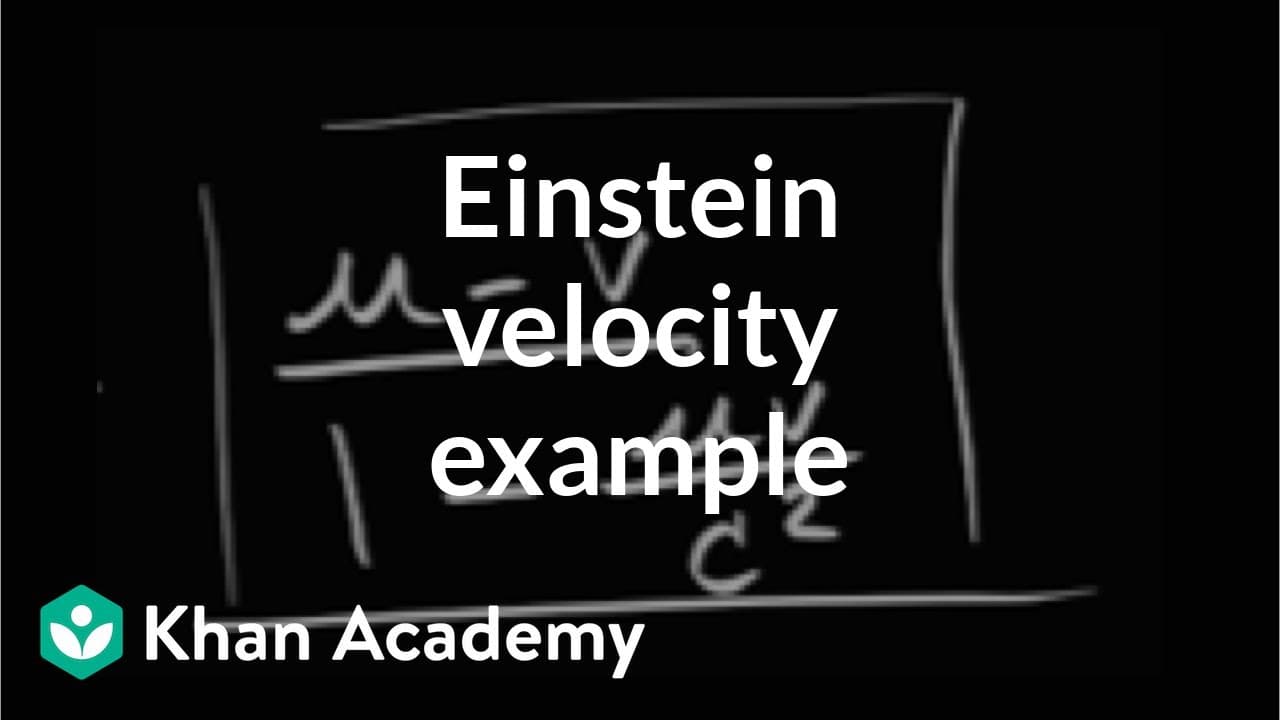
Einstein's velocity addition formula allows for accurate calculations of relative velocities in special relativity.
Transcript
- [Voiceover] Now let's apply the formula we came up with the last video sometimes known as the Einstein velocity addition formula. And we'll see that it's a pretty neat thing. So let's say, so this is once again me floating in space, my frame of reference is just the s frame of reference, Let's say my friend over here, she's flying away from me, h... Read More
Key Insights
- 🙂 The Einstein velocity addition formula prevents violations of the absolute speed of light.
- ❓ Relative velocities cannot be calculated using traditional Newtonian methods in a relativistic context.
- 🐎 The formula is applicable in scenarios where objects are moving at speeds close to the speed of light.
- 🙂 Incorporating the speed of light into calculations ensures adherence to the principles of special relativity.
- 👻 The formula allows for accurate calculations of relative velocities in different frames of reference.
- 👾 This understanding of relative velocities has practical implications in fields such as astrophysics and space travel.
- 🤘 The negative sign in the formula indicates the direction of the velocity relative to the observer.
Install to Summarize YouTube Videos and Get Transcripts
Explore YouTube Video Summarizer or Get YouTube Transcript Extractor
Questions & Answers
Q: How does the Einstein velocity addition formula differ from Newtonian methods of calculating relative velocities?
In a Newtonian world, relative velocities are simply added together, which can lead to violations of the laws of the universe. The Einstein velocity addition formula takes into account the absolute speed of light, ensuring that it is not violated.
Q: Why is it important to consider the speed of light when calculating relative velocities?
The speed of light is a fundamental constant in the universe, and according to the principles of special relativity, nothing can travel faster than it. By incorporating the speed of light into the calculations, the Einstein velocity addition formula ensures that this principle is upheld.
Q: How does the Einstein velocity addition formula prevent violations of the laws of the universe?
The formula includes a denominator that accounts for the absolute speed of light. By dividing the numerator by this value, the result is a value that is always less than the speed of light, preventing violations of its absolute nature.
Q: How can the Einstein velocity addition formula be applied practically?
The formula allows for accurate calculations of relative velocities in scenarios where objects are moving at speeds close to the speed of light. This can have practical applications in fields like astrophysics an space travel, where understanding relative velocities is crucial.
Summary & Key Takeaways
-
The video explains Einstein's velocity addition formula, which is used to calculate relative velocities in special relativity.
-
In a Newtonian world, velocities would be simply added together, but this violates the laws of the universe.
-
With the Einstein velocity addition formula, velocities are calculated using a formula that takes into account the absolute speed of light, ensuring that it is not violated.
Read in Other Languages (beta)
Share This Summary 📚
Summarize YouTube Videos and Get Video Transcripts with 1-Click
Try YouTube Summary with ChatGPT & Claude or YouTube Transcript Generator
Explore More Summaries from Khan Academy 📚



Summarize YouTube Videos and Get Video Transcripts with 1-Click
Try YouTube Summary with ChatGPT & Claude or YouTube Transcript Generator