Products
Features
YouTube Video Summarizer
Summarize YouTube videos
Web & PDF Highlighter
Highlight web pages & PDFs
Chat with PDF
Ask any PDF questions with AI
Ask AI Clone
Chat with your highlights & memories
Audio Transcriber
Transcribe audio files to text
Glasp Reader
Read and highlight articles
Kindle Highlight Export
Export your Kindle highlights
Idea Hatch
Hatch ideas from your highlights
Integrations
Obsidian Plugin
Notion Integration
Pocket Integration
Instapaper Integration
Medium Integration
Readwise Integration
Snipd Integration
Hypothesis Integration
Apps & Extensions
Chrome Extension
Safari Extension
Edge Add-ons
Firefox Add-ons
iOS App
Android App
Discover
Discover
Ideas
Discover new ideas and insights
Articles
Curated articles and insights
Books
Book recommendations by great minds
Posts
Essays and notes from readers
Quotes
Inspiring quotes collection
Videos
Curated videos and summaries
Explore Glasp
Glasp Newsletter
Weekly insights and updates
Glasp Talk
Interview series with great minds
Glasp Blog
Latest news and articles
Glasp Use Cases
Learn how others use Glasp
Build & Support
Glasp API
Access Glasp's API for developers
MCP Connector
Connect Glasp to Claude & ChatGPT
Community
Glasp Reddit Community
Students
Student discount and benefits
FAQs
Frequently Asked Questions
AboutPricing
DashboardLog inSign up

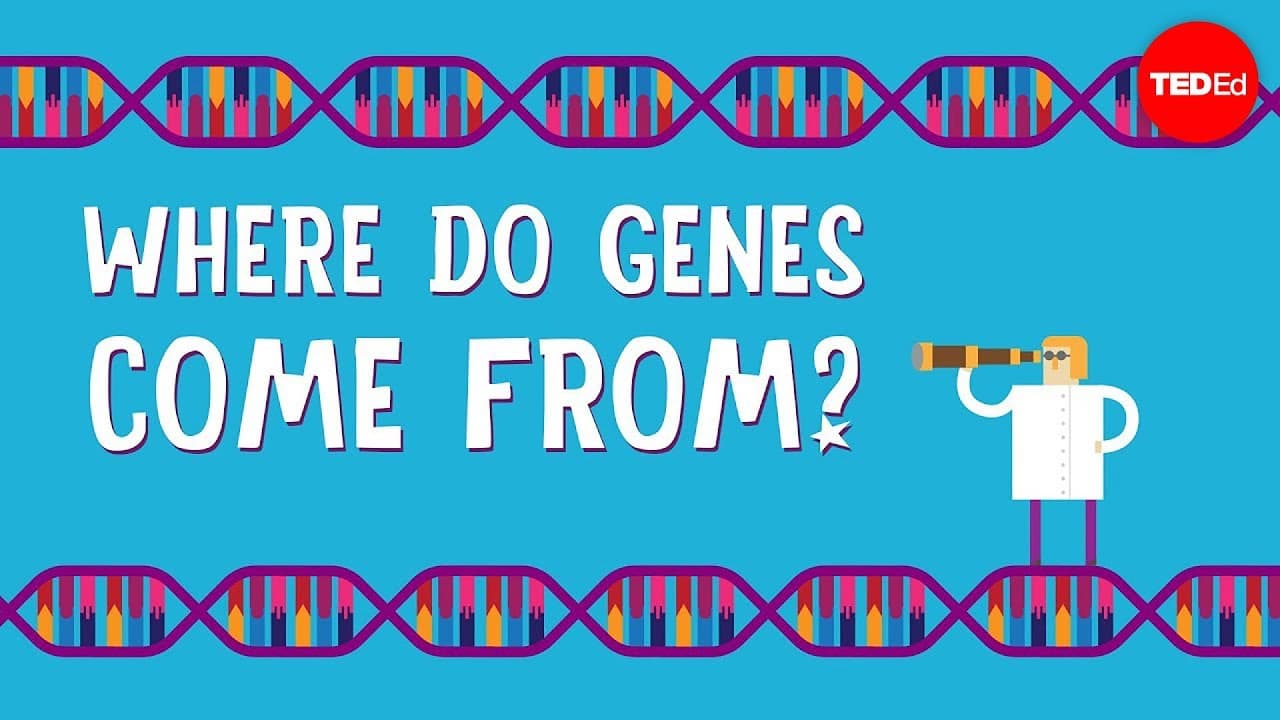
Where do genes come from? - Carl Zimmer
927.8K views
•
September 22, 2014
by
TED-Ed
YouTube video player
Where do genes come from? - Carl Zimmer

TL;DR

Genes originate from basic sets in primitive life forms, evolving through mutations and duplications to create new functions and proteins.

Transcript

You have about 20,000 genes in your DNA. They encode the molecules that make up your body, from the keratin in your toenails, to the collagen at the tip of your nose, to the dopamine surging around inside your brain. Other species have genes of their own. A spider has genes for spider silk. An oak tree has genes for chlorophyll, which turns sunligh... Read More

Key Insights

  • 😫 Genes in living beings originate from basic sets carried by primitive life forms.
  • 🥺 Mutations and duplications in DNA lead to the emergence of new genes with diverse functions.
  • 👶 New genes can quickly take on essential functions once they evolve.
  • 🎭 Mutations can change gene functions, causing proteins to perform different jobs.
  • 👶 Environmental challenges and adaptations drive the evolution of new genes.
  • 👶 Non-coding DNA sequences can mutate and create new proteins in organisms.
  • 👶 Life on Earth continues to produce new genes as long as species exist.

Install to Summarize YouTube Videos and Get Transcripts

Explore YouTube Video Summarizer or Get YouTube Transcript Extractor

Questions & Answers

Q: How do genes originate in living organisms?

Genes originate from the basic sets carried by primitive life forms, passed down through generations and evolving through mutations and duplications.

Q: What role do mutations play in the creation of new genes?

Mutations in DNA, caused by errors in replication or environmental factors, lead to the emergence of new genes with altered functions and proteins.

Q: Can genes change their function over time?

Yes, through mutations and duplications, genes can evolve to perform different tasks, such as producing new proteins in different organs or at different stages of life.

Q: How do random sequences of DNA contribute to the creation of new genes?

Mutations in non-coding DNA sequences can create areas where cells start reading the DNA, forming new proteins that may eventually become beneficial for an organism.

Summary & Key Takeaways

  • Genes encode molecules in all living beings, from basic functions to specialized proteins.

  • Mutations and duplications in DNA lead to the emergence of new genes with diverse functions over millions of years.

  • Life on Earth continues to generate new genes, evolving and adapting to environmental challenges.


Read in Other Languages (beta)

English

Share This Summary 📚

Summarize YouTube Videos and Get Video Transcripts with 1-Click

Download browser extensions on:

Try YouTube Summary with ChatGPT & Claude or YouTube Transcript Generator

Explore More Summaries from TED-Ed 📚
Can you solve the river crossing riddle? - Lisa Winer thumbnail
Can you solve the river crossing riddle? - Lisa Winer
TED-Ed
The surprising effects of pregnancy thumbnail
The surprising effects of pregnancy
TED-Ed
How did Hitler rise to power? - Alex Gendler and Anthony Hazard thumbnail
How did Hitler rise to power? - Alex Gendler and Anthony Hazard
TED-Ed
The tragic myth of Orpheus and Eurydice - Brendan Pelsue thumbnail
The tragic myth of Orpheus and Eurydice - Brendan Pelsue
TED-Ed
The Infinite Hotel Paradox - Jeff Dekofsky thumbnail
The Infinite Hotel Paradox - Jeff Dekofsky
TED-Ed
How to build a fictional world - Kate Messner thumbnail
How to build a fictional world - Kate Messner
TED-Ed

Summarize YouTube Videos and Get Video Transcripts with 1-Click

Download browser extensions on:

Try YouTube Summary with ChatGPT & Claude or YouTube Transcript Generator

Apps & Extensions

  • Chrome Extension
  • Safari Extension
  • Edge Add-ons
  • Firefox Add-ons
  • iOS App
  • Android App

Key Features

  • YouTube Video Summarizer
  • Web & PDF Summarizer
  • Web & PDF Highlighter
  • Chat with PDF
  • Ask AI Clone
  • Audio Transcriber
  • Glasp Reader
  • Kindle Highlight Export
  • Idea Hatch

Integrations

  • Obsidian Plugin
  • Notion Integration
  • Pocket Integration
  • Instapaper Integration
  • Medium Integration
  • Readwise Integration
  • Snipd Integration
  • Hypothesis Integration

More Features

  • APIs
  • MCP Connector
  • Blog & Post
  • Embed Links
  • Image Highlight
  • Personality Test
  • Quote Shots

Company

  • About us
  • Blog
  • Community
  • FAQs
  • Job Board
  • Newsletter
  • Pricing
Terms

•

Privacy

•

Guidelines

© 2026 Glasp Inc. All rights reserved.