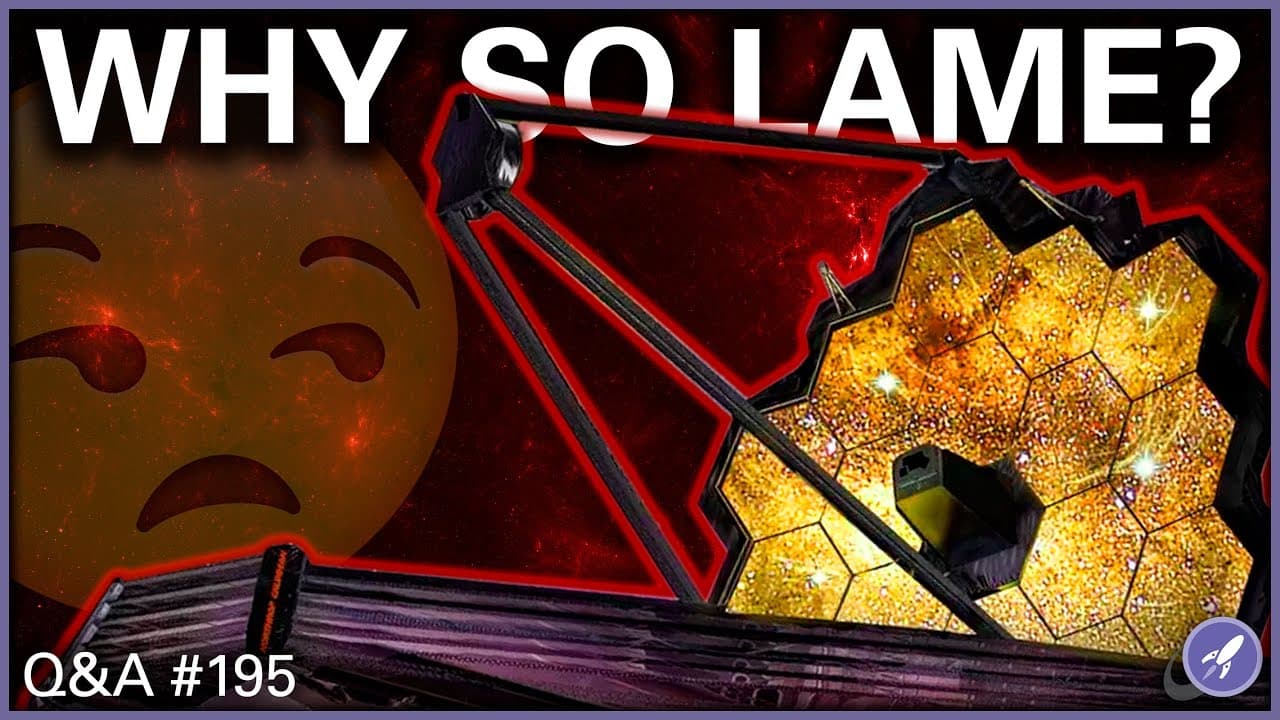
JWST Worth the Hype? How to Build a Wormhole? How to Pass Van Allen Belts? | Q&A 195
TL;DR
Professor Kane answers space and astronomy questions, covering cosmic background radiation, gravitational waves, star color changes, black holes, Van Allen belts, and James Webb Telescope.
Transcript
hi everyone I'm Professor Kane I'm the publisher of universe today and I have been a space and astronomy journalist for over 20 years and this is our question show your questions my answers so wherever you are across my channel if a question Pops in your brain just write it down I'll gather them up and I will answer them here and a reminder that I ... Read More
Key Insights
- ❓ Cosmic background radiation offers valuable insights into the early universe's properties.
- 🥵 Gravitational waves can heat planets as they pass through, showcasing energy transfer mechanisms.
- 🤩 Stars like Sirius change color due to atmospheric refraction, revealing dynamics alongside atmospheric distortion explanations.
- 🖤 Observing black hole radiation provides insights into the environment surrounding these astronomical objects.
- 🗺️ Van Allen belts pose challenges to spacecraft due to intense radiation, prompting strategic planning for safe travel.
- ❓ The James Webb Telescope's capabilities surpass Hubble's, enhancing observation precision and infrared imaging.
- 🇨🇷 Starship's reusable technology reshapes spaceflight economics, potentially reducing costs significantly.
Install to Summarize YouTube Videos and Get Transcripts
Explore YouTube Video Summarizer or Get YouTube Transcript Extractor
Questions & Answers
Q: Can we observe the early universe using cosmic neutrino background and gravitational waves?
Cosmic microwave background helps map the universe, but the neutrino background can fill the gap before the cosmic microwave background. Gravitational waves offer unique insights.
Q: How do Sirius and other stars change color, and why do stars twinkle?
Stars appear to change color due to atmospheric refraction. Sirius is bright, making these color changes noticeable. Stars twinkle due to atmospheric distortions; planets don't twinkle as their disc shape minimizes jitter.
Q: How can we see radiation from black holes if nothing can escape them?
We see radiation from the environment around black holes, not the black holes themselves. Material swirling around black holes emits radiation, creating observable phenomena.
Q: What are the misconceptions people have about telescopes looking back through time?
One common misconception is the understanding of the speed of light and time dilation while observing celestial events. People often oversimplify the concepts of observing events in space through telescopes.
Summary & Key Takeaways
-
Professor Kane answers questions on cosmic background radiation, gravitational waves, star color changes, black holes, Van Allen belts, and the James Webb Telescope.
-
Cosmic background radiation, gravitational waves, and neutrino background offer insights into the early universe.
-
Gravitational waves can heat planets when passing through, taking advantage of energy transfer principles.
Read in Other Languages (beta)
Share This Summary 📚
Summarize YouTube Videos and Get Video Transcripts with 1-Click
Try YouTube Summary with ChatGPT & Claude or YouTube Transcript Generator
Explore More Summaries from Fraser Cain 📚

Summarize YouTube Videos and Get Video Transcripts with 1-Click
Try YouTube Summary with ChatGPT & Claude or YouTube Transcript Generator