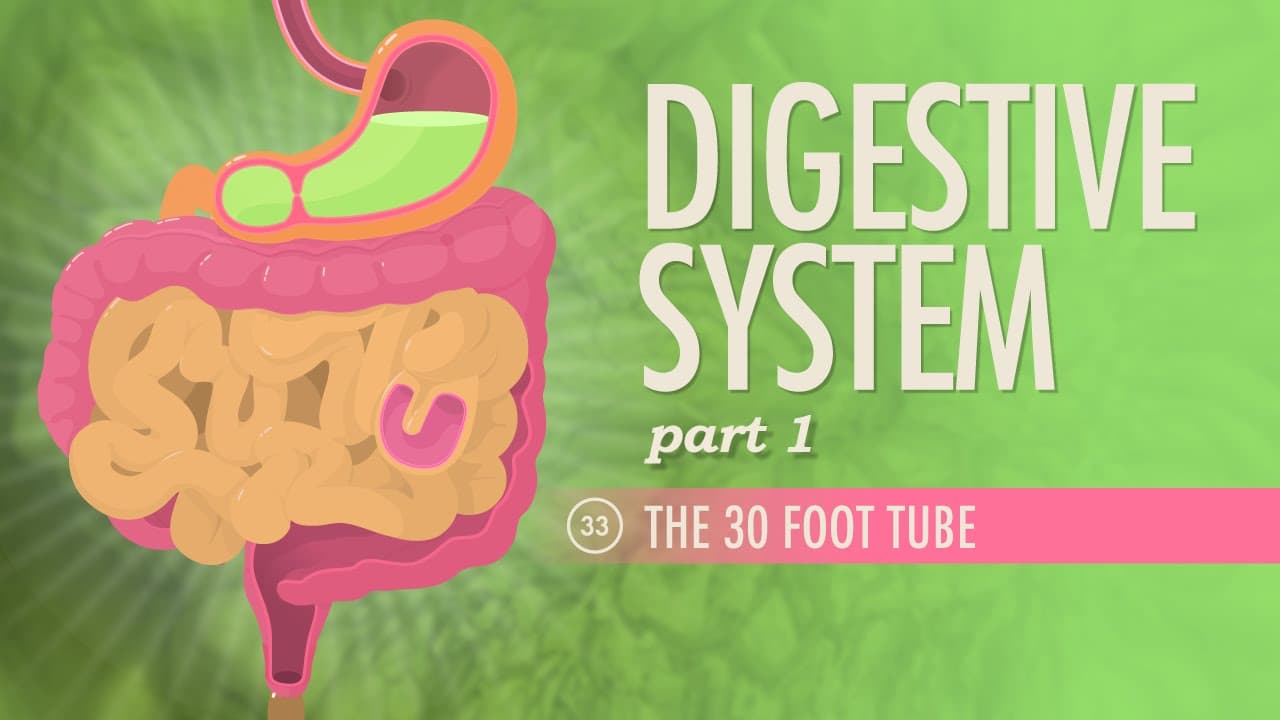
Digestive System, Part 1: Crash Course Anatomy & Physiology #33
TL;DR
The digestive system breaks down food into energy and nutrients.
Transcript
We all have our reasons for eating nachos at 3 in the afternoon. I happen to have my own. And don’t ask -- it’s personal. But more generally, we all eat any kind of food to accomplish two simple things: to obtain the energy we need to stay alive and to get the raw materials required for building all of our tissues and stuff. That’s because, when it... Read More
Key Insights
- The digestive system's primary function is to convert food into usable energy and raw materials for the body.
- Food is made of macromolecules like carbohydrates, proteins, and fats, which need to be broken down into monomers.
- Human digestion involves six main steps: ingestion, propulsion, mechanical breakdown, chemical digestion, absorption, and defecation.
- The alimentary canal, or gastrointestinal tract, is a hollow tube running from the mouth to the anus, facilitating digestion.
- Enzymes play a crucial role in breaking down food into its basic building blocks for absorption by cells.
- The digestive process involves both mechanical actions, like chewing, and chemical processes, like enzyme activity.
- Accessory digestive organs like the liver, pancreas, and gallbladder assist in the digestion by secreting necessary enzymes.
- The ultimate goal of digestion is nutrient absorption, after which indigestible substances are expelled from the body.
Install to Summarize YouTube Videos and Get Transcripts
Explore YouTube Video Summarizer or Get YouTube Transcript Extractor
Questions & Answers
Q: What is the main purpose of the digestive system?
The main purpose of the digestive system is to convert food into energy and raw materials that the body needs for various functions. This involves breaking down food into smaller components that can be absorbed by the body's cells.
Q: How does the digestive system break down food?
The digestive system breaks down food through mechanical and chemical processes. Mechanical breakdown involves physical actions like chewing, while chemical digestion involves enzymes breaking down macromolecules into monomers that can be absorbed by the body.
Q: What role do enzymes play in digestion?
Enzymes play a crucial role in digestion by acting as catalysts that speed up the chemical reactions necessary to break down large macromolecules into smaller monomers. These enzymes are secreted by accessory digestive organs and help convert food into absorbable nutrients.
Q: What is the alimentary canal?
The alimentary canal, also known as the gastrointestinal tract, is a continuous hollow tube that runs from the mouth to the anus. It is responsible for moving, digesting, and absorbing food, and is lined with epithelial cells that facilitate selective movement of materials.
Q: What are the six main steps of digestion?
The six main steps of digestion are ingestion, propulsion, mechanical breakdown, chemical digestion, absorption, and defecation. Each step involves specific organs and processes that work together to convert food into usable energy and nutrients.
Q: How does the body absorb nutrients from digested food?
The body absorbs nutrients from digested food through the small intestine, where nutrients pass into the blood via active and passive transport. This absorption allows cells to use the energy and building blocks to create new tissues and perform various functions.
Q: What happens to indigestible substances in the digestive system?
Indigestible substances, like fiber, are not absorbed by the body and are eventually expelled through the process of defecation. This is the final step in the digestive process, ensuring that waste materials are removed from the body.
Q: What are accessory digestive organs and their functions?
Accessory digestive organs, such as the liver, pancreas, and gallbladder, assist in digestion by secreting various enzymes that help break down food. These organs support the digestive process by ensuring that food is chemically digested into absorbable nutrients.
Summary & Key Takeaways
-
The digestive system breaks down food into energy and nutrients that the body can use. It involves multiple steps and organs working together to convert food into absorbable monomers.
-
The process starts with ingestion and involves both mechanical and chemical breakdown of food, propelled through the alimentary canal by peristalsis.
-
Accessory organs like the liver and pancreas aid in digestion by secreting enzymes, while the final step involves the expulsion of indigestible substances.
Read in Other Languages (beta)
Share This Summary 📚
Summarize YouTube Videos and Get Video Transcripts with 1-Click
Try YouTube Summary with ChatGPT & Claude or YouTube Transcript Generator
Explore More Summaries from CrashCourse 📚


Summarize YouTube Videos and Get Video Transcripts with 1-Click
Try YouTube Summary with ChatGPT & Claude or YouTube Transcript Generator