Products
Features
YouTube Video Summarizer
Summarize YouTube videos
Web & PDF Highlighter
Highlight web pages & PDFs
Chat with PDF
Ask any PDF questions with AI
Ask AI Clone
Chat with your highlights & memories
Audio Transcriber
Transcribe audio files to text
Glasp Reader
Read and highlight articles
Kindle Highlight Export
Export your Kindle highlights
Idea Hatch
Hatch ideas from your highlights
Integrations
Obsidian Plugin
Notion Integration
Pocket Integration
Instapaper Integration
Medium Integration
Readwise Integration
Snipd Integration
Hypothesis Integration
Apps & Extensions
Chrome Extension
Safari Extension
Edge Add-ons
Firefox Add-ons
iOS App
Android App
Discover
Discover
Ideas
Discover new ideas and insights
Articles
Curated articles and insights
Books
Book recommendations by great minds
Posts
Essays and notes from readers
Quotes
Inspiring quotes collection
Videos
Curated videos and summaries
Explore Glasp
Glasp Newsletter
Weekly insights and updates
Glasp Talk
Interview series with great minds
Glasp Blog
Latest news and articles
Glasp Use Cases
Learn how others use Glasp
Build & Support
Glasp API
Access Glasp's API for developers
MCP Connector
Connect Glasp to Claude & ChatGPT
Community
Glasp Reddit Community
Students
Student discount and benefits
FAQs
Frequently Asked Questions
AboutPricing
DashboardLog inSign up

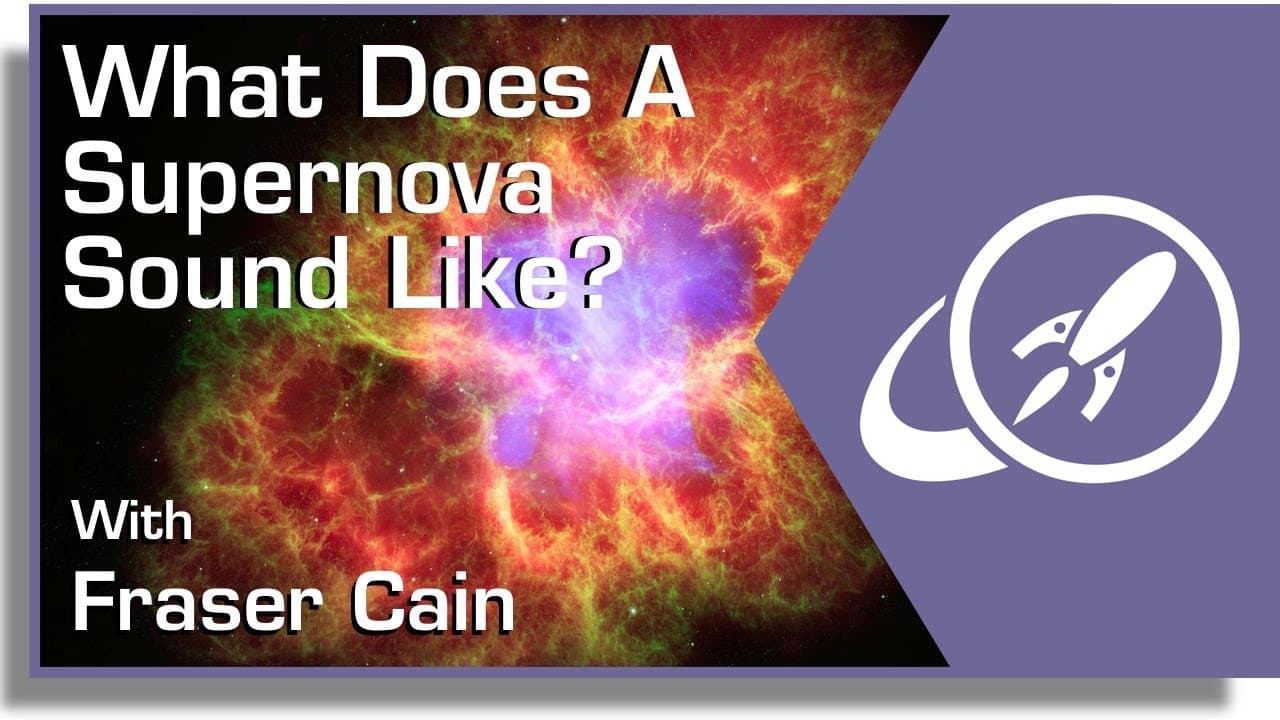
What Does a Supernova Sound Like?
38.8K views
•
June 23, 2014
by
Fraser Cain
YouTube video player
What Does a Supernova Sound Like?

TL;DR

Sound cannot travel in the vacuum of space due to lack of medium.

Transcript

put on your pedantry tinfoil helmet and saying your best comic book guy voice don't be ridiculous spaces I have sound effects you would not hear the death star exploding that is wrong there are no sounds in space you know that why did you even click on this wait wait wait I still have things I want to teach you give it in full hat on stick around f... Read More

Key Insights

  • 👾 Sound cannot travel in the vacuum of space due to the absence of a medium like air or water.
  • 👂 NASA converts space phenomena like radio waves into sound for humans to hear.
  • 👂 Astronauts can communicate by transferring sound pressure through their helmets.
  • 👾 Instruments like Voyager 1 and Marconi Inator 1000 help detect and convert space phenomena into audible signals.
  • 🫢 Dense gas clouds in galaxy clusters are exceptions where sound waves can be detected.
  • ✴️ Lack of molecules in space hinders the transmission of sound waves from exploding stars or lasers.
  • 👾 Space agencies work tirelessly to convert space activity into audible formats for human perception.

Install to Summarize YouTube Videos and Get Transcripts

Explore YouTube Video Summarizer or Get YouTube Transcript Extractor

Questions & Answers

Q: Why can't we hear sounds in space?

Sounds need a medium to travel, but space is a vacuum with no air or molecules for sound waves to propagate through.

Q: Can astronauts communicate in space?

Astronauts can communicate through the vibrations in their helmets, as the sound pressure can transfer through the helmets' surfaces.

Q: How do instruments like Voyager 1 detect space phenomena?

Instruments like Voyager 1 use specialized detectors to convert plasma or radio waves from space into audible signals for humans to hear.

Q: Are there any exceptions to the lack of sound in space?

Dense gas clouds in galaxy clusters have been found to transmit sound waves, but human ears aren't sensitive enough to perceive them without specialized equipment.

Summary & Key Takeaways

  • Sound requires a medium to travel, like air or water, but space lacks that medium.

  • In space, even exploding stars or lasers would be silent due to the absence of molecules to transmit sound waves.

  • Instruments like the Voyager 1 or Marconi Inator 1000 can help detect and convert space phenomena into audible signals.


Read in Other Languages (beta)

English

Share This Summary 📚

Summarize YouTube Videos and Get Video Transcripts with 1-Click

Download browser extensions on:

Try YouTube Summary with ChatGPT & Claude or YouTube Transcript Generator

Explore More Summaries from Fraser Cain 📚
Why Isn't the Asteroid Belt a Planet? thumbnail
Why Isn't the Asteroid Belt a Planet?
Fraser Cain
Are We Living in a Simulation? Understanding the Simulation Hypothesis thumbnail
Are We Living in a Simulation? Understanding the Simulation Hypothesis
Fraser Cain
What's On The Far Side Of The Moon? thumbnail
What's On The Far Side Of The Moon?
Fraser Cain
Exploring Space Lava Tubes: How To Prepare For It thumbnail
Exploring Space Lava Tubes: How To Prepare For It
Fraser Cain / Universe Today Podcast
Why Did Mars Lose Its Atmosphere? And How Can We Get It Back? thumbnail
Why Did Mars Lose Its Atmosphere? And How Can We Get It Back?
Fraser Cain

Summarize YouTube Videos and Get Video Transcripts with 1-Click

Download browser extensions on:

Try YouTube Summary with ChatGPT & Claude or YouTube Transcript Generator

Apps & Extensions

  • Chrome Extension
  • Safari Extension
  • Edge Add-ons
  • Firefox Add-ons
  • iOS App
  • Android App

Key Features

  • YouTube Video Summarizer
  • Web & PDF Summarizer
  • Web & PDF Highlighter
  • Chat with PDF
  • Ask AI Clone
  • Audio Transcriber
  • Glasp Reader
  • Kindle Highlight Export
  • Idea Hatch

Integrations

  • Obsidian Plugin
  • Notion Integration
  • Pocket Integration
  • Instapaper Integration
  • Medium Integration
  • Readwise Integration
  • Snipd Integration
  • Hypothesis Integration

More Features

  • APIs
  • MCP Connector
  • Blog & Post
  • Embed Links
  • Image Highlight
  • Personality Test
  • Quote Shots

Company

  • About us
  • Blog
  • Community
  • FAQs
  • Job Board
  • Newsletter
  • Pricing
Terms

•

Privacy

•

Guidelines

© 2026 Glasp Inc. All rights reserved.