How to Design a Fluorescence Microscopy Experiment

TL;DR
Choosing the right microscope and technique depends on your specific experimental needs. Consider factors like sample type, resolution, and imaging depth when selecting between techniques like confocal, TIRF, or widefield microscopy. Ensure compatibility with your dyes and consider the hardware limitations of your available equipment to optimize your microscopy experiment.
Transcript
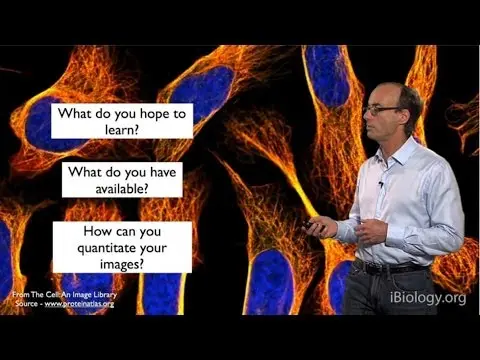
I'm Kurt Thorn and today I'm gonna be talking about how to design a microscopy experiment and in the lectures throughout this course we've talked a lot about different types of microscopes and different techniques for optical imaging and what I want to try to do today is share some general guidelines to put all this together and to give some advic... Read More
Key Insights
- Microscopy selection depends on sample type and experimental goals.
- Resolution needs dictate objective lens choice; high NA for high resolution.
- Confocal microscopy improves contrast by eliminating out-of-focus light.
- TIRF microscopy is ideal for imaging near the cover slip, like membrane dynamics.
- Dye compatibility with available laser lines and filter sets is crucial.
- Live cell imaging requires environmental controls for temperature and humidity.
- Autofocus systems are essential for long time-lapse imaging to maintain focus.
- Sample preparation, including fixation and dye choice, affects imaging quality.
Install to Summarize YouTube Videos and Get Transcripts
Explore YouTube Video Summarizer or Get YouTube Transcript Extractor
Questions & Answers
Q: How to choose the right microscope for my experiment?
To choose the right microscope, consider your sample type, desired resolution, and imaging depth. Determine if you need live cell imaging, which requires environmental controls, or if fixed samples are sufficient. Evaluate your dye compatibility with available laser lines and filter sets, and consider hardware limitations such as autofocus capabilities for long time-lapse imaging.
Q: What factors affect the choice of microscopy technique?
Factors affecting the choice of microscopy technique include the type of sample, the required resolution, field of view, and whether you need 3D imaging. The compatibility of your dyes with the microscope's laser lines and filter sets is also crucial. Additionally, consider the hardware capabilities of your available equipment, such as autofocus systems and environmental controls.
Q: Why is numerical aperture (NA) important in microscopy?
Numerical aperture (NA) is important because it determines the resolution and light-gathering ability of a microscope objective. High NA objectives provide better resolution and are essential for imaging small structures. They also gather more light, which is beneficial for dim samples, but reduce the field of view, requiring trade-offs between resolution and brightness.
Q: When should I use confocal microscopy?
Use confocal microscopy when imaging thick samples where out-of-focus light obscures in-focus details. It provides improved contrast by eliminating out-of-focus light. Confocal is ideal for fixed samples, but spinning disk confocal or resonant laser-scanning confocal are better for live samples due to increased sensitivity and reduced phototoxicity.
Q: What is TIRF microscopy best used for?
TIRF microscopy is best for imaging structures near the cover slip, such as membrane dynamics, membrane trafficking, or single molecule studies. It provides high contrast by limiting the illumination to a thin section adjacent to the cover slip, making it unsuitable for imaging deeper structures like the nucleus.
Q: How does dye compatibility affect microscopy experiments?
Dye compatibility affects microscopy experiments by determining which laser lines and filter sets can be used. Incompatible dyes may not fluoresce properly or may require additional equipment, increasing costs. Ensure your chosen dyes match the capabilities of your microscope to avoid technical issues and optimize imaging results.
Q: What are the challenges of live cell imaging?
Live cell imaging challenges include maintaining environmental conditions such as temperature, CO2, and humidity to keep cells alive. Photobleaching and phototoxicity from prolonged light exposure are concerns, necessitating careful management of light intensity and exposure duration. Autofocus systems are crucial for maintaining focus during long time-lapses.
Q: How can sample preparation impact microscopy results?
Sample preparation impacts microscopy results through fixation and mounting procedures, which must preserve protein localization and structural integrity. Dye selection and compatibility with the microscope's capabilities are crucial. For thick fixed samples, clearing techniques can enhance imaging depth by reducing light scattering and sample opacity.
Summary & Key Takeaways
-
Selecting the appropriate microscopy technique is crucial for experimental success. Consider factors such as resolution, field of view, and sample type when choosing between methods like confocal, TIRF, or widefield microscopy. Ensure that your dyes are compatible with your microscope's laser lines and filter sets, and account for hardware limitations to optimize your experiment.
-
Resolution and numerical aperture (NA) are key when choosing microscope objectives. High NA objectives provide better resolution and light-gathering power but reduce the field of view. Consider the trade-offs between resolution and brightness, especially for dim samples, and ensure your microscope setup matches your experimental requirements.
-
Confocal microscopy is beneficial for thick samples due to its ability to eliminate out-of-focus light, enhancing image contrast. For live cell imaging, spinning disk confocal or resonant laser-scanning confocal are preferred. TIRF microscopy excels at imaging near the cover slip, making it suitable for studying membrane dynamics or single molecule biophysics.
Read in Other Languages (beta)
Share This Summary 📚
Summarize YouTube Videos and Get Video Transcripts with 1-Click
Try YouTube Summary with ChatGPT & Claude or YouTube Transcript Generator
Explore More Summaries from iBiology Techniques 📚
Summarize YouTube Videos and Get Video Transcripts with 1-Click
Try YouTube Summary with ChatGPT & Claude or YouTube Transcript Generator