What Is Bioimage Analysis in Microscopy?
TL;DR
Bioimage analysis is an emerging field in computer science focused on extracting quantitative information from biological image data. It has become essential due to the vast amounts of data generated by advanced microscopy techniques. Automated algorithms help quantify, segment, and analyze images, providing reproducible results and enabling scientists to draw meaningful conclusions from complex datasets.
Transcript
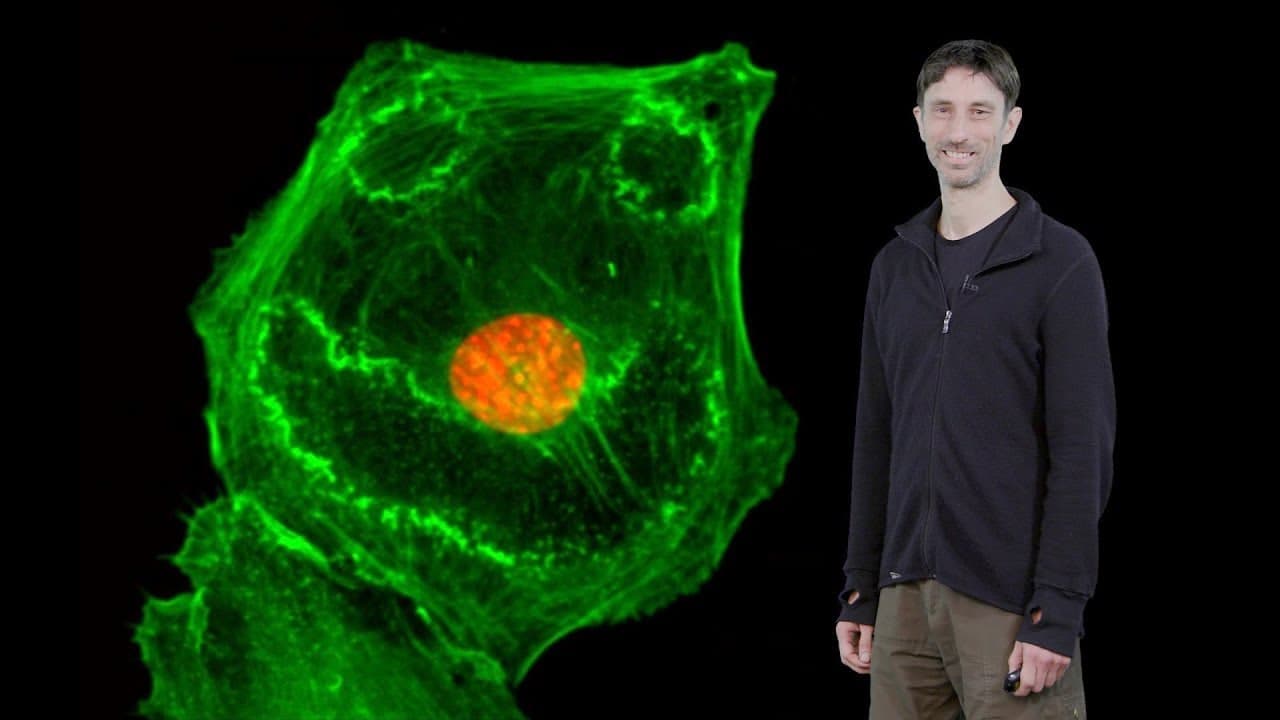
Hello. Welcome. My name is Christian Tischer. I work in the Centre for Bioimage Analysis at the EMBL in Heidelberg. And I will give an overview of bioimage analysis. So, what is bioimage analysis? I think one can say it's an emerging field in computer science that deals with extracting quantitative information from biological image data. So, why is... Read More
Key Insights
- Bioimage analysis is crucial for handling large datasets from advanced microscopy techniques.
- Automation in microscopy has led to data volumes too large for manual analysis.
- Quantification and statistical testing of image data are essential for scientific validity.
- Image processing techniques like denoising and deblurring enhance data interpretation.
- Machine learning, especially deep neural networks, improves image segmentation accuracy.
- Segmentation converts images into measurable objects, aiding in quantitative analysis.
- Software tools like ImageJ, KNIME, and CellProfiler facilitate bioimage analysis workflows.
- Community forums and networks support the development and sharing of bioimage analysis knowledge.
Install to Summarize YouTube Videos and Get Transcripts
Explore YouTube Video Summarizer or Get YouTube Transcript Extractor
Questions & Answers
Q: What is bioimage analysis?
Bioimage analysis is a field that focuses on extracting quantitative information from biological image data, typically obtained through advanced microscopy techniques. It involves using automated algorithms to process, segment, and analyze images, allowing scientists to quantify and interpret complex datasets accurately and reproducibly.
Q: Why is bioimage analysis important in modern microscopy?
Bioimage analysis has become crucial due to the vast amounts of data generated by modern microscopy, which are too large to analyze manually. It enables researchers to quantitatively interpret image data, ensuring scientific findings are substantiated with robust, reproducible measurements, thus enhancing the reliability of biological discoveries.
Q: How does machine learning improve bioimage analysis?
Machine learning, especially deep convolutional neural networks, enhances bioimage analysis by improving the accuracy of image segmentation. These algorithms can automatically identify patterns and features in complex image datasets, allowing for more precise and efficient analysis compared to traditional methods, thus facilitating better scientific insights.
Q: What are some key techniques used in bioimage analysis?
Key techniques in bioimage analysis include denoising and deblurring to improve image quality, segmentation to convert images into measurable objects, and statistical testing to validate findings. These techniques help in extracting meaningful quantitative data from images, which is essential for scientific research and discovery.
Q: What role do software tools play in bioimage analysis?
Software tools like ImageJ, KNIME, and CellProfiler are essential for facilitating bioimage analysis workflows. They provide the necessary functionalities for processing, analyzing, and visualizing image data, enabling researchers to apply complex algorithms and techniques efficiently to derive quantitative insights from biological images.
Q: How is image segmentation performed in bioimage analysis?
Image segmentation in bioimage analysis involves dividing an image into distinct regions or objects, typically by applying image processing techniques like thresholding and filtering. This process converts complex image data into measurable components, allowing for quantitative analysis and providing insights into the biological structures being studied.
Q: What are the challenges in bioimage analysis?
Challenges in bioimage analysis include managing large and complex datasets, ensuring the accuracy and reproducibility of automated analysis, and integrating various software tools and techniques. Additionally, interpreting results accurately requires understanding the limitations of imaging techniques and the potential for artifacts in the data.
Q: What community support is available for bioimage analysis?
Community support for bioimage analysis includes forums and networks where researchers can share knowledge, ask questions, and collaborate on developing new techniques. Initiatives like the Network of European Bioimage Analysts help define the profession and provide resources for learning and applying bioimage analysis effectively.
Summary & Key Takeaways
-
Bioimage analysis is essential for processing and interpreting large volumes of data from modern microscopy. It enables the extraction of quantitative information, which is critical for scientific research. Automated algorithms provide reproducible and accurate results, facilitating the analysis of complex biological images.
-
Advancements in microscopy have led to an explosion of data that requires automated analysis. Bioimage analysis involves techniques like denoising, deblurring, and segmentation to convert images into measurable data, which can then be quantitatively analyzed to draw meaningful scientific conclusions.
-
Machine learning, particularly deep neural networks, has significantly enhanced the accuracy of image segmentation in bioimage analysis. Software tools and community support are vital for researchers to effectively apply bioimage analysis techniques and ensure the validity and reproducibility of their findings.
Read in Other Languages (beta)
Share This Summary 📚
Summarize YouTube Videos and Get Video Transcripts with 1-Click
Try YouTube Summary with ChatGPT & Claude or YouTube Transcript Generator
Explore More Summaries from iBiology Techniques 📚
Summarize YouTube Videos and Get Video Transcripts with 1-Click
Try YouTube Summary with ChatGPT & Claude or YouTube Transcript Generator