How to Use GNNs in Recommendation Systems
TL;DR
Graph Neural Networks (GNNs) can effectively estimate user ratings for unrated items in recommendation systems by leveraging graph signal processing. By representing items as nodes and rating similarities as edges, GNNs learn to predict ratings based on previously rated items. This approach outperforms traditional methods, even without extensive hyperparameter tuning.
Transcript
in this segment we will study the problem of recommendation systems the objective is to estimate the rating a user might give to a target item we describe the problem setting in terms of graph signal processing by creating a graph where items are notes rating similarities between items defined edges and ratings given by users are the graph signals ... Read More
Key Insights
- Recommendation systems aim to estimate user ratings for unrated items.
- Graph signal processing represents items as nodes and rating similarities as edges.
- GNNs leverage graph structures to predict ratings based on user-rated items.
- Pearson correlation coefficients define edge weights between item nodes.
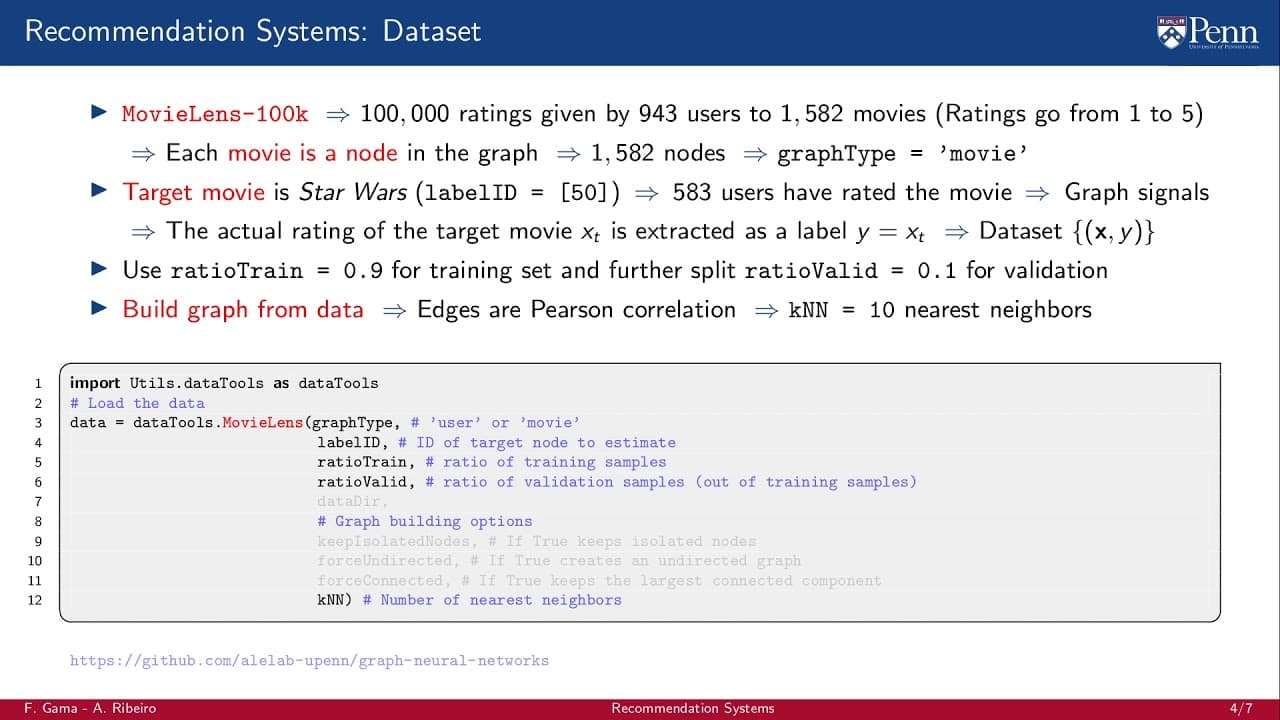
- The MovieLens dataset is used to train GNNs for movie rating predictions.
- A two-layer GNN architecture with local readout layers estimates ratings.
- Smooth L1 loss and Adam optimizer are used for training the GNN model.
- GNNs outperform nearest neighbor methods in rating prediction accuracy.
Install to Summarize YouTube Videos and Get Transcripts
Explore YouTube Video Summarizer or Get YouTube Transcript Extractor
Questions & Answers
Q: How do GNNs improve recommendation systems?
GNNs improve recommendation systems by utilizing graph signal processing to represent items as nodes and rating similarities as edges. This setup allows GNNs to learn and predict user ratings for unrated items based on the ratings of items previously rated by the user. The method leverages the graph structure to capture complex relationships and dependencies between items, resulting in more accurate predictions than traditional methods.
Q: What dataset is used in the video for training GNNs?
The MovieLens 100k dataset is used for training GNNs in the video. This dataset contains 100,000 ratings provided by 943 users for 1,582 movies. The dataset allows the GNN to learn from a large number of user-item interactions, which helps in estimating the ratings for unrated items based on graph signal processing techniques.
Q: What is the role of Pearson correlation in GNNs for recommendation systems?
In GNNs for recommendation systems, the Pearson correlation coefficient is used to define the edge weights between item nodes in the graph. It measures the similarity in ratings between pairs of items, allowing the GNN to leverage these similarities to predict user ratings for unrated items. By encoding rating similarities as edge weights, the GNN can better capture the relationships between items and improve prediction accuracy.
Q: What architecture is used for the GNN in the video?
The video describes a two-layer GNN architecture with local readout layers for estimating user ratings. The architecture involves concatenating layers of graph convolutions and point-wise non-linearities, followed by a final readout layer that computes linear combinations of features at each node. This setup allows the GNN to focus on the target node's features to predict the rating accurately.
Q: Why is smooth L1 loss used in training the GNN model?
Smooth L1 loss is used in training the GNN model due to its favorable gradient properties, which help in stabilizing the learning process. It is less sensitive to outliers compared to other loss functions like mean squared error (MSE), making it more suitable for tasks where precise estimation of ratings is crucial, such as in recommendation systems.
Q: How is the GNN model evaluated in the video?
The GNN model is evaluated using the root mean square error (RMSE) metric. The evaluation process involves comparing the predicted ratings with the true ratings from the validation dataset. The model's performance is assessed based on the RMSE values, with lower RMSE indicating better prediction accuracy. The video highlights that the GNN achieves an RMSE of 0.85, outperforming the nearest neighbor method.
Q: What are the key hyperparameters in the GNN architecture?
Key hyperparameters in the GNN architecture include the number of layers, the number of features in each layer, the number of filter taps, and the choice of non-linearity. In the video, a two-layer GNN is used, with 64 features in the first layer and 32 in the second. Each layer includes 5 filter taps, and a value non-linearity is chosen to enhance the model's learning capacity.
Q: What is the significance of the local readout layer in the GNN?
The local readout layer in the GNN is significant because it focuses on computing a linear combination of features at the target node without involving exchanges of information between nodes. This layer outputs a single scalar representing the estimated rating for the target item, allowing the GNN to make precise predictions by concentrating on the relevant node features. It enhances the model's ability to provide accurate recommendations.
Summary & Key Takeaways
-
Graph Neural Networks (GNNs) can predict user ratings for unrated items by leveraging graph signal processing. Items are represented as nodes, and rating similarities as edges, allowing GNNs to estimate ratings based on items a user has previously rated. This method is more accurate than traditional nearest neighbor approaches.
-
In recommendation systems, the MovieLens dataset is used to train GNNs, with items as nodes and Pearson correlation coefficients as edge weights. A two-layer GNN architecture with local readout layers is designed to estimate ratings, using smooth L1 loss and Adam optimizer for training.
-
The GNN model achieves better accuracy in rating predictions compared to nearest neighbor methods, even without extensive hyperparameter tuning. The approach demonstrates the effectiveness of GNNs in recommendation systems, providing a glimpse into the potential of graph-based architectures for similar tasks.
Read in Other Languages (beta)
Share This Summary 📚
Summarize YouTube Videos and Get Video Transcripts with 1-Click
Try YouTube Summary with ChatGPT & Claude or YouTube Transcript Generator
Explore More Summaries from Alelab Alelab 📚
Summarize YouTube Videos and Get Video Transcripts with 1-Click
Try YouTube Summary with ChatGPT & Claude or YouTube Transcript Generator