Finding The Current In a Parallel Circuit With 3 Resistors
TL;DR
By using a specific formula, it is possible to calculate the current flowing through each resistor in a parallel circuit.
Transcript
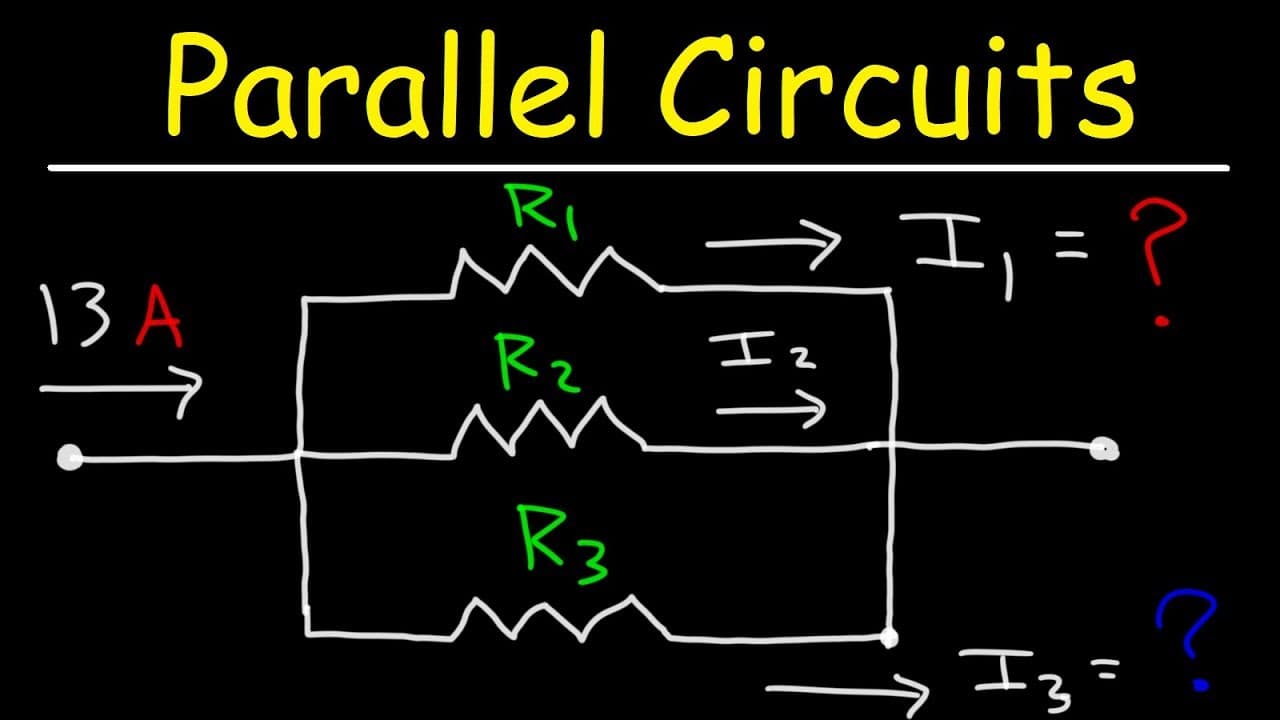
here's a question for you let's say we have three resistors connected in parallel with respect to each other we know the current that is entering this circuit let's say that current is 13 amps now let's call this r1 r2 and r3 and let's say that r1 is 4 ohms and we're going to say r2 is 6 ohms and r3 is 8 ohms and this is all you know you don't know... Read More
Key Insights
- 💐 In a parallel circuit, the currents flowing through the resistors can be determined even without knowing the voltage values.
- 💐 A specific formula can be used to calculate the current flowing through each resistor in a parallel circuit.
- ❓ Once the current through one resistor is known, the currents through the other resistors can be calculated using Ohm's Law.
- ⚡ In a parallel circuit, the voltages across the resistors are equal.
- ⚡ The voltages across the resistors can be found by multiplying the current through each resistor by its respective resistance.
- ⚡ Using the voltage values, the currents through the resistors can be calculated by dividing the voltage by the resistance.
- ❓ The formula and Ohm's Law provide alternative methods to calculate the currents in a parallel circuit.
Install to Summarize YouTube Videos and Get Transcripts
Explore YouTube Video Summarizer or Get YouTube Transcript Extractor
Questions & Answers
Q: How can you determine the current flowing through resistor 1 and the other resistors in a parallel circuit without knowing any voltage values?
The current flowing through resistor 1 can be calculated using the formula i1 = (r2 / r1 + r2 + ((r1 * r2) / r3)) * total current. Similarly, the currents through the other resistors can be calculated using their respective formulas.
Q: Is it necessary to use the formula to calculate the currents in a parallel circuit?
No, once the current through one resistor is known, the currents through the other resistors can be found using Ohm's Law, which states that current equals voltage divided by resistance.
Q: How can the voltages across the resistors be determined?
The voltages across the resistors are equal, and by multiplying the current flowing through each resistor by its respective resistance, the voltages can be found.
Q: How can the currents through the resistors be calculated using the voltage values?
By dividing the voltage across each resistor by its resistance, the currents flowing through the resistors can be calculated.
Summary & Key Takeaways
-
In a parallel circuit with three resistors, the current entering the circuit is known, but the voltages across the resistors are not given.
-
A formula, i1 = (r2 / r1 + r2 + ((r1 * r2) / r3)) * total current, can be used to calculate the current flowing through resistor 1, and a similar formula can be used for the other resistors.
-
Alternatively, once the current through one resistor is known, the current through the other resistors can be calculated using Ohm's Law.
-
The voltages across the resistors are equal, and by multiplying the current through each resistor by its respective resistance, the voltages can be found.
-
By dividing the voltage by the resistance of each resistor, the currents can be calculated.
Read in Other Languages (beta)
Share This Summary 📚
Summarize YouTube Videos and Get Video Transcripts with 1-Click
Try YouTube Summary with ChatGPT & Claude or YouTube Transcript Generator
Explore More Summaries from The Organic Chemistry Tutor 📚




Summarize YouTube Videos and Get Video Transcripts with 1-Click
Try YouTube Summary with ChatGPT & Claude or YouTube Transcript Generator