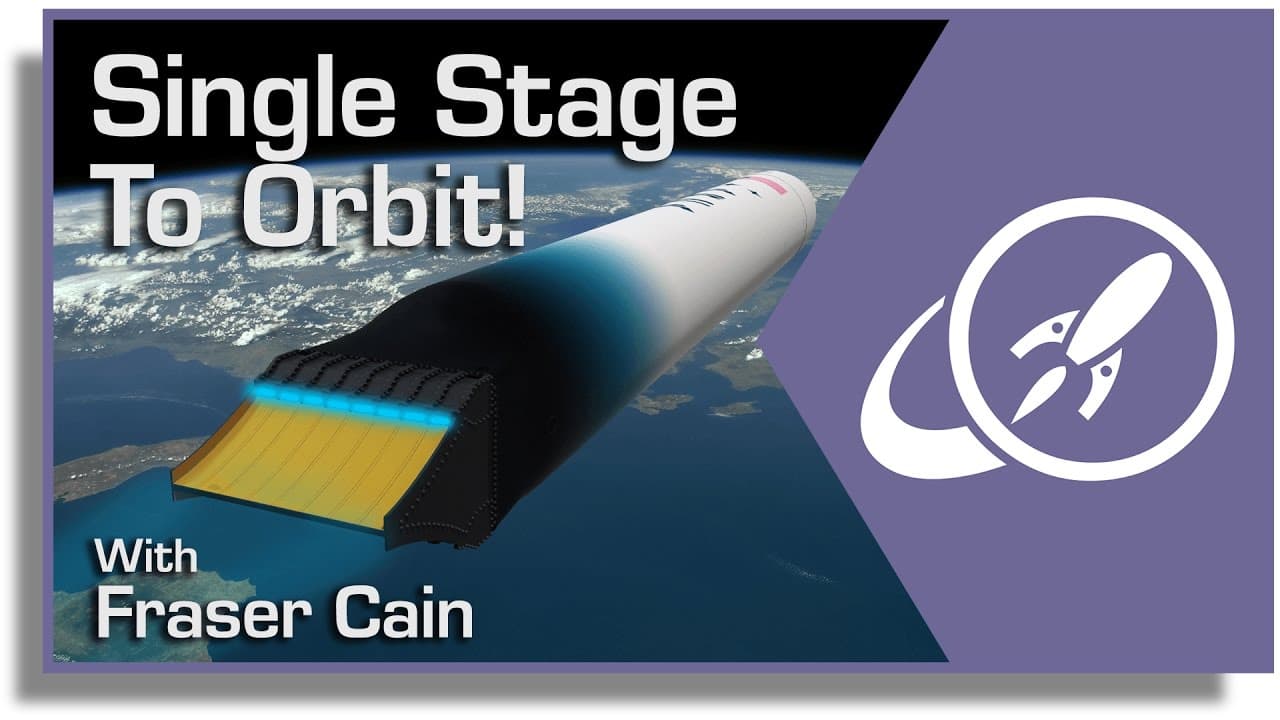
Why Do Rockets Need Stages? The Quest to Build a Single Stage to Orbit (SSTO)
TL;DR
Exploring the challenges and potential of single stage to orbit rockets and futuristic fuel systems like metallic hydrogen for more efficient space travel.
Transcript
Now, don’t get me wrong, Science Fiction is awesome. Like almost everyone working in the field of space and astronomy, I was deeply influenced by science fiction. For me, it was Star Trek and Star Wars. I had a toy phaser that made this awesome really loud phaser sound, and I played with it non-stop until it disappeared one day. And I was sure I’d ... Read More
Key Insights
- 🛰️ Science fiction influences real space exploration, shaping ideas like single stage to orbit rockets.
- 🚀 Current rockets rely on staging due to specific impulse limitations of chemical propulsion.
- 👾 Experimental concepts like the British Skylon rocket and nuclear propulsion offer potential advancements in space travel.
- 👾 Metallic hydrogen shows promise as a high-specific impulse fuel for efficient space travel.
- 🧑🏭 Reusability and reliability are crucial factors in the development of future rocket systems.
- 👾 Space elevators are a potential alternative to traditional rocket launches for cost-effective access to space.
- 🛰️ Achieving the dream of single stage to orbit rockets requires advancements in propulsion technology and materials science.
Install to Summarize YouTube Videos and Get Transcripts
Explore YouTube Video Summarizer or Get YouTube Transcript Extractor
Questions & Answers
Q: What are the challenges of single stage to orbit rockets?
Single stage to orbit rockets face specific impulse limitations and payload capacity issues, making them impractical with current technology.
Q: What is the concept behind the British Skylon rocket?
The Skylon rocket aims to combine jet engine-like efficiency in the atmosphere with traditional rocket propulsion in space for a more versatile space travel system.
Q: How does metallic hydrogen provide a potential breakthrough in rocket fuel technology?
Metallic hydrogen, with its high specific impulse, could revolutionize space travel by enabling single stage to orbit rockets and efficient interplanetary travel.
Q: Why are nuclear rockets considered for future missions despite the risks?
Nuclear rockets offer high efficiency but carry the risk of radioactive fallout in case of explosions, making them a potential choice for future interplanetary missions.
Summary & Key Takeaways
-
Science fiction has inspired space travel but has also led to unrealistic ideas like single stage to orbit rockets.
-
Current rockets use staging due to specific impulse limitations of chemical rockets.
-
Various experimental rocket concepts like the British Skylon and nuclear rockets offer new possibilities for future space travel.
Read in Other Languages (beta)
Share This Summary 📚
Summarize YouTube Videos and Get Video Transcripts with 1-Click
Try YouTube Summary with ChatGPT & Claude or YouTube Transcript Generator
Explore More Summaries from Fraser Cain 📚




Summarize YouTube Videos and Get Video Transcripts with 1-Click
Try YouTube Summary with ChatGPT & Claude or YouTube Transcript Generator