How to Build a Black Hole
TL;DR
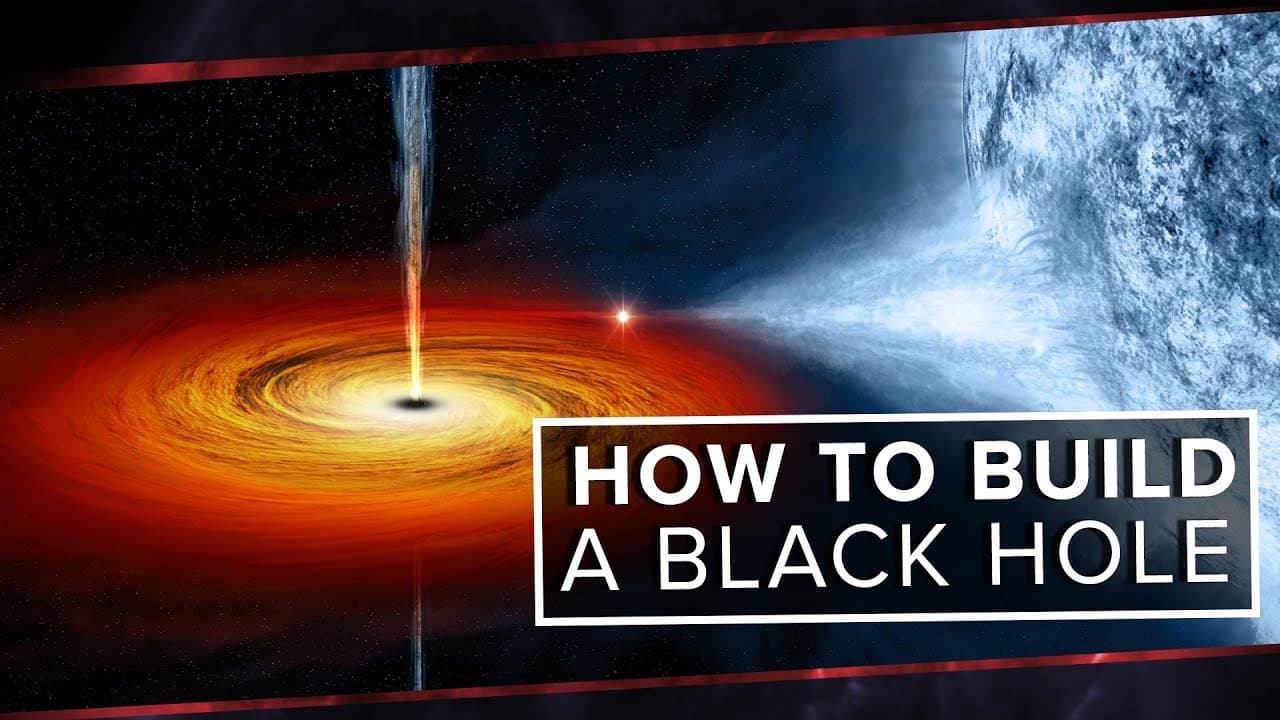
Explains how black holes form using quantum mechanics.
Transcript
[MUSIC PLAYING] Black holes are one of the strangest objects in our universe. To make one, we need both general relativity and quantum mechanics. Today, I'm gonna show you how. [MUSIC PLAYING] In a previous episode, we discussed the true nature of black holes. We talked about them as general relativistic entities, as space time regions whose bounda... Read More
Key Insights
- Black holes require both general relativity and quantum mechanics for their formation, highlighting the complex nature of these cosmic entities.
- The process begins with a massive star undergoing a supernova, leaving behind a neutron star, which is a dense ball of neutrons.
- Neutron stars are stabilized by degeneracy pressure, a quantum mechanical effect that prevents particles from occupying the same quantum state.
- The Heisenberg uncertainty principle allows neutron stars to circumvent degeneracy pressure, enabling them to collapse into black holes if additional mass is added.
- As mass increases, the neutron star's radius decreases, eventually leading to the formation of an event horizon and a black hole.
- Inside a black hole, space-time paths lead to a singularity, a point of infinite curvature where current physics cannot predict the outcome.
- From an external observer's perspective, events within the event horizon are lost from the universe's timeline, leaving only the black hole's mass, charge, and spin as observable properties.
- Black holes are dynamic, capable of growing and changing over time, influencing the universe in significant ways.
Install to Summarize YouTube Videos and Get Transcripts
Explore YouTube Video Summarizer or Get YouTube Transcript Extractor
Questions & Answers
Q: How does a black hole form from a massive star?
A black hole forms from a massive star after it undergoes a supernova explosion, leaving behind a neutron star. The neutron star, stabilized by degeneracy pressure, can collapse into a black hole if additional mass is added. The Heisenberg uncertainty principle allows for increased momentum space, enabling the star to collapse further and form an event horizon, marking the creation of a black hole.
Q: What role does the Heisenberg uncertainty principle play in black hole formation?
The Heisenberg uncertainty principle plays a crucial role in black hole formation by allowing neutron stars to circumvent degeneracy pressure. As the neutron star's mass increases, its radius decreases, and its momentum space expands. This quantum effect permits the star to collapse further, eventually leading to the formation of an event horizon and a black hole.
Q: What happens to the material inside a black hole?
Inside a black hole, space-time paths lead to a singularity, a point of infinite curvature where current physics cannot predict the outcome. The material of the original neutron star is lost from the universe's timeline, and events within the event horizon cannot be observed. The black hole retains mass, charge, and spin, influencing the universe despite the loss of the original material.
Q: What properties does a black hole retain after formation?
After formation, a black hole retains properties such as mass, electric charge, and spin. These properties continue to influence the universe, affecting the black hole's gravitational field and interactions with surrounding matter. Despite the loss of the original stellar material, these retained properties are observable and significant in understanding the black hole's behavior.
Q: How does the concept of an event horizon relate to black holes?
The event horizon is a critical concept in black holes, marking the boundary beyond which events cannot be observed from the outside universe. It represents the point where the gravitational pull becomes so strong that not even light can escape. The formation of an event horizon signifies the creation of a black hole, with all events within it lost from the universe's timeline.
Q: Can black holes change over time?
Yes, black holes can change over time. They are dynamic entities capable of growing by accumulating additional mass. They can also emit radiation, known as Hawking radiation, leading to gradual mass loss. These changes influence the black hole's properties and its interactions with the universe, making them complex and evolving cosmic phenomena.
Q: What is the significance of degeneracy pressure in neutron stars?
Degeneracy pressure is significant in neutron stars as it stabilizes them against gravitational collapse. It arises from the Pauli exclusion principle, which prevents particles from occupying the same quantum state. This pressure is incredibly strong, initially resisting the gravitational forces trying to compress the neutron star, playing a crucial role in its stability before potential collapse into a black hole.
Q: How do black holes influence the universe despite their event horizons?
Despite their event horizons, black holes influence the universe through their retained properties like mass, charge, and spin. These properties affect the black hole's gravitational field, impacting nearby matter and light. Black holes can also interact with other cosmic entities, such as stars and galaxies, playing a significant role in shaping the structure and dynamics of the universe.
Summary & Key Takeaways
-
Black holes are formed from the remnants of massive stars after a supernova, resulting in a neutron star. The neutron star's collapse into a black hole is governed by quantum mechanics, specifically the Heisenberg uncertainty principle, which allows for increased momentum space as the star's mass increases.
-
The formation of a black hole involves the creation of an event horizon, beyond which events are no longer part of the universe's timeline. The black hole retains properties like mass, charge, and spin, continuing to influence the universe despite the loss of the original stellar material.
-
Black holes are not static; they can grow and change over time. Understanding the formation and behavior of black holes involves both general relativity and quantum mechanics, revealing the complex nature of these cosmic phenomena.
Read in Other Languages (beta)
Share This Summary 📚
Summarize YouTube Videos and Get Video Transcripts with 1-Click
Try YouTube Summary with ChatGPT & Claude or YouTube Transcript Generator
Explore More Summaries from PBS Space Time 📚

Summarize YouTube Videos and Get Video Transcripts with 1-Click
Try YouTube Summary with ChatGPT & Claude or YouTube Transcript Generator