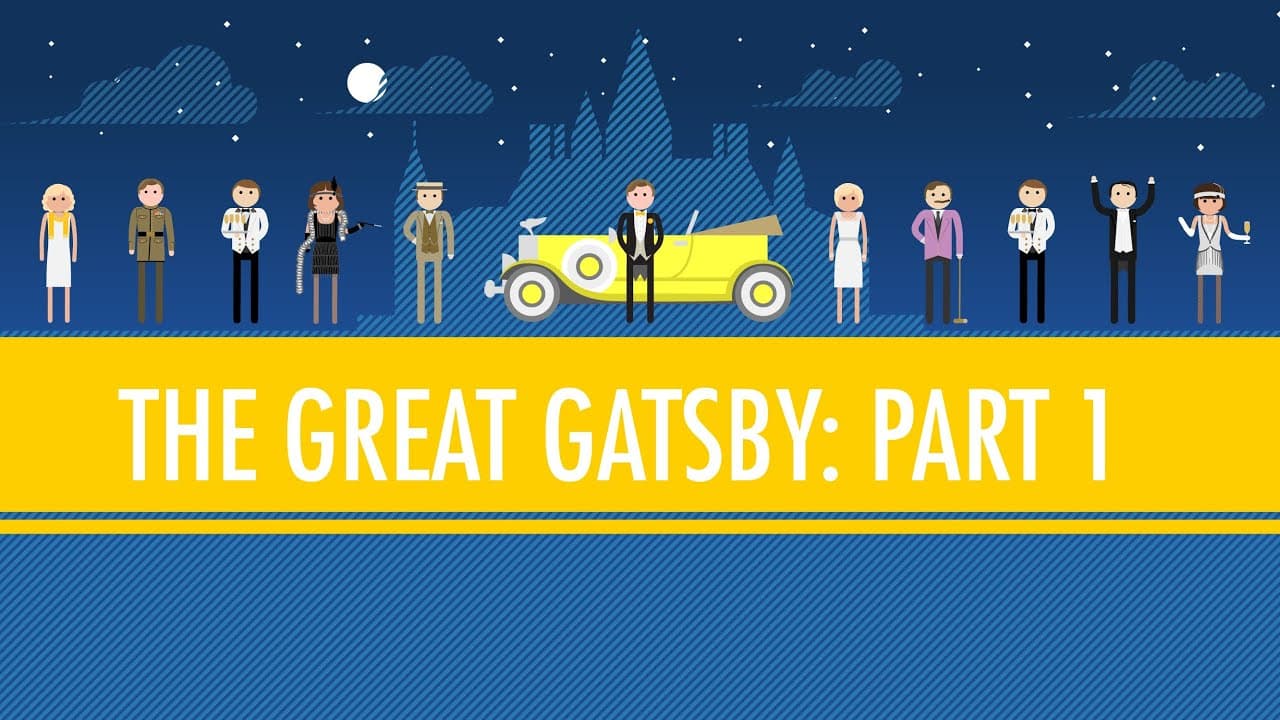
Like Pale Gold - The Great Gatsby Part 1: Crash Course English Literature #4
TL;DR
John Green analyzes The Great Gatsby's take on the American Dream.
Transcript
Hi, I'm John Green, this is Crash Course Literature. So the two books most often cited as the "Great American novel" are The Adventures of Huckleberry Finn and this slender beast, The Great Gatsby by F. Scott Fitzgerald. The US is a country founded on the principles of freedom and equality; Huck Finn is a novel about slavery and radical inequality.... Read More
Key Insights
- The Great Gatsby is often cited alongside Huck Finn as a contender for the title of 'Great American Novel,' exploring themes of the American Dream and social inequality.
- Daisy Buchanan's character is intentionally unlikeable, embodying traits such as entitlement and limited empathy, reflecting the novel's critique of the American upper class.
- Nick Carraway, the narrator, represents the theme of inherited wealth and privilege, challenging the notion of equal opportunity in America.
- The novel critiques the objectification of women, as seen in Gatsby's pursuit of Daisy as a symbol of his success and fulfillment.
- Tom Buchanan's character highlights the hypocrisy and moral decay of the American aristocracy, despite their claims of cultural superiority.
- The symbolism of the green light and the color yellow illustrates the novel's themes of unattainable dreams and the corrupting influence of wealth.
- Fitzgerald uses the Jazz Age setting to critique the excesses and superficiality of the 1920s, foreshadowing the economic collapse of the Great Depression.
- The novel questions the sustainability of the American Dream, suggesting that the pursuit of wealth and status leads to destruction and moral decay.
Install to Summarize YouTube Videos and Get Transcripts
Explore YouTube Video Summarizer or Get YouTube Transcript Extractor
Questions & Answers
Q: What is the significance of Daisy Buchanan's character in The Great Gatsby?
Daisy Buchanan represents the moral decay and superficiality of the American upper class. Her character embodies traits such as entitlement and limited empathy, which reflect the novel's critique of the American Dream. Despite being unlikeable, Daisy's character challenges readers to reflect on societal values and the consequences of privilege.
Q: How does The Great Gatsby critique the American Dream?
The Great Gatsby critiques the American Dream by highlighting the disparity between the ideal of equal opportunity and the reality of social inequality. Through characters like Gatsby and Nick, Fitzgerald explores themes of inherited wealth, privilege, and the corrupting influence of materialism. The novel suggests that the pursuit of wealth and status leads to moral decay and destruction.
Q: What role does symbolism play in The Great Gatsby?
Symbolism is central to The Great Gatsby, with elements like the green light and the color yellow illustrating key themes. The green light represents Gatsby's unattainable dreams, while yellow symbolizes the corrupting influence of wealth. Fitzgerald uses these symbols to critique the superficiality and moral decay of the 1920s, challenging readers to reflect on the true nature of the American Dream.
Q: How does Nick Carraway's background influence his perspective in The Great Gatsby?
Nick Carraway's background as a privileged Midwesterner who inherits wealth influences his perspective on the events of The Great Gatsby. His narrative challenges the notion of equal opportunity, highlighting the disparity between the ideal of the American Dream and the reality of social inequality. Nick's observations expose the moral decay and superficiality of the upper class, prompting readers to question societal values.
Q: What is the significance of the Jazz Age setting in The Great Gatsby?
The Jazz Age setting of The Great Gatsby is significant as it reflects the excesses and superficiality of the 1920s. Fitzgerald uses this backdrop to critique the moral decay and materialism of the era, foreshadowing the economic collapse of the Great Depression. The novel's setting highlights the unsustainable nature of the American Dream, challenging readers to reflect on the consequences of unchecked ambition.
Q: How does The Great Gatsby address the theme of objectification?
The Great Gatsby addresses the theme of objectification through Gatsby's pursuit of Daisy as a symbol of his success and fulfillment. By presenting Daisy as an object of desire rather than a fully realized character, Fitzgerald critiques the societal tendency to reduce individuals to symbols of status and achievement. This theme challenges readers to consider the impact of objectification on personal relationships and societal values.
Q: What does the color yellow symbolize in The Great Gatsby?
In The Great Gatsby, the color yellow symbolizes the corrupting influence of wealth and the moral decay of the 1920s. While gold traditionally represents wealth and beauty, Fitzgerald uses yellow to decouple these ideas, associating richness with corruption and death. This symbolism challenges readers to reconsider the true nature of the American Dream and the consequences of materialism.
Q: Why is the ending of The Great Gatsby considered one of the saddest in American literature?
The ending of The Great Gatsby is considered one of the saddest in American literature because it highlights the intractable unfairness of society and the futility of the American Dream. Gatsby's tragic fate underscores the disparity between guilt and innocence, as well as the moral decay and superficiality of the upper class. The novel's conclusion prompts readers to reflect on the consequences of unchecked ambition and the unsustainable nature of the American Dream.
Summary & Key Takeaways
-
John Green explores The Great Gatsby's critique of the American Dream, focusing on characters like Daisy Buchanan, who embody the moral decay of the upper class. The novel's symbolism, such as the green light, highlights themes of unattainable dreams and the corrupting influence of wealth.
-
Nick Carraway's narrative reveals the inequality and privilege inherent in the American social system, challenging the notion of equal opportunity. The novel's setting in the Jazz Age critiques the excesses and superficiality of the 1920s, foreshadowing the Great Depression.
-
The Great Gatsby's exploration of themes like objectification and moral decay raises questions about the sustainability of the American Dream. Fitzgerald's use of color symbolism, such as yellow, decouples wealth from greatness, associating it instead with corruption and death.
Read in Other Languages (beta)
Share This Summary 📚
Summarize YouTube Videos and Get Video Transcripts with 1-Click
Try YouTube Summary with ChatGPT & Claude or YouTube Transcript Generator
Explore More Summaries from CrashCourse 📚






Summarize YouTube Videos and Get Video Transcripts with 1-Click
Try YouTube Summary with ChatGPT & Claude or YouTube Transcript Generator