What Are Infinite Limits and Vertical Asymptotes?
TL;DR
Infinite limits occur when a function approaches positive or negative infinity as the input approaches a certain value. Vertical asymptotes in rational functions can be found by setting the denominator equal to zero, which indicates where the function is undefined. Factors in the denominator that cancel do not contribute to vertical asymptotes.
Transcript
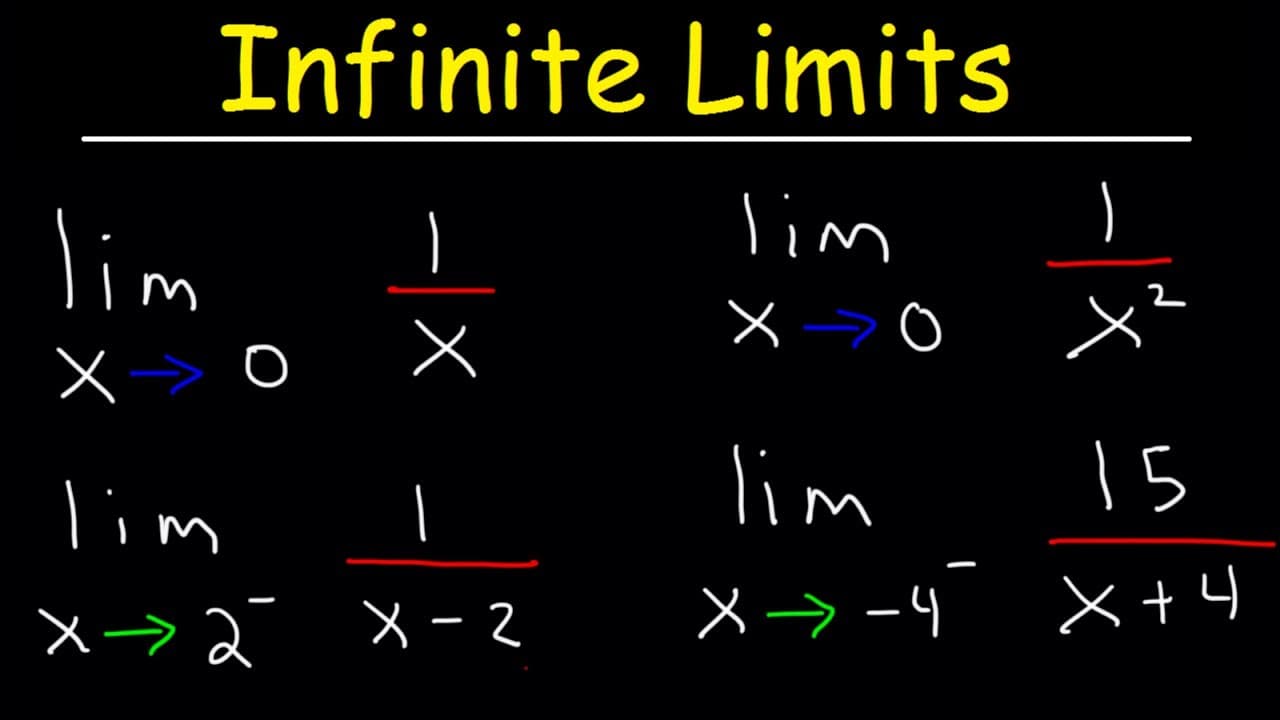
now let's talk about infinite limits what is the limit as x approaches zero of the function one over x what's the answer to that well first what we need to do is check the limit at the left side and the right side so let's start the left side what is one divided by negative point one one divided by negative point one is negative ten but now let's p... Read More
Key Insights
- 👈 The limit as x approaches zero from the left or right depends on the value of the denominator.
- ♾️ The value in the denominator of a fraction with a small number approaches infinity or negative infinity.
- 😫 In a rational function, the vertical asymptotes are found by setting the denominator equal to zero and solving for x.
- 🥺 Factors in the denominator may cancel out, leading to no vertical asymptotes.
- ❎ Imaginary numbers, such as those involving the square root of negative numbers, do not lead to vertical asymptotes or holes.
Install to Summarize YouTube Videos and Get Transcripts
Explore YouTube Video Summarizer or Get YouTube Transcript Extractor
Questions & Answers
Q: How do you evaluate the limit as x approaches zero from either side for a function with a small number in the denominator?
To evaluate this limit, check the values of the function on the left and right sides of zero. If the number in the denominator is small, the fraction value becomes large. If it is negative, the limit approaches negative infinity, and if it is positive, the limit approaches positive infinity.
Q: What happens if the left and right sided limits of a function do not match?
If the left and right sided limits do not match, the overall limit of the function does not exist.
Q: How do you find the vertical asymptote of a rational function?
To find the vertical asymptote, set the denominator of the rational function equal to zero and solve for x. The solutions for x represent the vertical asymptotes.
Q: Can all rational functions have vertical asymptotes?
Not all rational functions have vertical asymptotes. Some factors in the denominator may cancel out, resulting in no vertical asymptotes.
Summary & Key Takeaways
-
The analysis discusses limit problems involving infinite limits and undefined limits, demonstrating how to evaluate them for different functions.
-
It explains how to find vertical asymptotes by factoring the denominator of a rational function and setting it equal to zero.
-
Examples are provided for each concept, illustrating the step-by-step process.
Read in Other Languages (beta)
Share This Summary 📚
Summarize YouTube Videos and Get Video Transcripts with 1-Click
Try YouTube Summary with ChatGPT & Claude or YouTube Transcript Generator
Explore More Summaries from The Organic Chemistry Tutor 📚




Summarize YouTube Videos and Get Video Transcripts with 1-Click
Try YouTube Summary with ChatGPT & Claude or YouTube Transcript Generator