How Does Solar Wind Influence Planetary Orbits?
TL;DR
Solar wind exerts a consistent but minimal photon pressure on planets, gradually affecting their orbits over billions of years. While this effect is too small to be observed in the short term, it does contribute to orbital changes and has measurable impacts on smaller bodies like asteroids through the Yarkovsky effect.
Transcript
are cosmic ray observatories a thing could we see the reflection of an ocean on an exoplanet and could the light pressure from the Sun push the planets around all this and more in this week's question show hello and welcome to the question show your questions my answers as always wherever you are across my channel if a question pops into your brain... Read More
Key Insights
- ✋ Cosmic ray observatories offer crucial insights into high-energy cosmic particles and extreme astronomical events.
- 🥹 Techniques like rotational mapping and specular reflection hold potential for detecting oceans on exoplanets and confirming habitability.
- 😎 The sun's photon pressure impacts celestial bodies like planets and asteroids, influencing their orbits over long timescales.
- 📻 The collapse of the Arecibo Observatory poses challenges in asteroid mapping and radio astronomy, necessitating considerations for rebuilding or alternative solutions.
- 👾 SpaceX's Starship presents a game-changing platform for launching space telescopes, reducing costs and streamlining deployment processes.
- 🔬 The AI-generated content challenge on YouTube poses a significant issue for scientific accuracy and credibility in science communication.
- 🫠 Reading Ian M Banks' Culture series offers profound insights into advanced civilizations, societal dynamics, and ethical dilemmas in a post-scarcity universe.
Install to Summarize YouTube Videos and Get Transcripts
Explore YouTube Video Summarizer or Get YouTube Transcript Extractor
Questions & Answers
Q: Are cosmic ray observatories operational?
Yes, ground-based, space-based, and balloon-based cosmic ray observatories have been active for over half a century, aiding in studying high-energy cosmic particles.
Q: Can we detect the reflection of oceans on exoplanets?
Techniques like rotational mapping and specular reflection offer potential ways to detect oceans on exoplanets, providing insights into habitability and liquid water presence.
Q: How does the sun's photon pressure affect planetary orbits?
While the sun's photon pressure can influence planets' orbits, the effect is minimal and slow, mainly observable in phenomena like the Yarkovsky effect on asteroids.
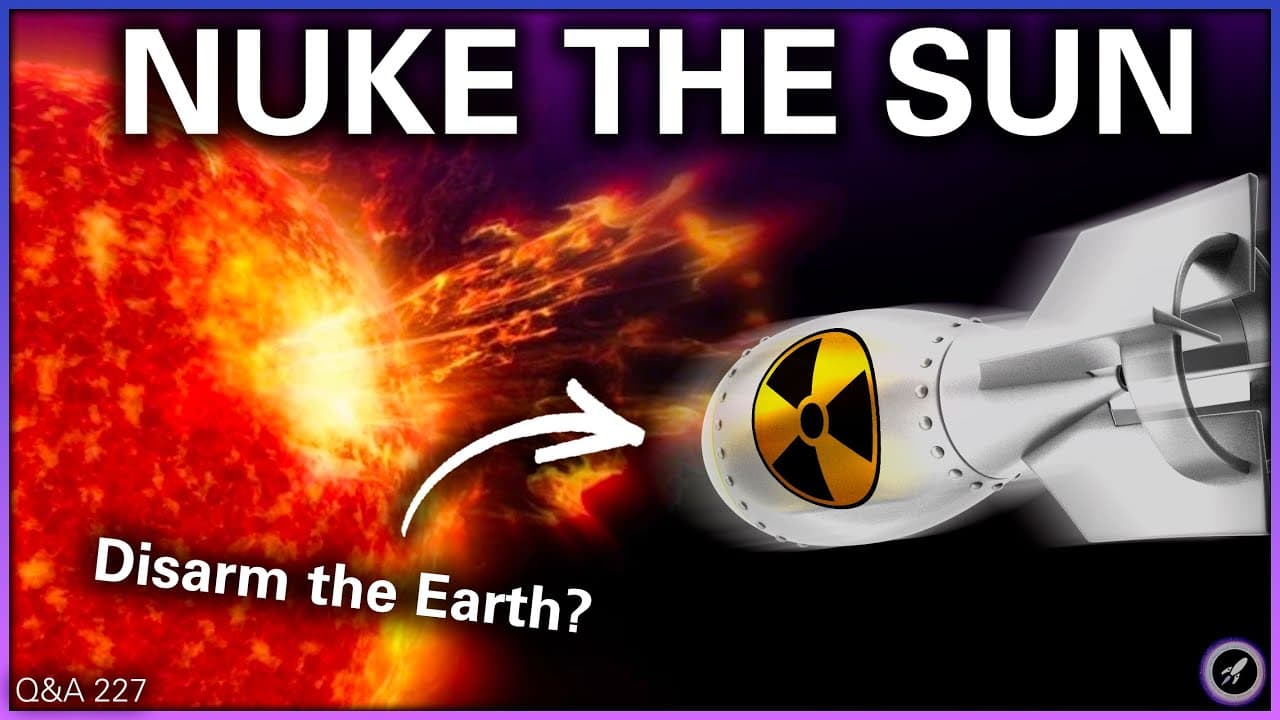
Q: Could sending nuclear weapons to the sun cause catastrophic solar flares?
Sending all nuclear weapons to the sun wouldn't trigger solar flares; instead, they'd be consumed harmlessly, as the sun's inherent energy dwarfs any human-made input.
Summary & Key Takeaways
-
Cosmic ray observatories observe high-energy particles passing through Earth's atmosphere, aiding in understanding these extreme events.
-
Detecting the reflection of an ocean on an exoplanet is theoretically possible through techniques like rotational mapping and specular reflection.
-
The sun's photon pressure affects planets' orbits over billions of years, manifesting in phenomena like the Yarkovsky effect on asteroids.
Read in Other Languages (beta)
Share This Summary 📚
Summarize YouTube Videos and Get Video Transcripts with 1-Click
Try YouTube Summary with ChatGPT & Claude or YouTube Transcript Generator
Explore More Summaries from Fraser Cain 📚

Summarize YouTube Videos and Get Video Transcripts with 1-Click
Try YouTube Summary with ChatGPT & Claude or YouTube Transcript Generator