Too Many Triangles - Numberphile
TL;DR
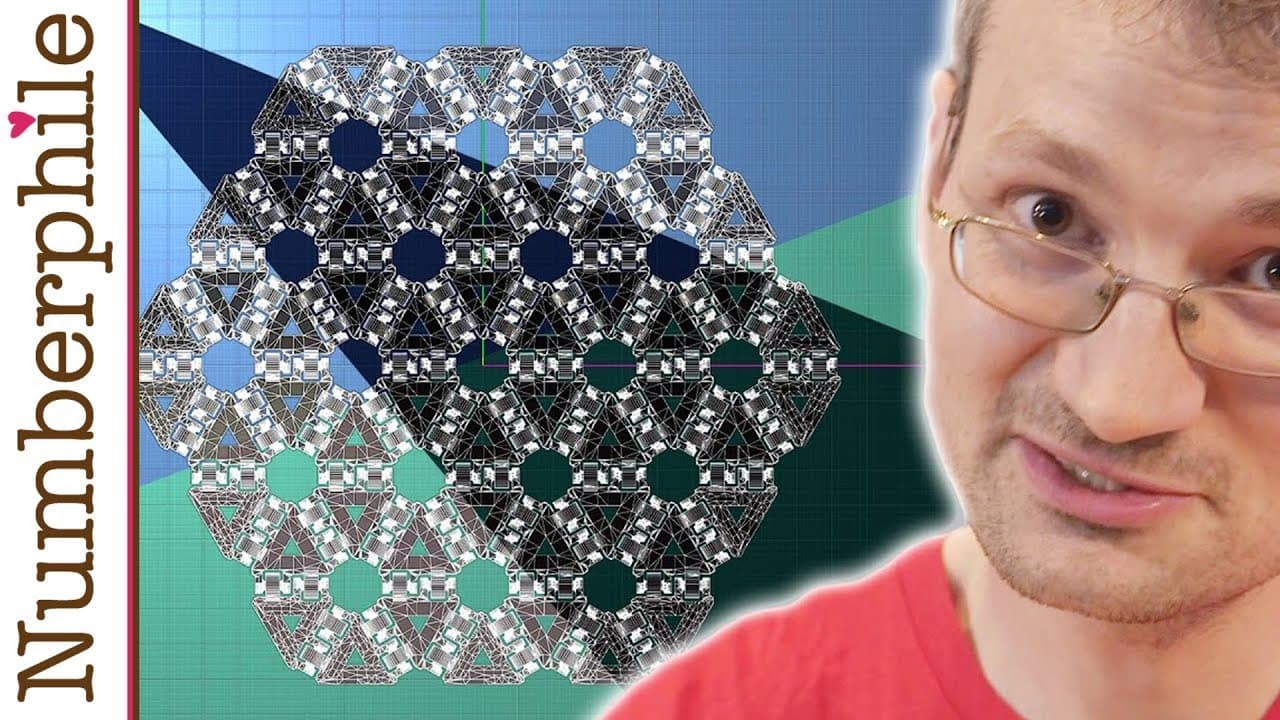
Transitioning from Platonic solids with 3, 4, and 5 triangles around each vertex to a challenging exploration of fitting 7 triangles and beyond.
Transcript
so here's three of only three of the Platonic solids, the things you can make out of equilateral triangles. So here I've got tetrahedron, four triangles, octahedron, eight triangles, and the icosahedron, 20 triangles, what's changing as you go from here to here to here is how many triangles there are around each corner or on each vertex so the tet... Read More
Key Insights
- 💯 Platonic solids are geometrically perfect figures derived from equilateral triangles.
- 🥺 Fitting 7 triangles around a vertex leads to physical and conceptual challenges.
- 👾 Transitioning to hyperbolic space unveils negatively curved, crinkly shapes beyond traditional geometry.
- 🤗 The exploration extends to open questions on the limits of fitting triangles infinitely.
- 💨 Geodesic domes offer a way to smoothen the crinkly geometry of certain shapes.
- ❓ The discussion touches upon exponential vs. cubic growth in geometric patterns.
- ❓ The concept of hyperbolic doilies demonstrates intricate geometric transformations.
Install to Summarize YouTube Videos and Get Transcripts
Explore YouTube Video Summarizer or Get YouTube Transcript Extractor
Questions & Answers
Q: How are Platonic solids formed, and what distinguishes them?
Platonic solids are constructed from equilateral triangles, with distinct numbers of triangles around each vertex, creating geometric perfection.
Q: What challenges arise when attempting to fit 7 triangles around a vertex?
Fitting 7 triangles around a vertex leads to difficulty, as demonstrated by physical or 3D printed models, showcasing the complexity of geometry.
Q: How does hyperbolic space relate to these geometric explorations?
Hyperbolic space offers a twist, with negatively curved and crinkly shapes, providing a richer understanding of geometric possibilities beyond Euclidean space.
Q: What open question surrounds the exploration of fitting triangles infinitely?
The question of how far one can extend the geometry of fitting triangles infinitely remains open, with the challenge of exponential vs. cubic growth in numbers.
Summary & Key Takeaways
-
Platonic solids are constructed from equilateral triangles, with varying numbers of triangles around each vertex.
-
Attempting to fit 7 triangles around a vertex leads to problems in a physical or 3D printed model.
-
The concept extends to hyperbolic space, where the geometry becomes crinkly and negatively curved, posing open questions on limits.
Read in Other Languages (beta)
Share This Summary 📚
Summarize YouTube Videos and Get Video Transcripts with 1-Click
Try YouTube Summary with ChatGPT & Claude or YouTube Transcript Generator
Explore More Summaries from Numberphile 📚






Summarize YouTube Videos and Get Video Transcripts with 1-Click
Try YouTube Summary with ChatGPT & Claude or YouTube Transcript Generator