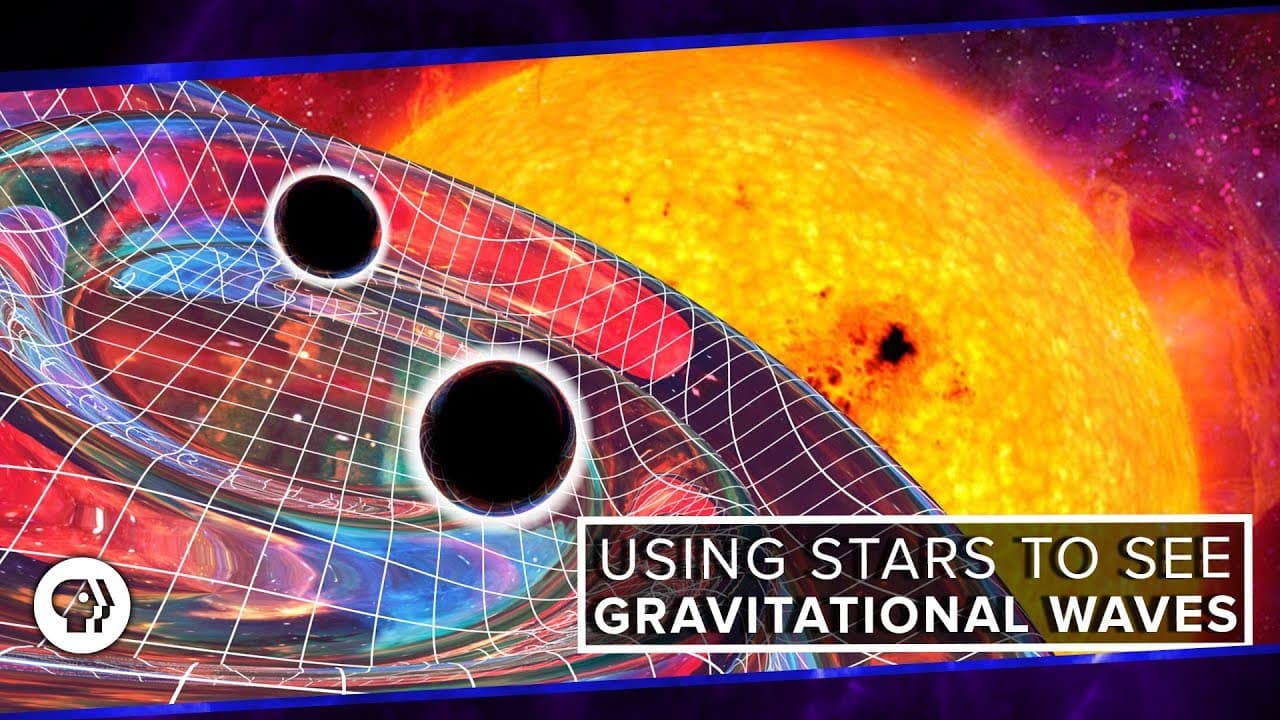
Using Stars to See Gravitational Waves
TL;DR
Gravitational waves offer new insights into cosmic phenomena.
Transcript
[MUSIC PLAYING] Thanks to brilliant.org for supporting PBS Digital Studios. Now that gravitational waves are definitely a thing, it's time to think about some of the crazy things we can figure out with them. In some cases, we're going to need a gravitational wave observatory the size of a galaxy. In fact, we've already built one. [MUSIC PLAYING] We... Read More
Key Insights
- LIGO has observed five black hole mergers, revealing unexpectedly massive black holes, challenging existing stellar evolution models.
- Gravitational lensing might amplify gravitational wave signals, making black holes appear more massive than they are.
- The observation of a neutron star merger marked the first time a gravitational wave event was also detected in light.
- LISA, a space-based observatory, will detect lower frequency gravitational waves, unveiling supermassive black holes' mergers.
- Pulsar timing arrays act as a galaxy-scale observatory, detecting long-wavelength gravitational waves from the early universe.
- Gravitational waves might interact with stars, causing oscillations and heat generation, potentially observable in galactic cores.
- The gravitational wave background could provide insights into cosmic phenomena like cosmic strings and the early universe.
- Gravitational wave astronomy is in a golden age, promising unexpected discoveries and solving long-standing cosmic mysteries.
Install to Summarize YouTube Videos and Get Transcripts
Explore YouTube Video Summarizer or Get YouTube Transcript Extractor
Questions & Answers
Q: What significant discoveries has LIGO made?
LIGO has detected five black hole mergers, revealing unexpectedly large black holes. These discoveries challenge existing stellar evolution models, as the observed black holes are more massive than theoretical predictions suggest. Researchers are investigating various explanations, including gravitational lensing, which might amplify gravitational wave signals and make black holes appear more massive.
Q: How do gravitational waves interact with stars?
Gravitational waves can interact with stars by setting up oscillations if the wave frequency matches the star's natural resonant frequency. This interaction generates internal friction, heating the stellar interior and potentially causing the star to brighten. Such effects might be observable in dense star fields, particularly in galactic cores with binary supermassive black holes.
Q: What role do pulsar timing arrays play in gravitational wave detection?
Pulsar timing arrays act as a galaxy-scale observatory, detecting long-wavelength gravitational waves. By monitoring shifts in the arrival time of pulsar signals, these arrays can identify tiny fluctuations in space due to gravitational waves. This method provides insights into the gravitational wave background and could reveal information about the early universe.
Q: What is the significance of the neutron star merger observation?
The neutron star merger observation was groundbreaking as it marked the first time a gravitational wave event was detected in both gravitational waves and light. This multi-messenger observation allowed astronomers to study the event across the electromagnetic spectrum, providing valuable insights into neutron star properties and the origins of heavy elements in the universe.
Q: What future projects are planned for gravitational wave detection?
Future projects include the Laser Interferometer Space Antenna (LISA), a space-based observatory scheduled for a 2034 launch. LISA will detect lower frequency gravitational waves, focusing on the mergers of supermassive black holes. Its three components will orbit the sun, with arms 2.5 million kilometers long, enabling the detection of a wide range of cosmic phenomena.
Q: How might gravitational waves provide insights into the early universe?
Gravitational waves could reveal information about the early universe by detecting the gravitational wave background. This background may originate from binary supermassive black holes, cosmic strings, or the instant after the Big Bang. By studying these waves, astronomers hope to gain insights into the universe's formative epochs and fundamental forces.
Q: What challenges do researchers face in explaining massive black holes?
Researchers face the challenge of explaining the unexpectedly massive black holes detected by LIGO. Current stellar evolution models suggest black holes should be smaller, leading scientists to explore alternative explanations. These include the possibility of black holes forming in dense environments like globular clusters or being amplified by gravitational lensing.
Q: How does gravitational wave astronomy impact our understanding of the universe?
Gravitational wave astronomy is revolutionizing our understanding of the universe by providing a new way to observe cosmic phenomena. It allows scientists to study events that were previously undetectable, such as black hole mergers and neutron star collisions. This field is expected to yield unexpected discoveries and solve long-standing cosmic mysteries, marking a golden age of astronomical research.
Summary & Key Takeaways
-
Gravitational wave astronomy is advancing rapidly, with LIGO detecting multiple black hole mergers, revealing unexpected black hole masses. Researchers are exploring various explanations, including gravitational lensing, to account for these anomalies.
-
The detection of a neutron star merger, observed in both gravitational waves and light, marked a significant milestone. Future projects like LISA will expand gravitational wave detection capabilities, focusing on supermassive black holes.
-
Pulsar timing arrays are being used to study the gravitational wave background, offering a glimpse into the universe's early epochs. Gravitational waves may also interact with stars, causing observable effects in dense star fields.
Read in Other Languages (beta)
Share This Summary 📚
Summarize YouTube Videos and Get Video Transcripts with 1-Click
Try YouTube Summary with ChatGPT & Claude or YouTube Transcript Generator
Explore More Summaries from PBS Space Time 📚
Summarize YouTube Videos and Get Video Transcripts with 1-Click
Try YouTube Summary with ChatGPT & Claude or YouTube Transcript Generator