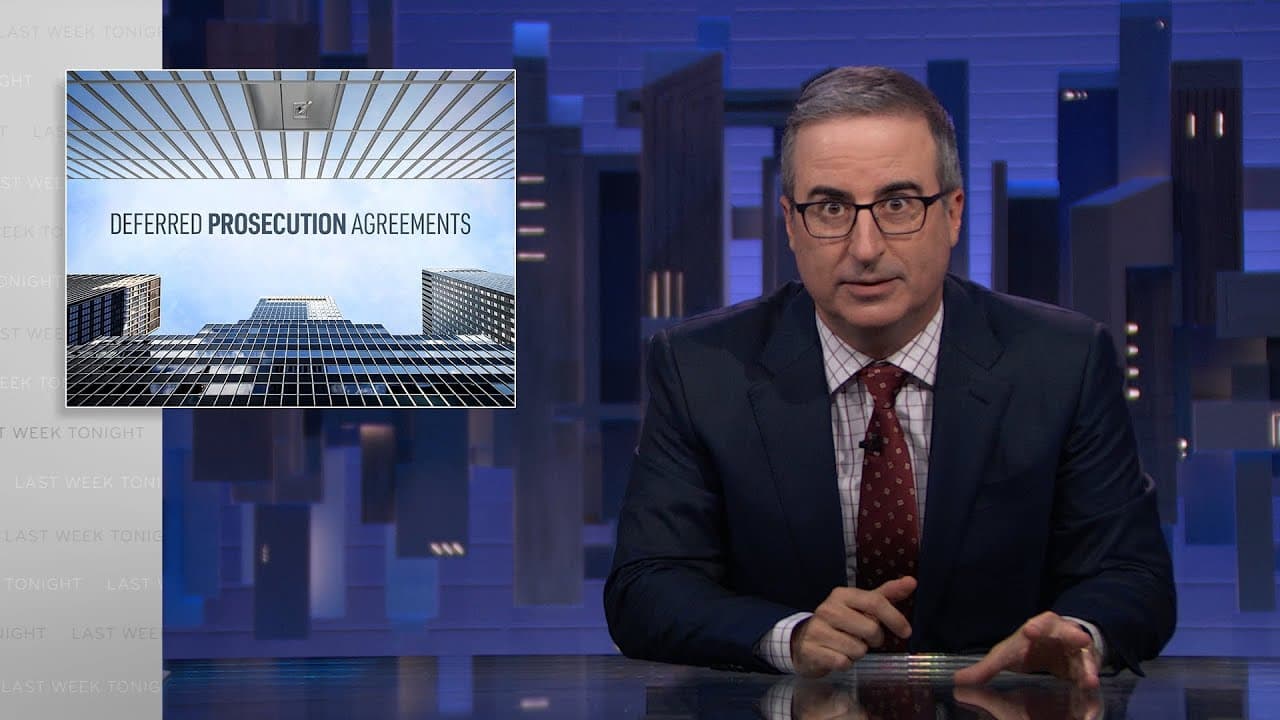
What Are Deferred Prosecution Agreements?
TL;DR
Deferred prosecution agreements (DPAs) allow corporations to avoid criminal charges by meeting certain conditions, but they often lead to minimal penalties for serious misconduct. Many companies, like GM, HSBC, and Boeing, exploit DPAs to evade true accountability, with individual executives rarely facing prosecution. This systemic failure necessitates stronger enforcement mechanisms to ensure corporate accountability and protect the public.
Transcript
♪ (“LAST WEEK TONIGHT" THEME MUSIC PLAYING) ♪ Our main story tonight concerns crime. Once again, voted number one by Reasons to Tiptoe magazine. (AUDIENCE LAUGHS) Specifically, we're going to talk about corporate crime, something our current president is famously not that concerned about. Not only was he convicted on 34 counts of falsifying busines... Read More
Key Insights
- Deferred prosecution agreements (DPAs) allow corporations to avoid prosecution by agreeing to certain conditions, often resulting in minimal consequences for serious offenses.
- The use of DPAs has significantly increased since the Arthur Andersen case, shifting the focus from individual accountability to corporate settlements.
- Corporations often face minimal fines relative to their profits, making DPAs a routine cost of doing business rather than a deterrent.
- Despite evidence of wrongdoing, individuals within corporations are rarely prosecuted, leaving victims without justice.
- The lack of transparency in monitoring compliance with DPAs allows corporations to continue unethical practices without public accountability.
- Companies like GM, HSBC, and Boeing have repeatedly violated regulations but continue to evade significant legal consequences through DPAs.
- The current system fails to hold corporations accountable, enabling them to engage in practices that can lead to severe harm to the public.
- There is a need for stronger enforcement of corporate accountability, including higher fines and more frequent prosecution of executives.
Install to Summarize YouTube Videos and Get Transcripts
Explore YouTube Video Summarizer or Get YouTube Transcript Extractor
Questions & Answers
Q: What are deferred prosecution agreements (DPAs)?
Deferred prosecution agreements (DPAs) are out-of-court settlements that allow corporations to avoid prosecution by agreeing to certain conditions, such as paying fines or improving compliance measures. These agreements are often used to settle cases of corporate misconduct without holding individuals accountable.
Q: Why have DPAs become more common since the Arthur Andersen case?
DPAs became more common after the Arthur Andersen case because prosecutors became reluctant to risk putting large companies out of business. The collapse of Arthur Andersen, due to its involvement in the Enron scandal, led to thousands of job losses, prompting a shift towards using DPAs to avoid similar outcomes.
Q: What are some criticisms of DPAs?
Critics argue that DPAs allow corporations to avoid meaningful accountability for serious crimes. The fines imposed are often a small fraction of a company's profits, and individuals responsible for wrongdoing are rarely prosecuted. This system fails to deter future misconduct and lacks transparency in monitoring compliance.
Q: How have companies like GM, HSBC, and Boeing used DPAs?
GM, HSBC, and Boeing have used DPAs to settle cases of serious misconduct, such as selling cars with faulty ignition switches, laundering money for drug cartels, and misrepresenting aircraft safety. Despite the gravity of their actions, these companies have avoided significant legal consequences by agreeing to DPAs.
Q: What changes are suggested to improve corporate accountability?
To improve corporate accountability, it is suggested that fines be increased to serve as a real deterrent, executives be prosecuted more frequently, and DPAs be brought into the official legal system for greater transparency. Additionally, there should be a willingness to prosecute repeat offenders, even if it affects their business operations.
Q: Why is there a lack of transparency in monitoring compliance with DPAs?
There is a lack of transparency in monitoring compliance with DPAs because these agreements are not criminal proceedings, and their monitoring reports are not required to be public records. This allows corporations to continue unethical practices without public accountability, as there is limited oversight of their compliance.
Q: How do DPAs impact victims of corporate misconduct?
DPAs often leave victims of corporate misconduct without justice, as they focus on settling with the corporation rather than prosecuting individuals responsible for wrongdoing. This can result in victims feeling that their suffering has not been adequately addressed, as the companies involved continue to operate with minimal consequences.
Q: What role does the government play in corporate accountability?
The government plays a crucial role in corporate accountability by enforcing regulations and prosecuting misconduct. However, the current system of DPAs often allows corporations to avoid significant consequences, highlighting the need for stronger enforcement measures, including higher fines, more frequent prosecution of executives, and greater transparency in compliance monitoring.
Summary & Key Takeaways
-
Deferred prosecution agreements (DPAs) allow corporations to avoid prosecution by agreeing to certain conditions, often resulting in minimal consequences for serious offenses. This system has become prevalent since the Arthur Andersen case, with corporations facing minimal fines relative to their profits.
-
Despite evidence of wrongdoing, individuals within corporations are rarely prosecuted, leaving victims without justice. The lack of transparency in monitoring compliance with DPAs allows corporations to continue unethical practices without public accountability.
-
Companies like GM, HSBC, and Boeing have repeatedly violated regulations but continue to evade significant legal consequences through DPAs. There is a need for stronger enforcement of corporate accountability, including higher fines and more frequent prosecution of executives.
Read in Other Languages (beta)
Share This Summary 📚
Summarize YouTube Videos and Get Video Transcripts with 1-Click
Try YouTube Summary with ChatGPT & Claude or YouTube Transcript Generator
Explore More Summaries from LastWeekTonight 📚





Summarize YouTube Videos and Get Video Transcripts with 1-Click
Try YouTube Summary with ChatGPT & Claude or YouTube Transcript Generator