What Caused the Big Bang and How Does Inflation Work?
TL;DR
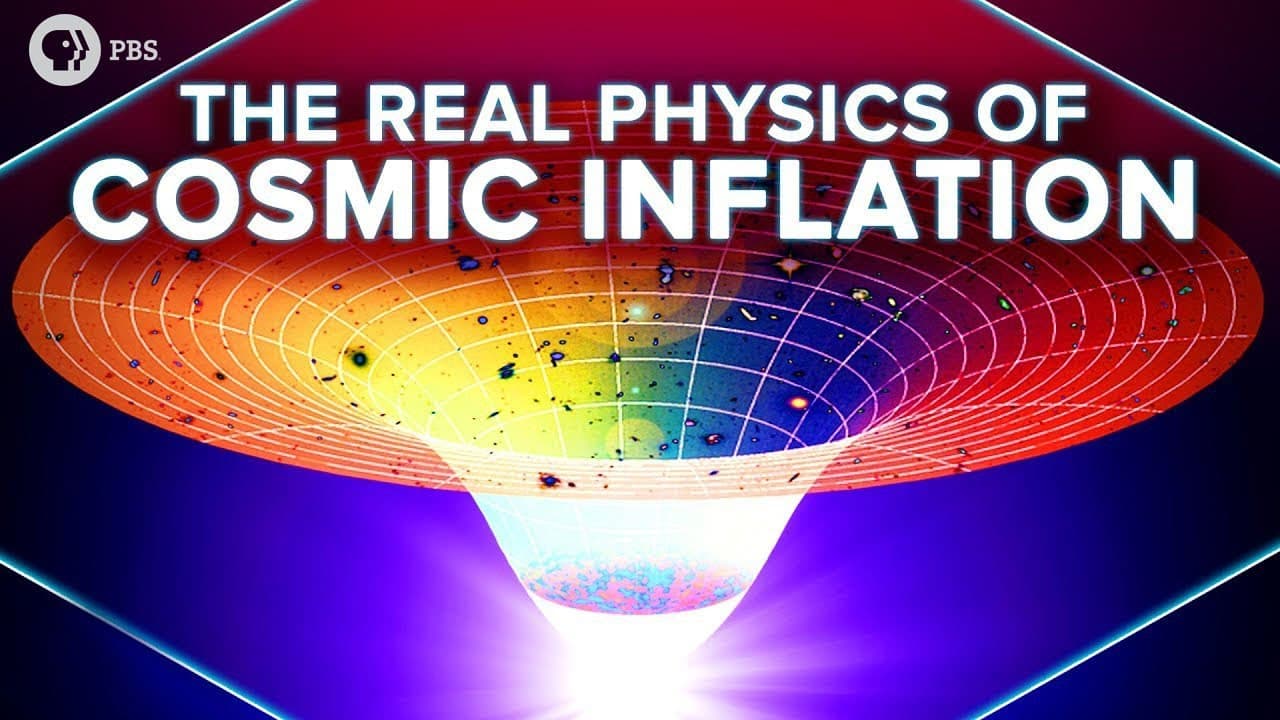
The Big Bang was initiated by cosmic inflation, a rapid expansion of the universe that occurred in a tiny fraction of a second. This process, driven by the inflaton field, solved key cosmological issues like uniformity and flatness, transitioning from a false vacuum state to a true vacuum state, which explains the universe's current expansion. Alan Guth's inflation model inspired further theories about how inflation ends and the possibility of eternal inflation, leading to the idea of a multiverse.
Transcript
Every astronomy textbook tells us that soon after the Big Bang there was this period of exponentially accelerating expansion called Cosmic Inflation. In a tiny fraction of a second, inflationary expansion multiplied the size of the universe by a larger factor than in the following 13 and a half billion years of regular expansion. This story seems l... Read More
Key Insights
- Cosmic inflation is a hypothesis explaining the rapid expansion of the universe shortly after the Big Bang, solving major cosmological puzzles such as uniformity and flatness.
- Inflation suggests that the universe expanded exponentially in a fraction of a second, multiplying its size more than in 13.5 billion years of subsequent expansion.
- The inflationary model addresses the absence of magnetic monopoles, predicted particles that should have been present in the early universe.
- Einstein's general theory of relativity supports inflation, with the cosmological constant explaining the exponential expansion due to vacuum energy density.
- Quantum field theory plays a crucial role in inflation, suggesting that a field with a high energy state, the inflaton field, drove the rapid expansion.
- The inflaton field's energy transition from a false vacuum state to a true vacuum state explains the end of inflation and the universe's current expansion.
- Alan Guth's original inflation model faced challenges, particularly regarding how inflation stopped, leading to new models that allow a smooth exit.
- The concept of eternal inflation and the multiverse arises from inflation theory, suggesting infinite universes could form from continuous inflation.
Install to Summarize YouTube Videos and Get Transcripts
Explore YouTube Video Summarizer or Get YouTube Transcript Extractor
Questions & Answers
Q: What is cosmic inflation?
Cosmic inflation is a theoretical period of exponential expansion of the universe that occurred just after the Big Bang. It explains how the universe expanded from a tiny fraction to an enormous size in a very short time, solving major cosmological puzzles like the uniform distribution of matter and the universe's flat geometry.
Q: How does cosmic inflation solve the flatness problem?
Cosmic inflation solves the flatness problem by causing the universe to expand so rapidly that any initial curvature is stretched out, making the universe appear flat. This rapid expansion dilutes any initial irregularities, leading to the observed flat geometry of the universe, which aligns with Einstein's theory of relativity.
Q: What role does the inflaton field play in inflation?
The inflaton field is hypothesized to have driven the rapid expansion during inflation. It started with a high energy state and, as the universe cooled, got stuck in a false vacuum state. This state provided the necessary constant energy density for exponential expansion, which ended when the field transitioned to a true vacuum, releasing energy that reheated the universe.
Q: How does inflation address the absence of magnetic monopoles?
Inflation addresses the absence of magnetic monopoles by diluting their presence. If monopoles were produced in the early universe, the rapid expansion during inflation would have spread them out over a vast volume, making them incredibly rare and difficult to detect in the current universe.
Q: What challenges did Guth's original inflation model face?
Guth's original inflation model faced challenges in explaining how inflation stopped. The model suggested that bubbles of non-inflating regions would form, releasing energy at their boundaries. However, this didn't match the observed even temperature distribution, leading to further developments in inflation models that allow a smooth transition across the universe.
Q: What is the cosmological constant in relation to inflation?
The cosmological constant is a term in Einstein's equations representing a constant energy density in space, leading to exponential expansion. In the context of inflation, it describes the effect of the inflaton field's vacuum energy, which drives the rapid expansion. A high cosmological constant during inflation explains the universe's exponential growth in its early moments.
Q: How does quantum field theory contribute to inflation theory?
Quantum field theory contributes to inflation theory by explaining how the inflaton field can have vacuum energy even without particles. It allows for the existence of a false vacuum state with high energy density, necessary for inflation. Quantum fluctuations can cause the field to transition to a true vacuum, ending inflation and leading to the universe's current expansion.
Q: What is eternal inflation and how does it relate to the multiverse?
Eternal inflation is a concept suggesting that once inflation starts, it continues indefinitely in some regions, forming new 'bubble' universes. These bubbles can stop inflating, creating separate universes with their own physical properties. This process implies a multiverse, where infinite universes exist, each potentially with different laws of physics.
Summary & Key Takeaways
-
Cosmic inflation theory posits a rapid expansion of the universe shortly after the Big Bang, solving major cosmological questions like uniformity and flatness. This theory, supported by Einstein's relativity and quantum field theory, suggests a brief period of exponential growth driven by the inflaton field.
-
The inflaton field, with its high energy state, caused the universe's rapid expansion, eventually transitioning from a false to a true vacuum state, ending inflation. This transition explains the universe's current expansion and the distribution of matter observed today.
-
Alan Guth's initial inflation model inspired further developments, addressing how inflation ends. New models propose a smooth exit from inflation, avoiding issues like uneven temperature distribution, and introduce concepts like eternal inflation and the multiverse.
Read in Other Languages (beta)
Share This Summary 📚
Summarize YouTube Videos and Get Video Transcripts with 1-Click
Try YouTube Summary with ChatGPT & Claude or YouTube Transcript Generator
Explore More Summaries from PBS Space Time 📚




Summarize YouTube Videos and Get Video Transcripts with 1-Click
Try YouTube Summary with ChatGPT & Claude or YouTube Transcript Generator