Newton's 2nd Law (6b of 21) The Normal Force, The Ferris Wheel
TL;DR
Exploring Newton's second law, uniform circular motion, and normal force on a ferris wheel.
Transcript
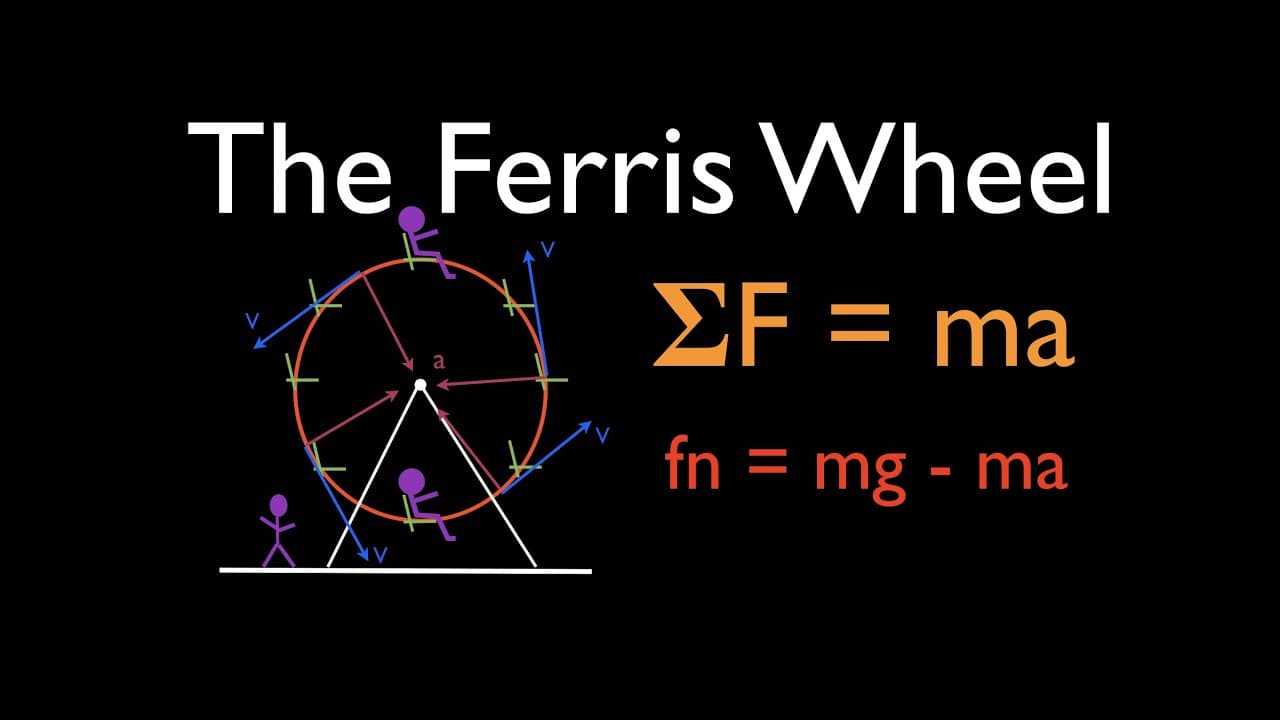
okay in this video I'm going to go over some of the physics of the ferris wheel we're going to use Newton's second law and we're also going to talk about uniform circular motion and the normal force we here's our diagram of the ferris wheel and the goal of this video is to determine what is the normal force acting on the person in these three locat... Read More
Key Insights
- 🎡 Newton's second law is crucial for analyzing forces acting on objects in motion, such as on a ferris wheel.
- 💱 Uniform circular motion involves constant speed but changing velocity due to directional changes.
- 🖐️ Normal force plays a vital role in supporting an object and counteracting gravitational forces.
- 🎡 Apparent weight changes on a ferris wheel due to acceleration, impacting the normal force calculations.
- 🪪 Proper identification of positive and negative directions for forces and accelerations is essential for accurate calculations.
- 🆘 Understanding acceleration towards the center in circular motion helps determine the normal force effectively.
- 🎡 Summing up forces using Newton's second law allows for precise calculations of normal forces at different locations on a ferris wheel.
Install to Summarize YouTube Videos and Get Transcripts
Explore YouTube Video Summarizer or Get YouTube Transcript Extractor
Questions & Answers
Q: What is the significance of uniform circular motion in the context of a ferris wheel?
Uniform circular motion implies constant speed but changing directions, leading to acceleration due to velocity changes while moving along a circular path.
Q: How is the normal force calculated for a stationary person on a ferris wheel?
For a person standing still, the normal force equals the person's weight as the sum of the forces is zero, with the gravitational force balanced by the normal force.
Q: How does the normal force differ at the top and bottom of a ferris wheel?
At the top, the normal force is reduced due to acceleration pointing towards the center, resulting in an apparent weight less than the actual weight. Conversely, at the bottom, the normal force is increased, leading to an apparent weight greater than the actual weight.
Q: Why is it crucial to consider acceleration direction when calculating normal force on a ferris wheel?
Acceleration direction affects the normal force calculation as it determines the net force acting on an object and how it balances with gravitational forces to maintain equilibrium.
Summary & Key Takeaways
-
Discusses the physics of a ferris wheel, focusing on Newton's second law, uniform circular motion, and normal force.
-
Demonstrates how to calculate the normal force at different locations on a ferris wheel using Newton's second law.
-
Explains how apparent weight changes at the top and bottom of a ferris wheel due to acceleration.
Read in Other Languages (beta)
Share This Summary 📚
Summarize YouTube Videos and Get Video Transcripts with 1-Click
Try YouTube Summary with ChatGPT & Claude or YouTube Transcript Generator
Explore More Summaries from Step by Step Science 📚

Summarize YouTube Videos and Get Video Transcripts with 1-Click
Try YouTube Summary with ChatGPT & Claude or YouTube Transcript Generator